
Chemical-plant valve and damper actuation is most often served by double-acting hydraulic cylinders sized to ISO 6020-2, with 316L stainless wetted metalwork, PTFE-based rod seals, and continuous-duty thrust ratings between roughly 5 kN and 2000 kN — a range that covers everything from small instrument-block ball valves up to large reactor-feed butterfly or plug valves [S2].
Selection pivots on four correlated variables: required thrust and stroke, the fluid and atmosphere compatibility of seals and wetted parts, the explosion-protection classification of the zone, and the response bandwidth the control loop needs from the paired hydraulic cylinder and valve package.
Why the double-acting cylinder is the default on chemical duty
A double-acting hydraulic actuator uses pressurized fluid on both sides of the piston to drive the rod in either direction, giving positive control of both opening and closing strokes — critical on ESD (emergency shutdown) and modulating control valves where spring-return single-acting units cannot match the energy budget [S2].
For plunger and piston-type actuators used in process control, measured viscous damping coefficient (VDC) values fall as chamber pressure rises from 0.6 MPa to 6.0 MPa, almost linearly within tested velocity bands, which means the same unit will respond faster at lower load pressures — a fact specifiers should remember when sizing accumulators and relief valves [S3].
The single-acting configuration remains useful where a fail-safe spring return is mandatory and stroke/force budgets are modest; MATLAB's reference model for this part defines a default piston area of 0.001 m², a piston stroke of 0.1 m, and a chamber dead volume of 1×10⁻⁴ m³, which are reasonable starting points for bench testing before scaling to plant hardware [S2].
Materials, seals, and surface finish for corrosive service
For most organic and acidic services, 316L stainless wetted parts with electro-polished surface finishes (Ra ≤ 0.4 µm on the rod) are the conservative default, while duplex 2205 or super-duplex 2507 enters the spec when chloride concentration, temperature, or pH excursions push 316L past its pitting-resistance envelope.
Seal stacks for chemical service are typically PTFE or PTFE-composite piston and rod seals with EPDM or FKM (Viton-class) O-ring backups; metal-to-metal bonnet bolting rather than threaded heads is preferred where the actuator will see thermal cycling, because differential expansion between carbon-steel tie rods and stainless body flanges is a known leak path on reboiler and column service.
Hydraulic fluid choice ties back to seal and atmosphere compatibility: phosphate-ester fluids give fire resistance but attack many common elastomers, while HFD-U synthetic esters and water-glycol (HFC) fluids are commonly listed in OEM chemical compatibility tables and pair with FKM or HNBR seals rather than standard NBR — a detail that frequently appears in hydraulic actuator failure post-mortems.
Explosion protection and hazardous-area zoning
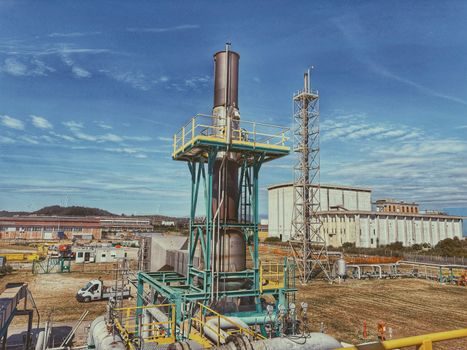
On any actuator that will live inside a classified area, the explosion-protection certificate must match the zone and gas group, with European projects typically requiring ATEX 2014/34/EU category 2 (zone 1) or category 3 (zone 2) marking, and non-European projects accepting the IECEx scheme against IEC 60079-0 and IEC 60079-1 for flameproof enclosures [S1].
For North-American sites, the relevant framework is the NEC class/division system with UL 1203-listed explosion-proof enclosures, and many global EPCs now demand dual-marked ATEX + IECEx + UL units to avoid parallel stocking of variants.
Recent academic work on approximation-free control for hydraulic actuators in safety-critical suspension systems shows the same stability-margins and prescribed-performance envelope techniques being adapted for process-valve position control, where the controller must guarantee transient response and steady-state accuracy even when the hydraulic pump supply pressure drops [S1].
Control bandwidth: on/off, proportional, or servo
On/off solenoid valves driving double-acting cylinders remain the cheapest ESD solution, but they limit cycle life to roughly 100,000–500,000 operations depending on cushion design, and they cannot hold an intermediate position without a separate brake or mechanical detent. [S2]
Proportional valves with integrated electronics give continuous position control over a 0–100% stroke envelope, with typical step-response settling times of 50–200 ms on small actuators; servo-valves push that figure below 20 ms, which is the territory of high-speed hydraulic motor loads, dynamic reactor pressure control, and polymer-reactor recipe transitions where dead-time on position feedback directly translates to off-spec product.
For the rare cases where the actuator is also expected to act as a structural damper — large damper vanes on FGD ducts, for example — the published VDC model B = α·υ⁻β (α > 0, β > 0) gives a usable fit for the plunger-type geometry and lets control engineers tune gain without overshoot at low velocities [S3].
Comparison of common actuator families on chemical duty

On four decision criteria — thrust density, clean-service compatibility, ESD fail-safe behaviour, and control bandwidth — the dominant families line up as follows. Hydraulic double-acting cylinders lead on thrust density and bandwidth, lose on inherent fail-safe (you need an accumulator or spring module), and win on clean-service compatibility when ordered in 316L with PTFE seals. Pneumatic spring-return actuators win on inherent fail-safe and capital cost, lose on thrust density and bandwidth, and require extensive instrument-air drying to remain clean-service compatible. Electric actuators win on clean-service and bandwidth for small valves, lose decisively on thrust density above ~50 kN, and have a poorer track record in sustained high-cycle modulating service in chemical plants. [S3]
The right pick, in one line, is: hydraulic double-acting for thrust above 50 kN and modulating duty with fire-resistant fluid; pneumatic spring-return for ESD on valves under DN300; electric for small instrumentation, isolation duty, and remote locations without instrument air. For very large dampers, hydraulic actuators paired with servo-valves remain the only realistic option when millisecond-class response and multi-MPa output pressure are both required.
Limits, failure modes, and what to push back on
The most common premature failures on chemical-duty hydraulic actuators are rod-seal extrusion under pressure spikes, corrosion pitting at the rod packing area from chloride-bearing atmospheres, and internal leakage past worn piston seals — the latter typically caused by particulate contamination of the hydraulic fluid, which is why most OEMs now publish NAS 1638 class 7 / ISO 4406 18/16/13 as the minimum cleanliness for warranty [S2].
Single-acting units are unsuitable where a high cycle rate is expected without external counter-force, because each stroke must wait for the spring to retract the piston — a hard physical limit that no amount of control tuning can overcome, and one that pushes specifiers toward double-acting designs above roughly 10 cycles per minute.
For multi-fluid plants, resist the temptation to share a single hydraulic power unit across radically different service areas; cross-contamination of phosphate-ester and mineral-oil fluids is a frequent root cause of seal swelling, and OEM chemical-reagent chemical reagent compatibility charts should be re-checked every time the fluid list is revised.
Next, verify that any candidate unit carries traceable material certificates to EN 10204 3.1 for wetted parts, that the positioner is rated for the same hazardous area as the actuator body, and that the local service network can deliver a seal rebuild kit inside 48 hours — three procurement checkpoints that typically separate a workable spec from a six-figure shutdown.
See also our earlier report, Hot Chamber Die Casting Machine Selection for Agriculture Machinery: 2026 Spec Map.