A hydraulic pump and a hydraulic cylinder are not competing options — they sit on opposite ends of the same energy-conversion chain, and the spec sheets of one directly constrain the other. Get the boundary wrong and you oversize the prime mover, undersize the actuator, or burn through seals in the first 200 hours.
In a working circuit, a pump's two headline ratings — pressure (bar) and flow rate (L/min) — define what every downstream cylinder can deliver in terms of force and stroke speed [S1]. Sourcing data from the past six months shows heavy-duty clamp and lifting cylinders commonly quoted in the 1-piece MOQ tier at US$50–US$500 per unit [S2], while integrated pump-and-cylinder lifting jacks in the 12-tonne class are stocked as single SKUs by industrial distributors [S4].
What Each Component Actually Does in the Circuit
A hydraulic pump is an energy-input device: torque in (from an electric motor, engine, or PTO) is converted into volumetric flow at a given pressure, with rated pressure and rated flow stated independently on the nameplate [S1]. A hydraulic cylinder is an energy-output device: the same pressurized flow entering its bore port produces linear thrust on the piston, and the rate at which the piston extends is set by flow divided by piston area [S1].
The cylinder's bore, rod, and stroke dimensions therefore set the mechanical work envelope, while the pump's pressure ceiling and flow capacity set whether that envelope is reachable in the time required by the machine cycle. A pump rated 250 bar / 40 L/min can drive a 100 mm-bore single-rod cylinder to roughly 196 kN of theoretical thrust at full pressure, with rod-side retract speed governed by the rod/piston area ratio — a relationship the spec sheet makes explicit on the cylinder side and the pump side must be matched to [S1][S5].
The Two Ratings That Couple Pump to Cylinder
Pressure is the first coupling variable: pump maximum operating pressure is the hard ceiling for the cylinder's working pressure, and most industrial cylinder lines on distributor shelves are sorted in RS-style catalogs by Maximum Operating Pressure as a primary filter [S5]. A clamp or press cylinder quoted at 250 bar working pressure requires a pump whose rated pressure is at least that — typically with a 10–15% margin for transient spikes.
Flow is the second coupling variable: pump displacement (cc/rev) × input speed (rpm) sets the flow that drives cylinder rod speed. A 12-tonne hydraulic jack pump listed in January 2026 stock uses a long-stroke cylinder matched to a hand or pneumatic pump body, demonstrating that pump flow and cylinder stroke length are co-specified in catalog entries rather than chosen independently [S4]. The classic sizing check is F = p × A and v = Q / A, where A is the effective piston area — the same A appears in both equations, which is exactly why a pump and a cylinder cannot be selected in isolation.
Pump Types vs Cylinder Types: How Families Pair
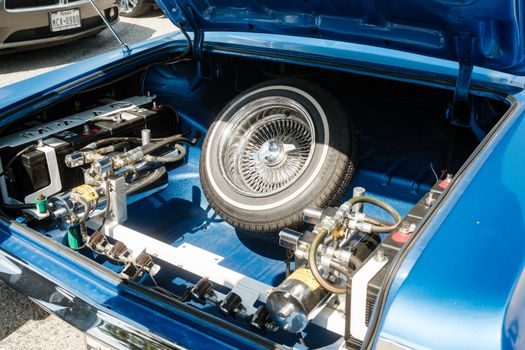
Pump families split by displacement behaviour: fixed-displacement gear and vane pumps for constant-flow circuits (open-center or load-sensing); variable-displacement piston pumps for energy-saving closed circuits and pressure-compensated systems. Cylinder families split by action: single-acting (spring or gravity return) for one-direction push, double-acting (two-port) for push-pull cycles, and telescopic/multi-stage for long stroke at short retracted length [S5].
Pairing logic is mechanical, not aesthetic. A fixed gear pump is fine with a single-acting lifting cylinder where retract happens by gravity. A double-acting clamp cylinder in a high-cycle press needs a pump with bidirectional flow control or a directional valve that handles meter-out flow on the cap side — otherwise shock loads damage the rod bearing. A hydraulic actuator in the broader sense includes rotary motors, but for linear motion the cylinder is the actuator and the pump is its energy source; choosing a telescopic cylinder for a tipper trailer with a small gear pump leads to painfully slow extension, because flow divided across each successive stage area keeps shrinking as the stages telescope out.
Selection Criteria Engineers Actually Lock First
For the pump, the four numbers that gate every vendor conversation are: (1) maximum continuous pressure (bar), (2) rated flow at working rpm (L/min), (3) input speed range (rpm), and (4) case drain / noise class if it's a piston pump. For the cylinder, the four that gate the same conversation are: (1) bore × rod diameter (mm), (2) stroke length (mm), (3) maximum working pressure (bar), and (4) mount style (flange, clevis, trunnion, foot). [S1]
Cross-checking is mechanical: pump pressure ≥ cylinder working pressure, with margin; pump flow × 60 / cylinder area = rod speed in mm/s, which must hit the machine cycle target. For load-holding, a double-acting cylinder paired with a fixed pump needs a hydraulic valve block with a check valve — the pump itself cannot hold pressure when shut off, and neither can a single-acting cylinder in a vertical lift without a pilot-operated check. Hydraulic power units (tank + pump + motor + valve manifold) are sold as integrated packages by Chinese OEM/ODM suppliers, and the cylinder is then sourced separately to match the unit's pressure and flow [S2].
Where Each Option Fits — and Where It Doesn't
For constant-load, high-cycle industrial presses and machine tools, double-acting cylinders fed by variable-displacement piston pumps are the default. For mobile and intermittent-duty lifting (jack, tipper, dock leveler), single-acting telescopic cylinders fed by fixed gear or hand pumps dominate — the 12-tonne / long-stroke combination shown in distributor catalogs is the textbook case [S4]. For clamping work in machining fixtures, short-stroke double-acting cylinders with flange mounts are standard, and clamping-cylinder specialists in Shandong publish them in the 50–500 USD FOB tier with 1-piece MOQ for OEM buyers [S2].
Where a pump-on-its-own or a cylinder-on-its-own answer fails: a pump without a matching cylinder is dead inventory; a cylinder without a hydraulic power unit or matched pump is a paperweight. The pair fails when designers size the pump to peak cylinder force (oversizing the drive motor) or size the cylinder to pump flow at full pressure (oversizing the actuator and the structure it bolts to). The Australian hydraulics aftermarket — service, repair, and installation of pumps, cylinders, and valves across mining, marine, and heavy industry — exists precisely because mismatches in this pair are the most common field failure mode [S6].
Limits, Failure Modes, and Standards Pressure
Pump-side failure modes: cavitation (inlet starvation, usually undersized suction line or restricted filter), case-pressure spike (drain line too small on piston pumps), and overheating at continuous max pressure without a derate. Cylinder-side failure modes: seal blow-by under pressure spikes above rated value, rod buckling when stroke length exceeds the Euler load threshold for the chosen rod diameter, and galling on chrome-plated rods in dirty environments. [S2]
Standards pressure is real on both sides: cylinder selection on industrial distributor catalogs is filtered by Standards/Approvals listings (typically ISO 6020 for industrial cylinders, manufacturer-specific tie-rod and welded-body ranges), and the pump side is governed by manufacturer rating curves plus cleanliness targets in ISO 4406 for the fluid. Sealing elastomers must be matched to fluid type and temperature window — NBR for mineral oil at moderate temperature, FKM for higher temperature or synthetic fluids, EPDM for phosphate-ester or water-glycol — and this choice is usually more binding than the pump/cylinder geometry question, because it determines seal life. Reference specs on catalog pages (bore, stroke, maximum operating pressure) are the decision data; everything else is sales talk [S5].
Sourcing Map: Where the Pair Is Built and Sold

Supply-side, the 2026 market is dominated by Chinese OEM/ODM manufacturers for both pumps and cylinders, with Shandong as the cluster center for clamping and lifting cylinders [S2]. Hydraulic cylinder specialists with multi-decade manufacturing histories (founded 2000 in one cited case) and global OEM/ODM service ship single-acting flange types and double-acting heavy-duty mining/marine cylinders in MOQ-1 export packaging [S3].
On the same supply side, hydraulic-pump-and-cylinder ODMs (Hualong-class) publish multilingual catalogs and OEM/ODM landing pages targeting global buyers. The Hydraulic System Suppliers 2026 tier map shows how these cluster-level manufacturers relate to the rest of the supply chain for engineers building a full procurement spec. Distributor-side, RS-style catalogs expose Maximum Operating Pressure, Cylinder Capacity, and Standards/Approvals as primary filters, with pricing in the US$50–US$500 OEM range for small-bore clamp cylinders and five-figure sums for large-bore tie-rod industrial units [S5].
Trackable signals to watch: revisions to ISO 6020-2 dimensional standards for compact cylinders, new pump-efficiency classes under EU Ecodesign for hydraulic power units (if applicable to your duty cycle), and the emergence of integrated electro-hydrostatic actuators that collapse the pump-cylinder pair into a single block — a change that would reset the boundary logic described above. Confirm pressure and flow match against the cylinder's actual bore and stroke on every PO, and the pump-cylinder pair behaves as a single coupled system rather than two independent purchases. For broader motion-control context, the same F × v coupling principle shows up in harmonic-drive sizing for rotary motion, where torque × speed maps to motor power the same way force × velocity maps to pump flow × pressure.