For pump and valve foundries, medium-frequency coreless induction melting furnaces in the 0.5-5 ton capacity band, paired with 250-3000 kW IGBT or thyristor power supplies, cover roughly 80% of carbon steel, stainless steel, and copper alloy melts used in body, bonnet, and disc castings [S2][S4].
Melt mass, metal, and furnace body choice
Body casting for gate valves, globe valves, and centrifugal pump housings typically falls in the 5-500 kg per piece range, so 0.5-2 ton furnaces dominate job-shop foundry layouts; a 1 ton medium-frequency unit can pour 3-4 heats per 8 h shift when melt-to-pour cycle is held under 90 min [S2].
For duplex stainless and high-nickel alloys (ASTM A890 4A/5A, CN7M), the same furnace class applies, but refractory selection shifts from silica-alumina to magnesia-spinel linings because Ni-Cr alloys attack acidic crucibles above 1600 °C; refractory life drops from roughly 200 heats on carbon steel to 80-120 heats on 25% Cr duplex at similar pour temperatures [S3]. Vacuum induction melting is reserved for super-austenitic or Ni-Fe-Cr grades where inclusion control matters, with a 0.5-1 ton vacuum furnace quoted around US$10,000 base at 1-set MOQ and 200 sets/year production capacity per a Shanghai-based supplier listing [S1].
Power supply topology and frequency
Three topologies compete for valve and pump foundry duty: thyristor medium-frequency (SCR-MF, 500-3000 Hz, 250-3000 kW), IGBT-MF (500-2000 Hz, 250-2000 kW), and virtual-impedance (VI) IGBT units, all described in current OEM catalogs for induction melting in this segment [S2]. The relevant comparison criteria for a process engineer are: melt rate (kg/h per 100 kW), electrical efficiency at full load, and tolerance to a partially loaded crucible (cold-start behavior).
For 1-2 ton furnaces melting carbon steel at 1550-1600 °C, IGBT units typically deliver 120-150 kWh/t at full load against 135-160 kWh/t for SCR units of similar rating; VI topologies are claimed by the manufacturer to keep efficiency flat from 30% to 100% load, which matters for foundries running partial heats at end-of-shift [S2]. A useful operating rule: choose 500-1000 Hz for 1-5 ton steel melts (better stirring, lower kWh/t) and 150-300 Hz for 5-10 ton iron melts (deeper penetration); the same power cabinet can usually be re-tapped, but the induction coil and capacitor bank must match the chosen frequency band.
Cooling loop, hydraulics, and balance of plant
Counter-flow closed cooling towers sized at 1.1-1.3x total furnace kW (heat rejection plus coil/cable losses) are the standard balance-of-plant; the supplier reference describes a fully enclosed circulation design with a building-block heat exchanger that can be serviced layer by layer, preventing debris blockage in the closed loop [S2]. Cooling-water quality specs typically call for conductivity below 500 µS/cm, hardness below 100 mg/L CaCO3, and inlet temperature at or below 35 °C to keep the copper coil below 60 °C surface rise at full power.
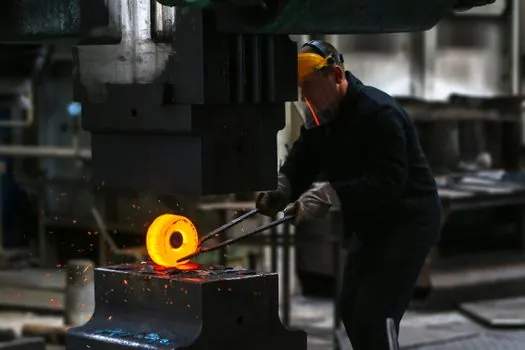
Hydraulic tilting furnaces with a double-acting oil cylinder and a separate yoke frame are the dominant pour-side configuration for valve and pump work because hand-pouring 200-500 kg of 1550 °C steel is unsafe; the spares ecosystem supports this with dedicated tilting-cylinder seal kits, furnace mouth and bottom pouring-block spares, and stainless steel water-inlet distributors listed as standard maintenance items [S2][S3]. A practical checkpoint: the induction coil water manifold, the hydraulic pack, and the closed cooler should be on separate electrical feeds so a single fault does not black-out the melt.
Refractory, lining, and consumables economics
Crucible and lining selection drives total cost-per-heat more than any other variable. For a 1 ton furnace, silica-alumina dry-vibration lining on carbon steel gives 200-300 heats at 5-8 mm erosion per 100 heats; switching to medium-grade alumina-silica with boron-oxide sintering aid, or to dry-ramming mixes with a cold-curing binder as patented in US4351058A, raises life to 350-500 heats on the same duty [S5].
Spare-parts suppliers such as Lawatherm Furnace (India) and Induction Furnace Components (India) stock the full critical-path item list: induction coils (water-cooled copper tubing, 12-20 mm OD), yokes, reactors/chokes, starting capacitors, lining vibrators, and insulation modules, with MOQs as low as 1 piece on temperature instruments and 5 pieces on punched grid components [S3][S6]. For a foundry running 8-10 heats per day, holding one full set of coil, yoke, and capacitor spares on the shelf cuts unplanned downtime risk; for lower-duty foundries, contract spares with a 5-7 day lead time is the usual compromise.
Standards, sourcing, and qualification checks
Valve and pump body castings typically reference ASTM A216 (carbon steel), A351 (austenitic stainless), A395/A536 (duplex and ductile iron), or EN 1561/1563 equivalents, while the induction furnace itself carries CE conformity under the EU machinery and low-voltage directives and EMC directive for European builds; Chinese OEM catalogs list induction melting furnaces, rolling mills, and cooling towers as their main product scope with OEM/ODM service availability for non-standard ratings [S4]. A buyer-side checklist before signing a PO: melt-rate curve at 30/60/100% load, kWh/t at rated capacity, refractory life guarantee in heats, water quality spec, and a full spare-parts price list for the first 24 months of operation.
For most pump and valve foundries in the 2,000-20,000 t/yr output band, the reference architecture is a 2-3 furnace cell of 1-2 ton medium-frequency units fed by twin 1500-2000 kW IGBT power supplies, with one closed cooling tower sized for 1.3x the combined kW and a shared hydraulic pouring bay. For batch or alloy-flexible work, a hybrid cell adding one small 0.1-0.3 ton furnace for bronze, monel, or aluminum-bronze trim castings covers the trim-alloy side of pump and valve production without cross-contaminating the steel melt; the broader taxonomy of induction melting furnace configurations and the role of the crucible furnace as a holding/buffer unit behind the melter are worth mapping before a greenfield layout. Related selection logic for adjacent parts flows, such as Induction Furnace Selection for Automotive Parts: 2026 Spec Map and Induction Furnace Selection for Agricultural Machinery: 2026 Spec Map, follows the same power-supply and refractory gates but with different tonnage bands.
For component-level specifications, see induction furnace.