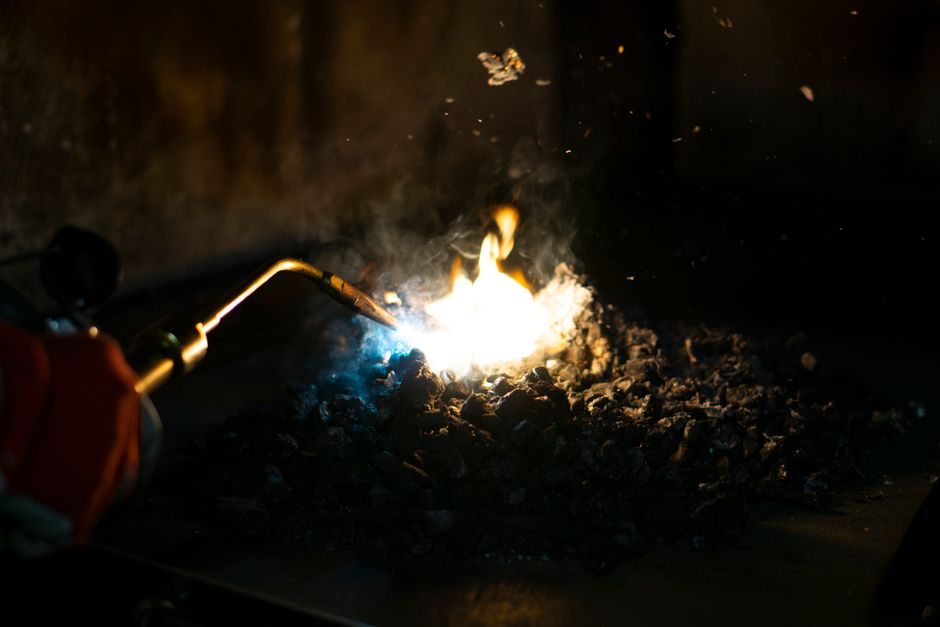
An induction furnace is an electrical furnace in which heat is produced by induced eddy currents in a conductive metal charge, with installed capacity spanning less than 1 kg laboratory units to 100-ton foundry melting vessels [S1][S4]. A cupola furnace, by contrast, is a vertical, refractory-lined shaft continuously charged with iron, coke and flux, in which combustion of metallurgical coke against preheated air supplies the energy to melt the metallic burden.
The two systems are not drop-in substitutes. Induction delivers a clean, electromagnetically stirred bath with per-batch flexibility in alloy and tonnage; cupola delivers a continuous, high-throughput stream of liquid iron at a lower energy-bill per ton, but it ties the plant to coke supply, basic oxygen/CO2 emissions, and a charge mix dominated by ferrous scrap and pig iron. Decision-making hinges on tonnage, alloy range, local power vs coke cost, and emissions permit constraints.
Energy and Capacity Envelope
Medium-frequency coreless induction furnace units are typically built in 0.25 t, 0.5 t, 1 t, 2 t, 3 t, 5 t, 8 t, 10 t, 15 t and 20 t molten-metal capacities, with 100 t units deployed in large steel-melting shops [S1]. Working principle rests on Faraday's law: an alternating solenoid coil induces eddy currents in the metal charge held in a water-cooled crucible, with a stack of laminated transformer core steering the magnetic flux path in the indirect (channel) variant [S1].
Cupola furnaces are classified by melt rate rather than batch size, with common industrial ratings of 1, 2, 3, 5, 8, 10, 15, 20, 30 and up to 80 tonnes of liquid iron per hour. The water-cooled, hot-blast cupola in particular sustains continuous high-throughput iron-making for ductile-iron and grey-iron foundries, where the per-ton coke rate is the dominant cost line. Where the melt shop needs ≤2 t/h, induction coreless often wins on flexibility; above 10 t/h, cupola economics pull ahead for plain-carbon iron grades.
Charge, Alloy Range and Melt Cleanliness
Induction melting accepts a wide charge spectrum — steel scrap, cast-iron returns, copper, aluminium, brass and specialty alloys — with melt weight tuning in increments as small as 50–100 kg by simply underfilling the crucible [S1][S3]. This makes it the default choice for tool-steel, stainless, high-chrome iron, copper-alloy and aluminium-jobbing foundries, where alloy changes several times per shift are routine.
Cupolas are essentially iron melters. The burden is layered iron scrap + returns + pig iron + coke + limestone/dolomite flux, and the metallurgical envelope is narrow: grey iron, ductile iron, and malleable iron. The coke bed also carbon-saturates the melt to roughly 3.2–4.0% C, so the operator trades compositional precision for throughput. Induction lets the operator dial carbon, silicon and manganese to the ladle; cupola locks much of that chemistry into the burden recipe.
Side-by-Side Comparison: Induction vs Cupola on 4 Decision Gates
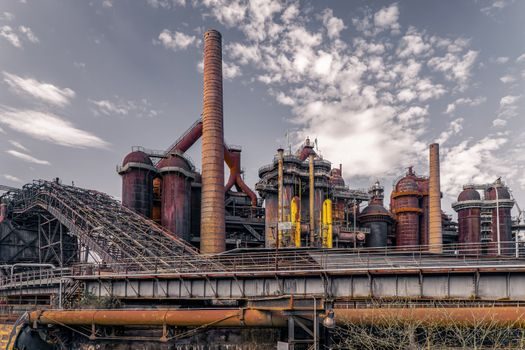
Four gates dominate the buying decision in 2026, lined up below. [S1]
<b>Energy cost per ton.</b> Channel (indirect-core) induction runs more efficient at sustained holding, often near 500 kWh/t on liquid iron.
<b>Emissions and permitting.</b> Cupola off-gas carries CO, CO2, SOx, NO x and PM-10 from coke combustion; a wet scrubber or baghouse is mandatory in most jurisdictions. Induction produces no combustion gas at the melt point — only cooling-water and stack losses — so permitting is materially simpler, and induction shops often site inside urban industrial parks where cupola would not be approved.
<b>Melt chemistry control.</b> Induction wins on every axis: tighter carbon equivalent (±0.05% achievable vs ±0.15% on cupola), lower sulfur pickup (no coke contact), and freedom to run low-sulfur steel or aluminum without a desulfurization step. Cupola iron typically needs external desulfurization (wire-injection Mg or CaC2) to reach ductile-iron-grade S ≤ 0.015%.
<b>Capital vs operating cost.</b> A 5 t medium-frequency coreless melting furnace in 2026 quotes roughly USD 250,000–500,000 for the furnace package; an equivalent 5 t/h cold-blast cupola lines up at USD 150,000–300,000, but with full emission control, hot-blast bustle and charge handling the installed cost converges. Cap-ex favors cupola; opex on most Chinese, Indian and EU grids now favors induction. A broader view of how furnace class maps to capacity and alloy is given in the melting furnace 2026 price and cost guide.
Operating Constraints and Failure Modes
Induction furnace downtime clusters on three components: the induction coil (water-cooled copper, lifetime 5–10 years in well-maintained shops), the thyristor or IGBT medium-frequency power supply (typical MTBF >30,000 h but sensitive to cooling-water quality), and the crucible refractory (ramming mass or preformed, 100–400 heats per lining depending on tonnage and melt superheat) [S3]. Crucible failure with metal run-out into the coil is the worst-case event; a leak-detection interlock and coil catch-pan are standard spec items.
Cupola downtime concentrates on the tuyere, bosh and stack refractory, the tuyeres themselves burning back at a predictable rate and the tap-hole washing out at every campaign. Stack-emission spikes during a cold start are common and trip baghouse differential-pressure alarms. Water-cooled copper tuyeres can be unlined for sustained campaigns; uncooled silicon-carbide tuyeres demand 2–3 week replacement cycles. The cupola is mechanically simple but refractory-intensive; induction is electronically complex but refracts in a single crucible.
Standards, Sourcing and Spare-Parts Map
No single international standard harmonizes the two furnace classes, but the operating envelope is governed by IEC 60079 series for hazardous-area classification of electrical equipment around the melt, by energy-efficiency programs such as China GB 20052 / India BEE star labeling on medium-frequency power supplies, and by foundry-sector environmental rules on cupola stack emissions (typically PM ≤ 50 mg/Nm³ and SO2 ≤ 400 mg/Nm³ on existing EU installations). [S2]
Spare-parts supply for both classes is mature. For induction, the catalogue spans induction coils, thyristor/IGBT modules, water-cooled cables, capacitor banks, hydraulic tilting cylinders, and ramming-mass refractories; multi-vendor spares are listed with lead times of 2–6 weeks for OEM parts and 1–2 weeks for aftermarket equivalents [S3]. For cupola, the parts list is dominated by refractory (silica, magnesia, silicon-carbide), tuyere assemblies, blowers, charging equipment and wet scrubber internals. The decision tree from class to RFQ is laid out in the induction furnace selection guide, which is a useful counterweight to the comparative view here.
For a foundry spec'ing a new melt shop in 2026, the next actionable node is a 30/60/90 day plan: lock the alloy mix and tonnage per shift, request two bids — one medium-frequency coreless and one hot-blast cupola — with a 10-year TCO model that prices electricity, coke, refractory, downtime and emissions compliance. The decision between an induction furnace and a cupola furnace is rarely technical alone; it is technical plus grid carbon-intensity plus local coke supply plus the foundry's permit ceiling. Watch for tightening EU Industrial Emissions Directive thresholds on PM and NO x from cupola stacks, and for falling IGBT inverter prices on the induction side — both shift the same decision matrix quarter to quarter.
For component-level specifications, see crucible furnace.