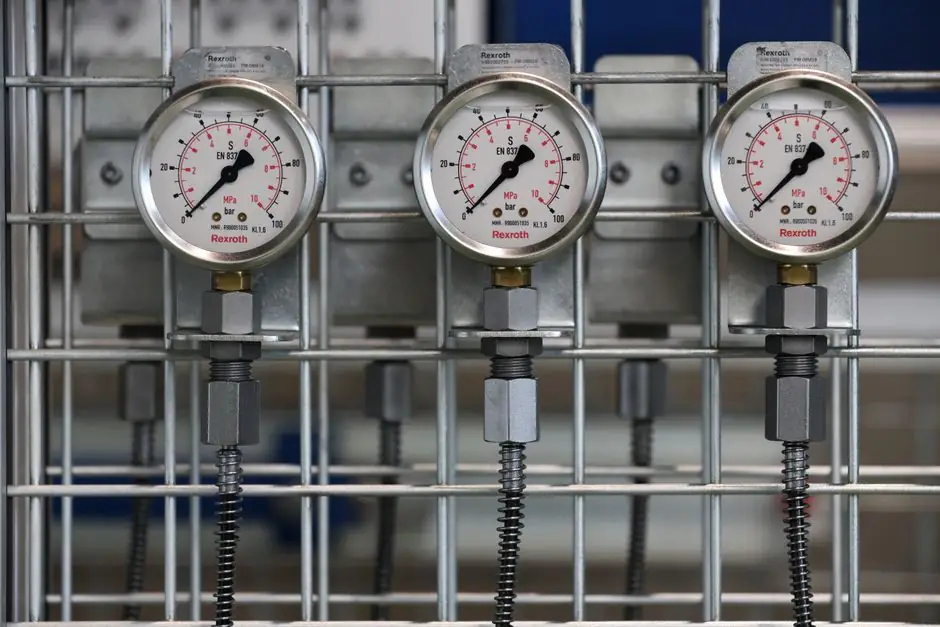
WIKA, ICS Schneider and Tameson all group the four contact types in the same way: magnetic snap-action, reed, inductive, and electronic [S1][S2][S3]. Of these, the inductive and magnetic snap-action pair covers most greenfield pump, compressor and hydraulic-panel specs, and the 2026-08-19 ICS Schneider selection guide treats the choice between them as a load-versus-area decision, not a brand decision [S4].
The split is electrical, not mechanical: a magnetic snap-action contact is a passive, potential-free dry contact that needs no supply and can switch up to roughly 30 W/1 A at 250 V AC in typical WIKA-class gauges, while an inductive contact is an active sensor that requires an intrinsically safe switching amplifier (SVA) and is specified specifically for zone 1/2 hazardous areas [S2][S6]. Both sit behind the dial of a pressure gauge and are tripped by the instrument pointer, but their failure modes and wiring rules are different enough that mis-specifying them is one of the most common field problems [S4].
How each contact actually trips
Magnetic snap-action contacts are mechanical switches in which a permanent magnet on the carrier arm pulls a contact arm attached to the pointer past the set point, producing a snap action that the magnet also holds closed, so contact pressure is preserved and arcing is damped [S2][S5]. Inductive contacts are contactless: a slotted control head sits at the set point, and a metal flag on the pointer entering the slot changes the head's internal oscillator current, which the downstream SVA interprets as a switch event [S2]. The mechanical variant is therefore a true switch you can hear; the inductive variant is a position sensor that only looks like a switch to the controller.
Tameson notes that set points should sit between 10 and 90 percent of full scale to keep hysteresis, accuracy and contact life inside spec, and that double-contact normally-open or normally-closed arrangements give redundant switching for safety loops [S3]. Reed contacts, the third option WIKA lists, combine the pointer magnet of the snap-action design with a hermetically sealed glass reed rated up to 60 W and up to 10^6 cycles, which is why they are often preferred for low-current PLC inputs [S2].
Electrical load, voltage, and PLC compatibility
WIKA is explicit that magnetic snap-action contacts are not suitable for low electrical loads, such as direct PLC inputs, because the contact resistance is unstable below a few milliamps; an external contact protection relay or a defined minimum load is recommended for liquid-filled gauges [S2]. ICS Schneider reinforces this: a contact pressure gauge is not a power switch, and the load must be dimensioned against the contact's voltage, current, and load type, with an interface relay or PLC input card absorbing the actual switching energy [S4].
Inductive contacts solve the low-current problem by design, but at the cost of a switching amplifier. BHG Senzory specifies that an inductive contact with SVA should be used for switching currents under 20 mA, because at those levels a dry mechanical contact would chatter or oxidise, while the inductive loop remains stable [S6]. For PLC inputs that draw around 5 to 20 mA at 24 V DC, ICS Schneider and Tameson therefore point users toward reed or electronic contacts rather than magnetic snap-action, reserving the latter for direct coil, solenoid, and alarm horn switching where the inrush is well above the contact's minimum load [S3][S4][S6].
Hazardous area, switching frequency, and lifetime

For zone 1 and zone 2 installations the inductive contact is the only one of the two that is intrinsically safe, because the SVA limits energy in the loop to below ignition threshold, and the head itself is fully potted so no spark can reach the process atmosphere [S2]. Magnetic snap-action contacts are explicitly not approved for hazardous areas in WIKA's documentation, and electronic contacts, although they switch small PLC signals directly, are also not Ex-rated [S2]. Reed contacts with their sealed glass envelope are occasionally used in Ex systems with a suitable barrier, but WIKA's lineup treats the inductive-plus-SVA combination as the default Ex solution [S2].
On switching frequency and wear, both inductive and reed contacts are contactless and rated for very high cycle counts, while magnetic snap-action contacts are mechanical but the magnetically assisted snap dramatically reduces bounce, arcing, and pitting, so service life is still commonly in the millions of cycles [S5]. For pump monitoring with dozens of start/stop events per day, that difference is rarely the deciding factor; for a compressor anti-surge or rapid-cycle hydraulic press, the inductive or electronic contact is the safer pick because there is no mechanical contact to weld or pit [S2][S4][S5].
Side-by-side decision matrix
Pulling the published guidance into one table, the four main contact options line up against the criteria that matter on a datasheet: typical load, Ex rating, PLC suitability, and wear behaviour. [S2]
Magnetic snap-action contact: passive, potential-free, switches roughly 30 W / 1 A at 250 V AC typical, not Ex, not ideal for low-current PLC inputs, mechanical but magnetically damped, long life in normal loads [S2][S5]. Reed contact: passive, switches up to 60 W, also handles low-current PLC inputs, up to 10^6 cycles, contact-free actuation, needs a protective circuit for capacitive or inductive loads [S2]. Inductive contact: active, requires SVA, intrinsically safe for zone 1/2, wear-free, switching current below 20 mA handled cleanly, used where high switching frequency or hazardous area rules out dry contacts [S2][S6]. Electronic contact: inductive head with built-in PNP/NPN transistor stage, no separate SVA, drives PLC inputs directly, wear-free, not Ex-rated [S2].
Selection rule of thumb that matches every source above: choose magnetic snap-action when you are switching a relay coil, solenoid, lamp, or horn at normal industrial current and the area is safe; choose inductive when you are in a hazardous area or need to switch at very low current with high frequency; choose reed when you need a single device to cover both high and low loads on a non-Ex line; choose electronic when the cabinet already runs 24 V DC logic and you want to skip the SVA but stay outside Ex zones [S1][S2][S4][S6].
Wiring, hysteresis, and common field failures

ICS Schneider flags switching hysteresis as the second-most-misunderstood parameter after contact type: too little hysteresis and a fluctuating pump output will chatter the contact, too much and the process will trip too late [S4]. They also warn against treating AC and DC loads the same, and against driving inductive loads (solenoids, contactors, motor starters) directly, because the flyback voltage destroys dry contacts within weeks; a snubber, varistor, or interface relay is mandatory in those circuits [S4].
Two more field-failure patterns show up across the sources. First, a magnetic snap-action contact that worked fine on a 230 V alarm horn will mysteriously fail to latch a 24 V DC PLC input, because the contact never gets enough current to break through any oxide film, exactly the load-mismatch case WIKA warns about [S2][S4]. Second, an inductive contact that trips correctly on the bench will not register on the PLC if the SVA is missing, unpowered, or wired with the wrong polarity, and the failure looks like a contact problem even though the sensing head is fine [S2][S6]. Specifying the contact and the amplifier as a matched pair, then verifying them together, is the simplest way to avoid both [S4][S6].
Standards, sourcing, and verifiable next steps
For hazardous-area work the relevant regime is ATEX category 2 (zone 1) and category 3 (zone 2) for the inductive contact plus SVA combination, and IEC 60079-11 governs the intrinsic-safety interface that limits loop energy [S2]. Set-point adjustment is mechanical via the adjustment lock and key, with the WIKA and ICS documentation both recommending 10 to 90 percent of full scale to keep hysteresis and contact life inside spec [S3][S4]. Material options for wetted parts run from brass through 304/316L stainless steel to Monel, Hastelloy, and tantalum, with glycerin or silicone case filling for vibration-heavy skid builds [S5].
Trackable signals for the next buying cycle: confirm whether the panel is Ex-classified and which zone, because that alone fixes the contact family; measure the actual load the contact will see, in voltage and current, and compare it to the gauge datasheet, not to a generic catalog number; and decide between direct PLC input and an interface relay before talking to a vendor, since the answer changes whether you need a reed, electronic, or inductive-plus-SVA stack rather than a magnetic snap-action unit. For related reading on instrument-level switching decisions, the comparison of bump test vs full calibration on portable gas detectors uses a similar contact-versus-sensor tradeoff, and the industrial filter TCO analysis covers the same lifecycle math for a different pressure-side component.
Spec-level background on the components involved: magnetic level gauge.