
Industrial automation software is the connective tissue between plant-floor hardware and enterprise planning — it ties PLCs, DCS, motion controllers, robotics, sensors, SCADA, MES and ERP into one controllable system [S1].
The 2026 stack is defined by four architectural tiers (fixed, programmable, flexible, integrated automation) plus a new compliance overlay: the EU Cyber Resilience Act, with TÜV Rheinland confirming B&R's CRA Guide for POWERLINK in mid-2026 [S2].
Definition and the Four Automation Tiers
Industrial automation software covers design, programming, monitoring and optimization of machines that once ran by hand, and it spans sequencing logic, simulation, real-time analytics, and ERP integration [S1].
Architecturally it splits into four tiers: fixed automation (hard-wired for high-volume repeat runs, software managing sequencing and timing); programmable automation (batch-changeable via software reconfiguration); flexible automation (robotics + CNC with rapid changeover); and integrated automation (lines linked as a coordinated digital factory) [S1]. Discrete and process manufacturing differ in how recipes flow — process manufacturing builds bulk goods from a formula (oil refining, chemicals) where outputs cannot be disassembled into their original inputs, while discrete manufacturing assembles distinct units [S5].
Core Capability Set and Selection Criteria
Specifying an industrial automation software platform in 2026 means weighing seven concrete capabilities: PLC/DCS/motion control coverage, HMI/SCADA visualization, 3D and discrete-event simulation, real-time data acquisition, predictive maintenance, MES/ERP integration, and cybersecurity posture [S1][S4].
Performance Information Technologies, a working systems integrator, lists SCADA/HMI, asset utilization, equipment efficiency, performance monitoring, process information dashboards, real-time process reporting, process quality control, continuous improvement, and energy management as the standard integration scope for plant deployments [S4]. The Autodesk capability framing adds explicit design-and-simulate-before-build, sensor-to-enterprise connectivity, and data-driven throughput optimization as front-end deliverables [S1].
Comparison: Fixed vs Programmable vs Flexible vs Integrated
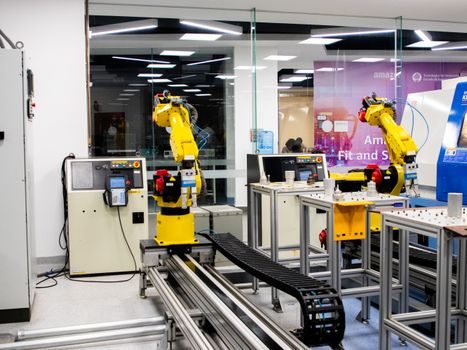
Fixed automation wins on per-unit cost at very high volume but loses on changeover speed — software is essentially sequencing/timing logic, with no provision for variant production [S1].
Programmable automation trades some throughput for batch flexibility, with software-controlled programs changed or updated to run different product batches with less retooling [S1]. Flexible automation pushes further, using robotics and CNC where software enables fast changeovers and automated setup for new products. Integrated automation is the ceiling: industrial automation software links machines, lines, and facilities into a coordinated digital factory, which is the only tier that meaningfully consumes MES and ERP data [S1]. The cost-vs-flexibility curve climbs steeply from fixed to integrated; most 2026 mid-volume plants sit at flexible-plus, with islands of integration at packaging or test cells.
Real-Time Data, Simulation, and Predictive Maintenance
Robotics and sensors on the factory floor feed real-time data at every step, and the same telemetry stream drives predictive maintenance models that flag rotating-equipment drift before failure [S1].
3D simulation and discrete-event simulation let engineers validate cycle time, buffer sizing, and takt balance before steel is cut, and they share data with downstream MES via Always-in-Sync™-style object linkage — a pattern visible in the Relyence FMEA platform which keeps PFMEAs, Control Plans and Process Flow Diagrams in lockstep across edits [S3]. SourceForge lists the Relyence FMEA entry starting at £140 per month per user, which is the working price band for mid-tier QMS/FMEA software bundled into automation programs [S3].
Vendor Map: B&R POWERLINK, Autodesk, and Integrators

B&R Industrial Automation's ACOPOS P3 generation is the most concrete 2026 servo drive release, marketed on compact size and intelligence for narrow-aisle pallet transport, and TÜV Rheinland's confirmation of B&R's CRA Guide for POWERLINK is the most concrete 2026 cybersecurity milestone for an automation protocol [S2].
Autodesk positions itself at the design-and-simulate end of the stack with solutions pages covering both industrial automation and process manufacturing, while outfits like Performance Information Technologies act as the integration layer — they configure SCADA/HMI, dashboards, and process quality control on top of vendor platforms rather than selling their own controllers [S1][S4][S5]. For a process engineer mapping a 2026 RFQ, the realistic shortlist splits into controller-vendor platforms (B&R, Siemens, Rockwell — outside the cited research), design/simulation tools (Autodesk), and QMS/FMEA adjuncts (Relyence) [S1][S3].
Limitations, Failure Modes, and Compliance Overlays
Industrial automation software is only as good as its sensor coverage — a missing tag at a critical measurement point will silently degrade any predictive-maintenance model, and SCADA dashboards will display green while the asset fails underneath [S4].
Process manufacturing adds a hard constraint: outputs cannot be disassembled into their component inputs, so recipe-management, batch records, and electronic signatures carry regulatory weight (FDA 21 CFR Part 11-style expectations) that discrete assembly does not face to the same degree [S5]. On the network side, the EU Cyber Resilience Act now imposes documented secure-development obligations on industrial control software, which is why vendors are publishing CRA-aligned guides and seeking third-party confirmation [S2]. Cross-vendor integration is still the most common failure point: when MES, SCADA, and ERP disagree on the unit of measure or the production-state model, the software stack surfaces the conflict as data drift rather than as a clear alarm.
Standards, Sourcing, and 2026 Procurement Notes
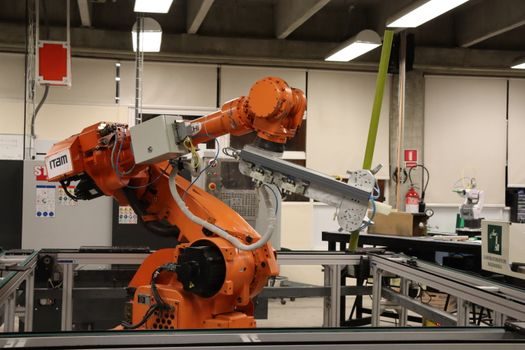
Plant-floor data exchange in this domain runs over a small set of established protocols — HART (FSK on a 4-20 mA loop), Foundation Fieldbus, PROFIBUS PA, and POWERLINK for real-time Ethernet — and the procurement decision is which subset the platform natively speaks, not whether the standard is supported generically [S1][S2].
For 2026 sourcing, the practical signal is the Cyber Resilience Act compliance trail — TÜV-confirmed guides and CRA-ready firmware are now a hard filter for EU-bound systems, and any vendor without a published CRA roadmap is a risk [S2]. On the software-license side, expect per-user-per-month pricing in the £140 band for FMEA/QMS adjuncts and enterprise agreements for the core SCADA/MES layer [S3]. Adjacent measurement hardware, from laser markers to abrasives process lines, now ships with native automation-software hooks, and the spec map is converging on a small number of OPC UA and MQTT brokers as the lingua franca. Trackable 2026 signals to watch: B&R ACOPOS P3 general-availability rollouts, further TÜV CRA confirmations beyond POWERLINK, and Autodesk design-suite updates that expose the simulation APIs to MES partners.
Spec-level background on the components involved: scada software, additive manufacturing material, and multifunction process calibrator.