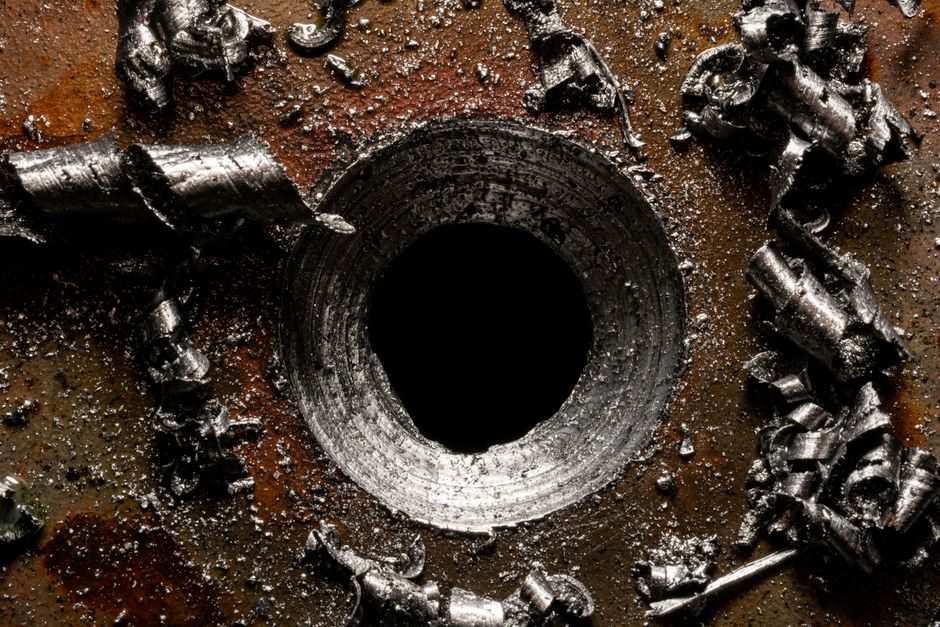
Bonded abrasives are built from three engineered inputs: a synthetic abrasive grain, a flexible or rigid backing, and a resin or glue bond — the combination that defines cut rate, heat tolerance, and dust behaviour on the workpiece [S3].
Selection is driven by workpiece material and stock-removal target: aluminium oxide for wood and general metal, silicon carbide for non-ferrous metals and stone, zirconia alumina for heavy stock removal, and ceramic alumina for high-pressure precision grinding under continuous cut [S3].
Raw Material Selection: Grain, Backing, and Bond Choices
Four synthetic grain families dominate modern coated-abrasive production, each with a distinct Knoop hardness and fracture behaviour that the specifier must match to the workpiece [S3]. Aluminium oxide covers the broadest wood-and-metal range; silicon carbide is sharper and more brittle, suited to non-ferrous metals, paint, and stone; zirconia alumina micro-fractures under heat to expose fresh cutting edges, making it the workhorse for heavy stock removal on steel; ceramic alumina grains stay sharp longest and are typically specified for high-pressure, high-RPM precision grinding.
Backing is a separate engineering decision. Paper backings (A/C/D/E/F weight classes) suit fine finishing and hand sanding; cloth backings (J-weight cotton or polyester) carry heavy-duty belts; fibre backings (vulcanised fibre, typically 0.7–0.8 mm) are the standard substrate for resin-fibre discs running on angle grinders at 80–100 m/s peripheral speed [S3]. Bond chemistry — phenolic resin for water-cooled industrial belts, urea-formaldehyde or hide glue for dry woodworking sheets — sets the upper temperature limit before the bond fails.
Grain Coating: Electrostatic Deposition and Coverage Ratio
The maker coat is a thin resin layer applied to the backing, after which the grain is deposited and oriented by electrostatic charge so that each particle stands on its pointed end — the geometry that maximises exposed cutting edge per square centimetre [S3]. The electrostatic field strength, typically tens of kilovolts on production coaters, is tuned to grain size: coarser grits (P24–P40) tolerate a stronger field, while fine grits (P180 and finer) need lower voltage to avoid back-ionisation and arcing.
Coverage ratio is the single most important downstream performance variable. Closed-coat products pack roughly 100% of the available surface with grain — maximum cut rate, higher frictional heat, faster loading on softwood. Open-coat products hold about 50–70% of the surface, leaving channels for dust extraction and a markedly longer life on resinous softwoods, paints, and composites [S3]. The spec trade-off is roughly a 20–30% cut-rate penalty for the open-coat dust-management gain, so selection should track the dust-to-stock-removal ratio of the application.
Size Coat, Curing, and Flex Conditioning
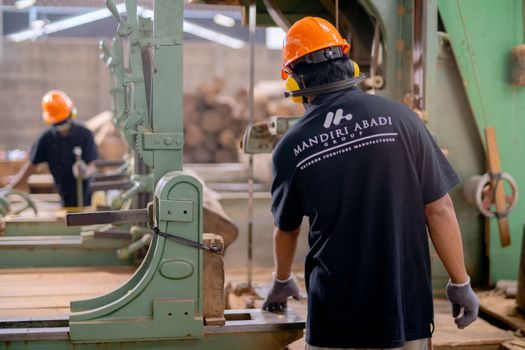
After electrostatic grain placement, a second resin layer — the size coat — is applied over the grain to anchor it to the maker coat; this coat is the primary determinant of belt life and heat resistance [S3]. Phenolic resin size coats, cured at 120–150 °C in a vertical festoon or horizontal lay-down oven, give the water- and heat-resistance needed for industrial metal grinding, while hide-glue size coats cure at lower temperature and remain the standard for fine woodworking sheets where flexibility and a softer touch matter more than thermal stability.
Post-cure flexing is the controlled-conditioning step that prevents cracking when the finished product is wound or bent around a contact wheel. Continuous products run through a series of idler rollers that impose a small radius of curvature, setting the residual curl and breaking the brittle resin skin. The final conversion step — slitting, sheet-cutting, or disc-stamping — determines whether the same jumbo roll becomes a 50 × 2000 mm narrow belt, a 230 mm fibre disc, or an A4 sheet for hand sanding.
Product Type Comparison by Application
Five product types share the same manufacturing chain but exit at different conversion stations, and the spec map below is what a buyer actually uses: [S3]
Belt (cloth backing) — best for high-RPM metal and hardwood stock removal, withstanding peripheral speeds of 30–80 m/s on wide-belt sanders and 80 m/s on portable belt grinders; grain choice is usually zirconia alumina P36–P120, closed-coat, phenolic bond. Disc (fibre or paper backing) — used on angle grinders at 80–100 m/s; fibre discs P24–P50 are the standard for weld blending and paint stripping, while PSA or hook-and-loop paper discs P80–P400 cover surface finishing. Sheet (paper backing, A-weight) — manual hand sanding at low pressure, grits P100–P600 and finer, typically hide-glue bond for woodworking or phenolic bond for automotive paint prep. Roll (cloth or paper, slit to width) — on-site or production-line conversion into hand pads, drum sander wraps, or orbital-sander cut sheets. Wheel (non-woven, nylon fibre + resin + grain) — a separate bonded product built on a non-woven web rather than a continuous backing, used for surface conditioning and satin finishing at 20–40 m/s.
Limits, Failure Modes, and Quality Signals

The first failure mode on a coated abrasive is bond breakdown, not grain wear: a phenolic size coat begins to lose shear strength above roughly 190 °C, so dry grinding of hard steel without coolant will burn the bond well before the grain is spent [S3]. The second is loading — the gap between grain tips fills with workpiece swarf and the cut rate collapses; open-coat construction and stearate anti-loading topcoats are the standard countermeasures on wood and paint.
Spec-relevant quality signals to verify on an incoming batch: grit-size conformance to FEPA standard (P-grade stamped on the back), closed-coat density visible as a uniform matte surface, no resin bleed-through on the backing, and — for belts — a clean slit edge without fraying. A single missing or out-of-spec variable among the four (grain type, backing weight, bond chemistry, coat ratio) will override all the others; the chain is only as strong as its weakest spec, which is why a single product data sheet should be read as four coupled parameters, not as four independent ones.
Process Engineering and Process-Control Fit
Inside an abrasives plant the variables that matter most — electrostatic field, resin viscosity, oven zone temperature, festoon dwell time, and slitting tension — are all closed-loop controlled; the OEM-side sensor stack on these lines is the same multi-loop profile used in any continuous-web coater, and the boundary logic for transmitters, valves, and flow meters in the resin-handling and oven-air circuits follows the same selection rules covered in the flow meter and industrial valve reference pages. [S3]
For plants integrating abrasives manufacture into a wider specialty-chemicals or coatings operation, the process line architecture, additive tankage, and cure-oven controls are the same subsystems reviewed in the related article on Specialty Chemicals Smart Manufacturing: Sensor, Valve, and Automation Specs for 2026 — useful context for any engineer scaling from lab coater to production line.