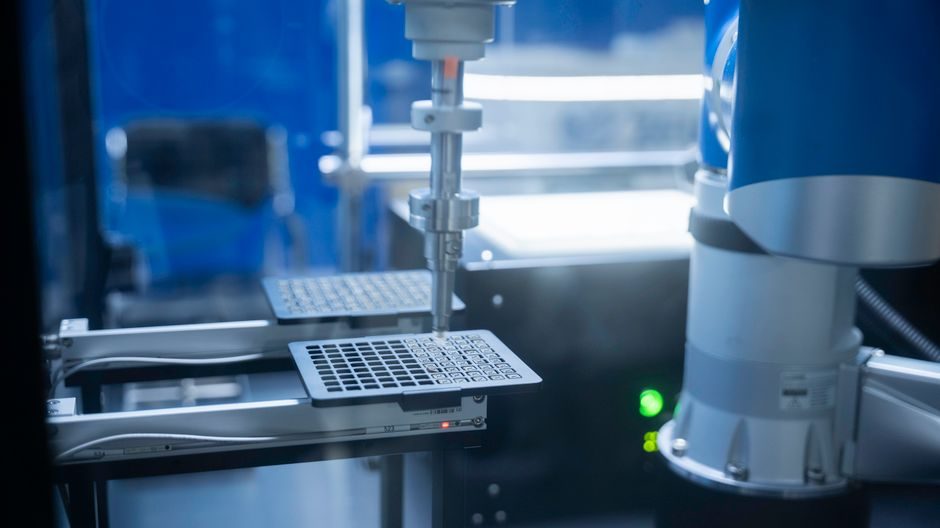
An industrial barcode scanner and a laser marker sit on opposite ends of the same traceability workflow — one decodes existing marks, the other creates them — and confusing the two is the single most common cause of failed line-side identification projects [S1][S5].
Both categories are dense with sub-types: scanners split into 1D laser, 2D imager, fixed-mount, cordless, and rugged variants, while markers split by source (fiber, CO2, UV, MOPA) and by substrate (metal, plastic, paper, glass). On Made-in-China, OEM auto barcode readers list at US$ 1-99 per piece MOQ 1, while terminal laser barcode scanners from Zhejiang suppliers such as Hangzhou Coditeck Technologies list at US$ 65-67 per piece MOQ 5 [S2][S5].
Defining the Two Categories and What Each Actually Does
An industrial barcode scanner is a READ device — it projects a light source (laser line, LED flood, or imaging CMOS sensor), captures the reflected contrast from a printed or directly-marked symbol, and outputs the decoded string over USB-HID, RS-232, Bluetooth, or TCP/IP. BarcodeFactory segments its scanner catalog by form factor (cordless, corded, rugged, wearable, ring, presentation, in-counter) and by industry (healthcare, industrial, warehouse, POS retail) [S1].
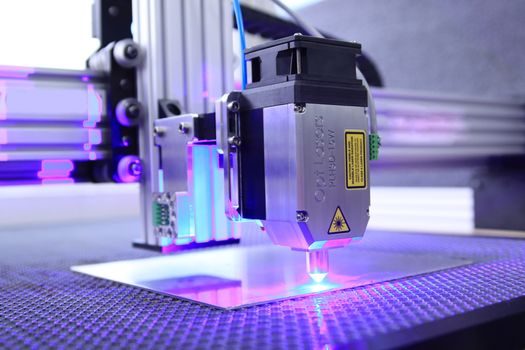
A laser marker is a WRITE device — it focuses a high-peak-power laser beam (typically 20-100 W fiber, 30-60 W CO2, or 3-15 W UV) onto a substrate, ablates or anneals the surface, and leaves a permanent alphanumeric, 2D Data Matrix, or graphic mark. The output is NOT a decoded string but a physical change in the material's top 5-50 microns [S5].
Selection Criteria: Substrate, Code Density, Environment, Throughput
Four specs drive the scanner choice: symbology (1D Code 128 / 39 vs 2D Data Matrix / QR), minimum element size (X-dimension, typically 5-20 mil for logistics, down to 2-3 mil for electronics), read distance (contact to 12+ m for long-range laser), and ingress rating (IP54 handheld, IP65/IP67 for line-side fixed mount) [S1][S4]. Symbology and X-dimension are the only two that the marker MUST be told to produce; the scanner MUST match them.
For a full side-by-side breakdown of source-vs-substrate vs area, the dedicated laser marker selection map covers the criteria in detail.
Comparison Matrix: Scanner Type vs Decision Criteria

Lining the four common scanner architectures up against cost, environment rating, symbology support, and integration effort gives a clean decision grid: 1D laser scanners are lowest cost (the OEM tier on Made-in-China starts at US$ 1/pc MOQ 1) and best for high-contrast printed 1D codes but cannot read 2D Data Matrix [S2]. 2D CMOS imagers cover both 1D and 2D, cost 2-5x a 1D laser, and dominate electronics and pharmaceutical tracks where Data Matrix is mandated [S1][S4].
Rugged IP65+ cordless ring or pistol scanners (e.g. Syble's 2D Bluetooth scanner with multifunction charging base) target freezer, warehouse, and forklift use, and add roughly 30-60% to the unit price over a desktop corded unit [S4]. Fixed-mount line-side imagers are the highest-cost scanner variant but deliver the only sub-100 ms decode cycle suitable for conveyors running above 60 m/min, which is the throughput band where marker quality is first judged [S1].
Where Each Is Used: Real Line-Side Pairings
The canonical pairing in automotive part marking is a 20-30 W fiber laser marker producing a 2D Data Matrix with 0.15-0.30 mm X-dimension on a steel or aluminum carrier, paired with a fixed-mount 2D imager (typically 1.2-2.4 MP CMOS) mounted 100-300 mm above the conveyor and decoding in 30-80 ms [S1][S5].
In food and pharma packaging, the dominant pairing is a CO2 laser marking a paper label or a UV laser marking a glass vial, paired with a presentation-mode 2D imager at the end-of-line pack station. In consumer electronics, the same UV laser produces a near-invisible mark on black anodized aluminum, and the scanner becomes a high-resolution 5 MP imager capable of reading 2 mil X-dimension codes [S1].
Limits, Failure Modes, and the Mark-Quality Hand-Off
Scanner decode failures trace to three root causes: insufficient print contrast (PCS below the 0.30-0.40 minimum most imagers demand), specular reflection on shiny substrates requiring a polarized housing, and X-dimension below the scanner's optical resolution. None of these can be fixed by changing the scanner — the mark itself has to be re-specified [S1].
Laser marker failures trace to substrate mismatch (CO2 cannot mark bare metal, fiber cannot mark transparent glass without a coating), depth-of-field miscalculation (the 110x110 mm marking area only stays in focus across roughly ±25 mm of height variation), and thermal damage on thin plastics. The shared failure surface — and the reason both products appear on the same spec sheet — is mark quality, measured by ISO/IEC 15415 or ISO/IEC 29158 for 2D, and ISO/IEC 15416 for 1D [S1].
Standards, Sourcing Signals, and the 2026 Supply Picture
The sourcing signals worth tracking in mid-2026 are: scanner unit prices from Chinese OEM/ODM lines holding in the US$ 1-99 range with MOQ 1-5 on Made-in-China, while branded 2D industrial imagers and rugged cordless units from Syble and similar suppliers cluster in the US$ 30-200 band with MOQ 1 [S2][S4][S5]. Fiber laser marker systems from the same supplier base list separately and are NOT substitutable for scanners despite both products being "laser" in name [S5].
For traceability programs that touch weighing or batching stations, the scanner often shares the control cabinet with a weighing indicator, and the marker often feeds the same line that is closed-loop with a strapping machine. The two trackable signals to watch in the next two quarters are: (a) any new ISO/IEC 15415 grade threshold tightening for 2D medical-device marks, and (b) Chinese ODM 2D imager pricing breaking below US$ 25 in lots of 500+, which would pull the entry point of line-side imaging into packaging-only budgets that today run 1D laser only.
Detailed specification references: laser level.