
Industrial brushes are spec'd first by filament material, then by construction, then by duty cycle — and 2026 sourcing from manufacturers such as WANDA, Tanis, Carolina Brush, IBC, RK, Sealeze, Brushtec, Topeak and Redtree still resolves almost entirely to that triad [S1][S3][S4][S5][S6][S7][S8][S9].
For a working engineer the fastest path to a defensible PO is: define the substrate, define the contaminant or finish target, then pick the filament, then pick the construction, then size diameter, core RPM and trim length to the available motor envelope.
Filament Material Map and Operating Limits
Crimped carbon steel wire remains the default for dry deburring, weld spatter removal and rust paint-stripping on ferrous parts, and the same steel wire in twisted-knot (stringer bead) form is what WANDA and RK list as their heavy-impact wheel brush [S1][S8].
Stainless steel (typically 304 and 302) is specified wherever rust bleed from the filament would stain the workpiece — 304 is common for general wash-down brush rolls; 302 is used where higher tensile strength is needed to resist filament fatigue on long cylinder rolls [S2][S4].
Brass and copper-alloy filaments are soft enough (roughly 40–60% the hardness of steel) to brush plated or polished surfaces — copper and brass conductive filaments are widely used for PCB surface conditioning and for static-dissipative cleaning, a function IBC publishes a dedicated printed-circuit-board brush line for [S2].
Nylon (PA 6, PA 6.6, PA 6.10, PA 6.12) covers the broadest duty window — flexible, chemically resistant, FDA-compliant grades are listed by IBC, Carolina and Topeak for food-contact washing, drying and polishing lines [S2][S4][S7]. Polypropylene (PP) is chosen where chemical resistance to acids/alkalis dominates; PP also has a lower softening point than nylon and is therefore paired with lower-RPM, lower-friction applications such as conveyor cleaning and product washing on bakery lines [S1][S2].
Natural fibres (horsehair, tampico, Union fibre) still appear on dry, fine-finish applications such as leather and shoe finishing, where WANDA lists a dedicated leather & shoe-making line [S1].
Construction Family vs Duty-Cycle Fit
Strip brush — a U-channel steel back holding crimped or straight filaments — is the workhorse of sealing, weatherstripping, dust exclusion and light surface sweeping; Carolina and Tanis both publish strip holders and straight-strip variants for conveyor and cabinet door-seal use [S3][S4]. Cylinder brush — a helical coil of strip wrapped on a shaft — is the rotary form factor for continuous in-line washing, drying, and product transport, with the spiral-wound-on-core and split-core variants being standard quote SKUs at IBC [S2].
Disc and wheel brushes — flat or saucer-shaped fibre or wire packs — are the bench and backstand tool for weld cleaning, paint stripping, deburring and edge blending; WANDA separates the "Wheel Brush" line and RK sells heavy-duty industrial wire wheel brushes as a dedicated category [S1][S8]. Cup brushes — the flared, end-brush geometry — fit angle-grinder and drill drives for inside-pipe and weld-root cleaning, and are also sold by WANDA as a stock product family [S1]. Twist-knot wire brushes (stringer bead) pack the highest impact per filament and are the only construction recommended for heavy weld scale, mill scale and hard oxide removal on steel plate [S1][S8].
For OEM conveyor cleaning, both spiral-wound and staple-set disc / panel formats are standard — Carolina lists a 13-form OEM replacement brush catalogue covering channel strip, coil, cup, disc, block, cylinder, sectional, staple-set disc, shaped handle, stenter and twisted-in-wire constructions [S4].
Filament-vs-Construction Decision Matrix
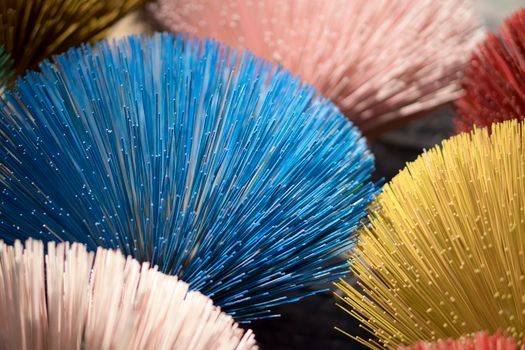
For process engineers the matching problem is two-dimensional. A common shortcut is the table below, which lines the six most common filament families against the four high-volume construction formats using the criteria most often surfaced in 2026 manufacturer datasheets: [S3]
1) Carbon steel — paired with twist-knot wheel, cup, and crimped wheel; cheap, aggressive, and acceptable only on ferrous parts where filament rust is tolerable [S1][S8].
2) Stainless steel (302/304) — paired with crimped wheel, strip, and cylinder; specified for food, pharma, and stainless workpieces where rust contamination is not acceptable [S2][S4][S9].
3) Brass / copper — paired with disc, strip, and small cylinder; used on plated, polished, and electronic surfaces where the brushing contact must stay softer than the substrate [S1][S2].
4) Nylon (PA 6/6.6) — paired with cylinder, strip, and staple-set disc; the most flexible food-grade and general-wash choice, with FDA-compliant options for direct food contact [S2][S4][S7].
5) Polypropylene — paired with strip and cylinder; chosen for chemical resistance on acid/alkali wash lines and bakery conveyor cleaning where lower softening temperature is acceptable [S1][S2].
End-Use Application Map and Industry Sectors
Food processing absorbs the largest single share of duty-specific SKUs. IBC publishes dedicated lines for bakery conveyor cleaning, egg cleaning, produce washing & waxing, drying brushes & rolls, and auger flight brushes, with most products specified in FDA-grade nylon or polypropylene filament [S2].
Surface preparation, weld cleaning and paint stripping are the second major bucket — WANDA's "Surface Preparation" and "Cleaning" application pages, and RK's heavy-duty wire wheel catalogue, both cover the same duty range and converge on twisted-knot or crimped carbon steel as the default [S1][S8].
Electronics is a smaller but higher-precision bucket — WANDA lists a dedicated "Electronics" line and IBC sells PCB brushes and wheels in conductive brass, copper and fine nylon for solder-side cleaning and surface conditioning [S1][S2].
Glass, window and solar-panel washing is yet another distinct bucket — Brushtec carries a dedicated "Glass Cleaning" product family and a related AlgaeEdge™ line for window and façade cleaning brushes [S6].
Agriculture, escalator, and road sweeping close the high-volume list — WANDA, Brushtec and Topeak all carry sweeper, cow, escalator and forklift main-broom / side-broom formats, with the Filament-vs-Construction match dominated by polypropylene, nylon and Union-fibre strip / coil constructions [S1][S6][S7].
For a broader context on how brush selection intersects with rotating-equipment selection on the same plant floor, the Industrial Brush Selection: Construction, Filament, and Duty Map reference and the Metal Stamping Part Types, Spec Bands and 2026 Industrial Use Map reference are useful cross-reads. On the food-line side, where brush hygiene and equipment-cleanliness standards converge, the O-Ring Seal Selection: Material, Pressure, Temperature, Gland reference covers the seal side of the same wash-down environment.
ISO 9001:2015 as the Common Quality Backbone

Multiple 2026 manufacturer pages now self-declare ISO 9001:2015 certification as the floor standard — IBC, Sealeze, Redtree, Topeak and RK all carry the marking in their public-facing site header or footer [S2][S7][S8][S9][S10]. ISO 9001:2015 is the quality-management-system standard, not a product standard, so the certificate does not by itself guarantee filament chemistry, tensile strength or trim tolerance — those are controlled in the manufacturer's internal inspection plan.
For food-contact applications the binding reference is typically FDA 21 CFR (for filaments) and USDA/FDA food-equipment construction standards (for the brush as a finished article). WANDA, IBC and Carolina all publish "Food" as a discrete market segment, and the filament chemistry is the spec line a buyer should pin in the PO, not the page-level certification badge [S1][S2][S4].
Failure Modes and Sizing Pitfalls
The three most common in-service failures across the 2026 manufacturer literature are: filament fatigue and breakage on cylinder rolls running outside their rated face-bar RPM, filament-set loss on staple-set discs run in the wrong rotation direction, and core / shaft deflection on long-span cylinder brushes where the cantilever load exceeds the shaft rigidity [S2][S4].
A fourth, less visible failure is chemical attack — nylon hydrolyses at sustained high temperature in the presence of steam or hot caustic; in those zones polypropylene or stainless wire is the safer pick, which is why IBC and Topeak both publish a separate chemical-resistant product group for those wash environments [S2][S7].
Sizing pitfalls are usually traceable to two root causes. First, undersizing the trim length for a deflection-style seal strip — strip brushes must be cut oversize by 10–20% relative to the seal gap and then "combed" so the working tips concentrate on the sealing line; the brush acts as a spring set, not as a wall [S3][S4]. Second, mismatching the brush face-bar peripheral speed to the filament class — a nylon abrasive-impregnated filament that is rated for, typically, 2,000–3,500 surface feet per minute will glaze and lose cut rate if the drive is oversized [S3].
Sourcing Channels and Custom OEM Builds

Most 2026 industrial-brush sourcing still runs through two channels: stock SKUs from regional manufacturers (IBC in the US, Carolina Brush in Gastonia NC, Tanis in Wisconsin, Sealeze, Redtree in California, Brushtec in the UK, WANDA and Topeak in China) and custom-built-to-print OEM brush assemblies for conveyor and OEM replacement programmes [S1][S2][S3][S4][S6][S7][S8][S9][S10].
Custom OEM is the larger dollar value of the two — Carolina Brush publishes an OEM replacement programme and lists "Custom Brushes" as a top-level menu, RK publishes its mission around "application-specific solutions", and IBC runs eight online quote forms covering cup strip, staple-set, in/out ring strip, spiral-wound coil, spiral-wound on core, split-core cylinder, straight strip and tufted cylinder [S2][S4][S8].
For machinery builders, brush-making equipment itself is a separate specification — Yangzhou Haixing (founded 1985) supplies CNC brush-making machines covering tufting, twisting, disc, strip and coiled brush formats, with model series HS40C, HM70E, RL250, VM70-25A, VM70-25B and VW70-15C visible in the 2026 product range [S5].
The reliable selection signals to watch over the next 6–12 months are: continued expansion of abrasive-impregnated nylon filament SKUs (Tanis CeramiX 3M-grain line being a current marker [S3]), more ISO 9001:2015 / FDA-21-CFR statements appearing on the public site headers of regional Chinese brush exporters [S1][S7], and ongoing customisation of cylinder and strip brush geometries for solar-panel and EV-battery conveyor cleaning lines, where glass-wash and dust-exclusion specifications are tightening. None of those signals is a forecast, only a trackable set of what is already in the 2026 manufacturer line-ups.
Component reference pages worth checking: industrial adhesive, industrial borescope, and industrial buzzer.