For capital manufacturing equipment, purchase price typically represents one-third to one-half of true total cost of ownership, depending on asset type, utilization intensity, and maintenance requirements [S2].
The model applies to standalone audible alarms, panel signal devices, and installed alarm systems, comparing direct expenditure with reliability, service life, operator training, integration, and operational continuity [S1][S4].
What the Industrial Buzzer TCO Model Must Capture
Total cost of ownership is the sum of direct and indirect costs over an asset’s complete lifecycle, from acquisition through disposal [S4]. For an industrial buzzer, that lifecycle can include engineering, hardware, software, wiring or network integration, commissioning, operator training, inspections, repairs, replacement parts, service calls, operating energy, system changes, and retirement [S1].
For capital manufacturing equipment, a rigorous TCO analysis accounts for installation and commissioning, ongoing maintenance and consumables, energy and utilities, operator training and labor, downtime risk, and end-of-life disposition in addition to sticker price [S2].
The core calculation is acquisition cost plus installation, training, annual operating cost multiplied by service years, annual maintenance multiplied by service years, annual downtime cost multiplied by service years, and disposal cost minus salvage value. For multi-year comparisons, costs should be discounted to present value using the organization’s cost of capital [S4].
Acquisition Price Is Only One Cost Line
Purchase price represents approximately one-third to one-half of true TCO for capital manufacturing equipment, depending on asset type, utilization intensity, and maintenance requirements [S2]. That range should not be transferred mechanically to every buzzer, but it demonstrates why a low quotation is an incomplete capital-equipment comparison.
S1 identifies hardware, software, and installation costs as acquisition costs for an industrial communication, public address, and alarm system [S1].
Low unit price can be offset by missing capabilities, restricted support, unsuitable construction, or poor system flexibility. The documented industrial-alarm TCO risk pattern includes sudden loss of support, failure to meet requirements, high maintenance expense, limited flexibility, and limited scalability [S1].
The comparison must therefore be normalized. Confirm that every proposal includes the same voltage, enclosure rating, sound-output requirement, mounting method, electrical interface, alert functions, documentation, and commissioning scope before ranking prices.
Installation, Operation, and Maintenance Drive the Next Costs
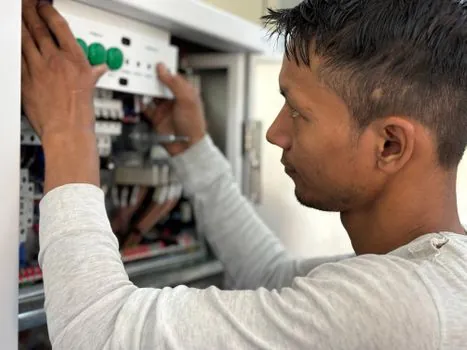
TCO includes installation costs over an asset's complete lifecycle [S4]. For an industrial buzzer, the relevant scope includes panel installation, field wiring, power distribution, control integration, acoustic setup, functional testing, and site acceptance records.
TCO includes training costs, and S1 identifies staff training as an operating cost for an industrial communication, public address, and alarm system [S1][S4]. For audible alarms, training cost covers alarm interpretation, response procedures, test routines, tag management, and maintenance isolation rather than equipment use alone.
TCO includes operating expenses, while S1 identifies energy consumption as an operating cost for an industrial communication, public address, and alarm system [S1][S4]. A conventional sounder may have little material consumption but still creates electrical load and inspection labor. Networked or programmable devices add configuration, cybersecurity, communications, and licensing considerations, while emergency or public-address architectures add broader system integration [S3].
TCO includes maintenance and repairs over an asset's complete lifecycle [S4]. Routine inspection, cleaning, gland checks, terminal checks, sound-level verification, battery or power-health checks, and replacement of aging components can be scheduled, while failures should be modeled separately as corrective work and production loss [S1][S2].
Options Compared by Cost, Service Life, and Disruption
A basic electromechanical buzzer has a lower acquisition cost and a simple interface, but its TCO depends on service life, replacement frequency, spare-part availability, and labor to reach mounted devices. A piezoelectric buzzer can provide efficient audible signaling, but comparison still requires the rated voltage, sound level, duty cycle, and operating-life evidence rather than technology labels alone [S4].
A networked signal device adds installation and configuration work but can improve remote status visibility, diagnostics, centralized testing, and maintenance over a larger site. The trade-off is additional engineering, software, security, integration, and upgrade effort [S3]. A modular signal tower or multi-stage alarm unit offers more functional coverage in one package, but its price and commissioning burden must be separated from the appliance itself.
Across these options, four criteria determine lifecycle cost: installed price, maintenance effort, expected service life, and the production consequence of failure. TCO includes downtime losses over an asset's complete lifecycle [S4]. A device that is inexpensive but stops audibly signaling an abnormal process may therefore cost more than a higher-priced unit with faster replacement.
No sound level, ingress-protection rating, electrical certification, temperature limit, or service-life figure should be inferred from this cost framework. Those are technical acceptance criteria and must be checked against the approved product data for each installation.
Who Should Use This Analysis, and When It Does Not Apply

The analysis is for reliability engineers, maintenance managers, controls engineers, procurement teams, and operations owners comparing audible alarms that have meaningful installation, inspection, or failure consequences [S4]. It is especially relevant where the HMI panel, control room, or machine interface uses audible notification as part of an operational or safety-related sequence.
It is not a substitute for hazard analysis, acoustic design, electrical safety review, or emergency-response validation. Total cost cannot justify an audible alarm that fails to meet the site’s required sound level, zoning, redundancy, enclosure, or certification criteria.
The method is also less decision-changing for a low-consequence, easily replaced laboratory signal device than for a distributed plant alarm. The justification threshold rises with wiring distance, restricted access, environmental exposure, required inspection frequency, and the production or safety cost of an unrecognized alarm condition.
Downtime, Adaptability, and Disposal Close the Lifecycle
Adaptability is an explicit TCO factor in industrial communication and alarm systems because expansion, integration, and modification require engineering and installation effort [S1]. A high-capacity industrial switch can also affect architecture and lifecycle economics, so network-related equipment should not be excluded from a wider alarm-system TCO boundary.
Disposal and decommissioning represent 1–5% of TCO in the general industrial framework and include removal, environmental remediation, and scrap or resale value [S4]. Industrial buzzer projects can also include obsolete controller compatibility, migration of configuration files, replacement of legacy relays or power components, and contractor removal.
Reliability and service life remain separate decision inputs rather than monetized percentages. They should be translated into expected repair frequency, replacement intervals, support duration, spare-part lead time, and the consequence of an alarm being inoperative during the analysis period [S1].
Building the Procurement and Maintenance Budget

Request a five-year or service-life TCO quotation for each credible industrial buzzer option, with one common cost structure covering acquisition, freight, installation, commissioning, training, annual energy, planned maintenance, spares, service calls, downtime, adaptation, and disposal [S1][S4].
Track three signals after award: installed cost per protected point, maintenance hours and service calls per year, and confirmed downtime caused by alarm-system failures. Record support availability, spare-part lead time, configuration retention, and retrofit compatibility at each review.
The first procurement checkpoint should verify whether the proposed industrial relay interface, power arrangement, and alarm architecture preserve the planned service life. The second should reconcile actual maintenance and downtime against the model. The third should test whether expansion or modernization requires replacement rather than configuration work.
A disciplined industrial display pairing should be evaluated in the same model, since audible and visual notification can share installation, integration, testing, and maintenance resources, allowing the comparison to reflect the complete notification system rather than isolated component prices.