
Selection hinges on three decisions: cooling capacity in kW (or refrigeration tons), compressor topology (scroll vs screw vs centrifugal), and heat-rejection path (air-cooled vs water-cooled) — each fixing the unit's footprint, COP, and maintenance envelope before vendor pricing is even read.
The 2026-07-19 sourcing feed from Made-in-China.com and OEM catalogs lists scroll air-cooled units priced US$1,000-6,000/set (1-piece MOQ, 380V/415V 3-phase 50/60 Hz), mid-range modular air-cooled water chillers at US$5,800-13,000, NDT screw type air-cooled chillers at US$9,000-45,000, and explosion-proof / low-temperature specialty builds above that band [S5][S6][S9]. The price spread of roughly 6-8x across the same compressor family is the first spec an engineer should interrogate.
Cooling Capacity Bands and Compressor Topology
Air-cooled scroll compressors dominate the 1-60 kW band used on laser cutters, small injection mold temperature controllers, and PCB plating baths; 380V/50Hz and 415V/60Hz dual-rated scroll units at US$1,000-6,000/set are the entry point [S5][S9]. Screw compressors take over from roughly 60 kW to 1,200 kW and are offered in both air-cooled and water-cooled frames, with NDT-classified screw air-cooled units priced US$9,000-45,000 [S5]. Centrifugal and magnetic-bearing oil-free units address the >1,500 kW central-plant range, typically water-cooled and paired with plate-and-frame or shell-and-tube heat exchangers [S3].
For high-pressure, oil-free, or pharma-grade circuits, a 35-year industrial heat-exchanger specialist recommends shell-and-tube (TI series) for high-temperature/pressure duties, plate-and-frame (MULTISECTION) for HVAC and refrigeration close-temperature approaches, and shell-and-coil for compact skid builds [S3]. Cooling capacity is rarely the binding constraint — the binding constraints are leaving-fluid temperature, approach temperature across the exchanger, and ambient at the condenser inlet.
Air-Cooled vs Water-Cooled: Site Constraints Decide
Air-cooled industrial chillers (modular, scroll, EVI scroll, and air-cooled screw) are the right pick when the plant has no cooling-water loop, limited outdoor footprint for a cooling tower, or seasonal low ambient above ~-5 °C; made-in-China catalog entries for modular air-cooled water chillers sit at US$5,800-13,000 with CE certification [S6]. Water-cooled screw and centrifugal chillers (water-cooled screw chiller, water-cooled central chiller, water-cooled glycol chiller, water-cooled inverter chiller) target facilities with an existing cooling-tower or chilled-water primary loop and typically run 15-30% more efficiently at full load because condenser water holds below 35 °C even in 35 °C ambient [S10].
If the duty is process cooling in a clean indoor room, the OEM portfolio from Hero-Tech Refrigeration lists water chillers, screw chillers, low-temperature chillers, oil chillers, laser chillers, and PCB/electroplating-specific builds, all backed by 1997-vintage manufacturing experience [S7]. TongWei's catalog adds explosion-proof and oil-chiller lines, glycol scroll/screw variants down to -30 °C, and combined heating-and-cooling units for mold temperature control [S4]. Both vendors carry portable and stationary frames, useful when the chiller rides between cells.
Specialty Variants: Glycol, Explosion-Proof, Laser, and Oil
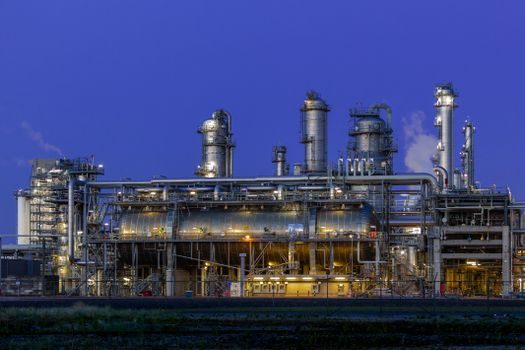
Glycol chillers (water-cooled glycol, air-cooled glycol scroll/screw, portable glycol) are specified when the leaving-fluid temperature must hold below 0 °C — typical duties include dairy, brewery, and chemical reactors where propylene or ethylene glycol mixtures at 30-50% concentration depress the freeze point to -10 °C down to -35 °C [S4][S10]. Explosion-proof chillers are required in ATEX-classified zones around solvent, paint, or petrochemical process lines; the compressor, motors, and control panel move to flameproof enclosures and the refrigerant selection is restricted to lower-GWP A1 classes. Laser chillers, listed by both TongWei and Hero-Tech, run a tight ±0.5 °C leaving-water tolerance to stabilize fiber-laser resonator output [S4][S7].
Oil chillers, heating-and-cooling units, and mold temperature controllers round out the specialty tier and typically share the same compressor skid as the water-chiller line, with the refrigerant circuit trimmed for higher leaving temperatures (60-180 °C) [S4]. When the upstream circuit is an industrial process heater loop — for example a flanged immersion heater on a plating bath — the chiller downstream acts as the trim cooler; this pairing is one of the most common mistakes in cell-level cooling design because the heater is sized for bring-up while the chiller is sized for steady-state loss, and the two seldom match without an explicit trim valve [S8].
Refrigerant, Compliance, and the 2026 Spec Map
Most 2026-vintage China-built scroll and screw chillers in the Made-in-China catalog are quoted on R-410A, R-134a, R-407C, with EVI (enhanced vapor injection) scroll units moving to R-410A or R-32 for higher COP at low ambient [S5][S9]. Units destined for the EU market show CE marking; pharma/food builds add 3-A or EHEDG on the process side, while petrochemical builds add ATEX category 2/3 on the electrical panel.
Engineers comparing a scroll chiller quote of US$1,000-6,000 against a screw quote of US$9,000-45,000 should not stop at the headline price: full-load COP, IPLV/NPLV, leaving-water tolerance, sound pressure (dB(A) at 1 m), and refrigerant GWP are the four numbers that separate a 5-year payback from a 10-year payback. A useful cross-reference for the plate-and-frame side of the loop is the heat exchanger selection guide, which lines shell-and-tube against plate-and-frame against shell-and-coil against the same duty.
Common Failure Modes and What to Spec Against Them
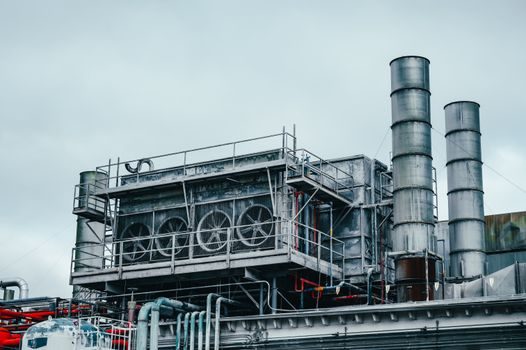
Three failure modes account for most field service calls on industrial chillers: condenser fouling (air-cooled coils clogged with dust or water-cooled tubes scaled with CaCO3), evaporator freeze-up on glycol units when the leaving-water temperature setpoint drifts below the glycol freeze point, and compressor short-cycling on undersized buffer tanks. The fix in each case is upstream of the chiller: a 2-3 minute buffer tank on the process loop, periodic coil cleaning intervals in the maintenance plan, and a leaving-temperature sensor strapped to the evaporator outlet with a freeze-stat interlock. [S1]
For the upstream strainer and trim on the water loop, the basket strainer selection guide and the pressure relief valve sizing article lay out the spec axes engineers should lock before the chiller is ordered. Downstream, the chiller's leaving-water branch typically feeds either a mold temperature controller or a process bath, and the chiller's control panel should be specified to accept a 4-20 mA or 0-10 V setpoint signal from the downstream PLC — a feature not all economy scroll units support, and a common retrofit driver.
Shortlist Logic: Three Builds That Cover Most Plants
For a small machine shop (CNC + small laser, 5-30 kW total process loss): an air-cooled EVI scroll chiller, 380V/50Hz, R-410A, integrated buffer tank and circulation pump, CE marked — landed roughly US$3,000-6,000 per the Made-in-China catalog [S5][S9]. For a mid-size injection-molding or extrusion hall (50-300 kW): a water-cooled screw chiller on a shared cooling-tower loop, with a plate-and-frame evaporator and leaving-water controlled at 7-12 °C — US$15,000-45,000 band [S5][S10]. For a chemical or paint process with flammable vapors: an explosion-proof screw or scroll chiller, ATEX category 2 zone 1 panel, R-134a or R-32 refrigerant, paired with a shell-and-tube or plate-and-frame heat exchanger sized by HEXONIC's duty-match logic [S3].
Trackable signals into 2026-Q3 include revised GB/T 18430.1 and ASHRAE 90.1 energy-ratio thresholds, the EU F-Gas phase-down steps that keep pushing screw units toward lower-GWP refrigerants, and continued rollouts of inverter-driven screw chillers that the AgsChiller catalog lists at competitive lead times [S10]. Engineers should re-validate leaving-water temperature, ambient derate, and refrigerant GWP against the actual quote before signing a PO; the rest of the spec — capacity, compressor, heat-rejection path — is set by the duty, not the vendor.
Spec-level background on the components involved: linear guide, and crossed roller guide.