
An industrial coating system delivers its rated service life only when substrate condition, ambient climate, application method, and cure schedule all sit inside the manufacturer's published window — the Prosyneffex industrial handbook fixes substrate+air ≥ 4 °C/40 °F and substrate ≥ 3 °C/5 °F above dew point as the non-negotiable floor for the entire installation cycle [S3].
Substrate Soundness and Bond-Inhibiting Contaminants
The substrate must be "structurally sound, cured and free of bond inhibiting contaminates" before any primer or topcoat touches the surface [S3].
For steel, the practical floor is SSPC-SP6/NACE No. 3 commercial blast (or SP10 near-white for immersion) with a measured profile of 50–100 µm (2–4 mil) to give the primer mechanical tooth. Oil, grease, and soluble salts are pulled first with detergent wash and fresh-water rinse, then tested: SSPC-SP2/SP3 hand-tool prep is acceptable only in non-immersion, dry-service atmospheric zones. Skipping decontamination is the single most common reason a coating system passes a holiday (pinhole) test on day one and blisters at the first thermal cycle [S3].
Ambient Climate Windows and Dew-Point Discipline
During installation and the initial cure cycle, substrate and ambient air temperature must hold at a minimum of 4 °C/40 °F, and substrate temperature must stay at least 3 °C/5 °F above the dew point [S3]. The dew-point margin is the more critical of the two for corrosion under-film (CUF) prevention: a 3 °C buffer collapses to zero the moment a warm afternoon hits a cold steel plate, and invisible condensation forms beneath the still-tacky primer.
Field practice is to log substrate temp, air temp, ambient RH, and calculated dew point at the start of every shift and whenever weather changes. Application is suspended if any of the four drifts out of window — no "pushing through" to hit a schedule. Ventilation has to be adequate for solvent vapour control and to keep the air temperature moving in the right band, and proper clothing/respiratory PPE is mandatory for applicators in confined or solvent-heavy environments [S3].
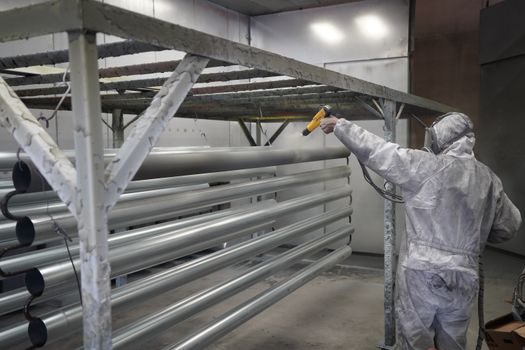
Application Methods: Spray, Roll, Brush — and Where Each Fails

Roll and brush are reserved for stripe coats on edges/welds, touch-up, and small geometric repairs where spray rebound would waste 30%+ of the product. [S3]
For a reference spec walkthrough on related factory-floor surface prep, the resin sand molding line installation guide covers the same substrate-cure discipline applied to mould equipment, and scaffolding installation system types covers the access side of any elevated coating campaign.
Thickness Control and Wet-to-Dry Film Math
Thickness must hit the spec, not exceed it. A wet film thickness (WFT) gauge gives an immediate check: WFT × %volume solids = dry film thickness (DFT). The Prosyneffex industrial handbook's full application data sits in the industrial coating encyclopedia entry as a working reference. [S3]
DFT is then verified with a calibrated coating thickness gauge on a statistically valid frequency — for field tanks and structural steel, five readings per 10 m² is a workable starting density, increased on critical immersion zones. A waterproof coating layer on the secondary containment side carries its own DFT table and must not be confused with the primary corrosion-resistant system.
Underwater, Submerged, and Confined-Space Boundaries

Synavax™ coatings are not meant to be used in an underwater or submerged environment, and the same caveat applies to many aerogel-loaded and high-solids polymer systems outside their tested envelope [S3]. Submerged service demands a different qualified system (typically a glass-flake epoxy or a vinyl ester at 1,000–2,000 µm DFT, applied in plural-component spray with induction-time-controlled mixing) — substituting a non-submerged product because the data sheet "looks similar" is an installation error, not a savings.
Confined-space installation adds OSHA/permit-required confined-space rules, continuous gas monitoring (LEL, O₂, H₂S), and supplied-air respirators; the Prosyneffex handbook treats adequate ventilation as a hard installation input, not a recommendation [S3].
Cure Schedule, Re-Coat Windows, and Holiday Detection
Every coating maker publishes a minimum re-coat window (often 4–24 h at 21 °C) and a maximum re-coat window (sometimes 7–30 days) — going past the maximum without re-abrasion is a documented cause of delamination between coats. The industrial handbook fixes the initial cure cycle inside the same 4 °C substrate minimum and the same dew-point discipline as the application pass [S3].
Any reading off-spec is re-prepped and re-applied — there is no "average thickness passes" shortcut in a QA-acceptance package.
Decision Matrix: Common Coating Families vs Installation Risk
Three families dominate industrial spec work, and the install window shifts with each. High-solids epoxy: easiest to spray, most forgiving on substrate RH, but longest full-cure (5–7 days) and strict re-coat window. Polyurethane topcoat: fast touch-dry, UV-stable, but extremely sensitive to moisture during cure (isocyanate + H₂O → CO₂ bubbles). [S3]
Selection rule for the field engineer: match the coating family's weakest install parameter against the worst-expected site condition (humid monsoon, cold morning, dust from blasting nearby), and pick the system where the spec margin is still positive. A useful cross-check sits in the industrial adhesive reference, which uses the same substrate-and-climate logic for bonded assembly.
Limitations, Common Failure Modes, and When to Replace vs Re-Repair
Field failures tracked back to installation cluster around five signatures. Blistering (osmotic or trapped-solvent) — root cause is uncured substrate moisture or off-ratio mixing; corrective action is full abrasive removal, re-prep, re-apply. Delamination between coats — root cause is missed re-coat window or surface contamination between passes; corrective action is abrasive sweep and re-coat, not a full strip. Rust creep from a holiday — root cause is missed pinhole or under-thickness; corrective action is local grind, prime, topcoat, then a re-test of the full zone. [S3]
Documentation (substrate prep log, climate log, WFT/DFT log, cure log, holiday test report, pull-off report) is the proof the install was inside window — and is the only credible defence when a failure investigation opens later.
Trackable signals for the next cycle: monitor NACE/SSPC surface-prep standard revisions for any change to the SP6/SP10 commercial/near-white blast profile, and watch coating-maker published re-coat windows for tightening on high-solid systems as VOC rules move. The Prosyneffex industrial handbook remains a current field reference as of 2025-09 [S3]; pair it with the project-specific product data sheet for any non-standard service condition.