
Industrial Ethernet switches and fieldbus gateways solve different problems on a plant LAN: the switch moves IP packets between controllers, I/O and HMIs at wire speed, while the fieldbus gateway translates non-IP cyclic process data (PROFIBUS, CANopen, Modbus RTU, DeviceNet) into TCP/IP frames a SCADA or protocol gateway tier can consume [S2][S6].
Spec the switch first when 100% of end devices already speak TCP/IP, PROFINET, EtherNet/IP or Modbus TCP; spec a gateway when a brownfield segment must stay on its native deterministic bus for cost or cycle-time reasons, and only the uplink has to ride on Ethernet [S6].
Definition and Functional Scope
An industrial Ethernet switch is a hardened Layer-2 (or Layer-3 managed) node, typically DIN-rail or 19" rackmount, with 5 to 16+ copper RJ45 ports, optional SFP fibre uplinks, optional PoE/PoE+ per IEEE 802.3af/at, fanless cooling, metal housing, IP40 protection and an operating window commonly quoted at -40 to +85 °C [S3].
A fieldbus gateway is a protocol translator: the Bürkert Type ME43, for example, is described as the central control unit for valve, sensor and mass-flow-controller products based on EDIP, and its basic variant is a fieldbus coupler that exposes the internal CANopen-based communication of those field devices to industrial Ethernet on the uplink side [S6]. The ME43 datasheet frames the gateway explicitly as a bridge between a vendor-specific CANopen sub-bus and a higher-level industrial-Ethernet master [S6].
Selection Criteria: When Each Wins
Use a managed industrial switch when the engineering constraint is port count, ring redundancy (MRP, ERPS, DT-Ring, Turbo Ring), PoE budget, EMI immunity, and VLAN/IGMP snooping for PROFINET or EtherNet/IP multicast filtering [S2].
Use a fieldbus gateway when the constraint is protocol conversion: a PROFIBUS-DP master that must feed a Modbus-TCP SCADA, a CANopen sub-bus that must be visible to a PROFINET controller, or a serial Modbus RTU cluster that must be polled over Ethernet. The ME43's published role is precisely to lift Bürkert EDIP/CANopen devices onto a higher-level fieldbus, not to switch IP traffic between peers [S6].
Power budget is a differentiator: PoE+ switches per IEEE 802.3at (delivering up to 30 W per port) are widely listed by industrial switch vendors, for example the Antaira LNP-0602 6-port industrial unmanaged PoE+ switch that supports IEEE 802.3at on its data ports [S7]. A fieldbus gateway generally does not source PoE; it draws 24 VDC and exposes converted process data, it does not power downstream IP cameras or wireless APs [S6].
Criteria-Based Comparison Matrix
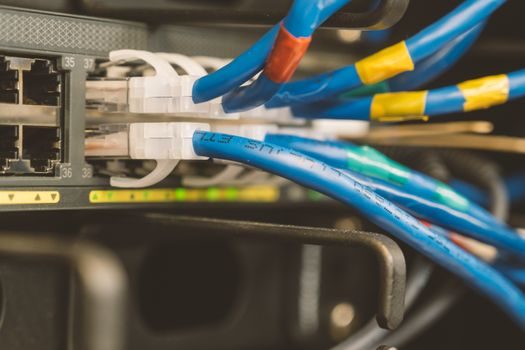
Decision matrix for the two device classes:
1. Primary function: switch = L2/L3 frame forwarding; gateway = fieldbus-to-Ethernet protocol translation [S2][S6].
2. Port count and media: switches expose 5/8/16 RJ45 + SFP fibre; gateways expose one or two fieldbus channels (e.g. CANopen, PROFIBUS, Modbus RTU) plus a single Ethernet uplink [S3][S6].
3. Environmental: industrial switches commonly rated -40 to +85 °C, IP40, fanless, 6 kV surge protection on data lines; fieldbus gateways are typically rated to the same industrial envelope but are not specified as PoE sources [S3][S6].
4. Integration effort: a switch is plug-and-play at the IP layer (plug & play advertised on entry-level industrial switches) [S3]; a gateway requires GSD/GSDML/EDS import, node address mapping and sometimes PLC function-block configuration to expose each cyclic word correctly [S6].
Who It Is For vs Who It Is Not
An industrial Ethernet switch is for system integrators building greenfield PROFINET, EtherNet/IP or Modbus-TCP cells where every device already has an RJ45 or SFP and runs TCP/IP natively; it is the wrong tool for a 32-node PROFIBUS-DP valve manifold that has no Ethernet on the device side [S2][S3].
A fieldbus gateway is for brownfield retrofit work and OEM machine builders who must keep an existing deterministic sub-bus (CANopen, PROFIBUS-PA, RS-485 Modbus) but want the data visible to a modern SCADA, protocol gateway or cloud broker [S6]. It is the wrong tool when the user actually needs more Ethernet ports on a working IP ring, or when the goal is to power a PoE camera, in which case an industrial PoE switch is the correct product.
Real Use Cases and Failure Modes
Rail-transit, power-substation and petrochemical tenders routinely list managed DIN-rail switches with ring redundancy and 6 kV surge protection on every copper port as a hard requirement [S2][S4]. A fieldbus gateway would be sub-specified for that role; conversely, specifying a switch to translate PROFIBUS-DP into PROFINET is impossible because a managed switch has no PROFIBUS physical layer and no PROFIBUS-DP slave/master state machine [S6].
Common failure modes: an unmanaged switch in a multicast-heavy EtherNet/IP ring will drop implicit (multicast) I/O messages because IGMP snooping is not enabled or not supported; a fieldbus gateway will appear to "lock up" if the cyclic PROFIBUS watchdog is mis-set, because PROFIBUS slaves expect a deterministic master token and the gateway cannot fake it from the Ethernet side alone [S6][S7]. Specifying the wrong class of device is therefore not a billing error, it is a commissioning error that surfaces only at first power-up.
Sourcing, Standards and Procurement Signals
Both device classes are sourced predominantly from China-based vendors offering managed rackmount, managed DIN-rail, unmanaged rackmount, unmanaged DIN-rail and PoE variants of the switch, and dedicated Modbus gateways and serial-port servers in the gateway tier [S2][S3][S5]. Buyers should still require an IEC 60079-series hazardous-area rating only if the device is actually mounted in a Zone 1/2 enclosure; a sub-station DIN-rail switch has different substation-hardening requirements than a fieldbus gateway mounted inside a non-Ex control cabinet.
Trackable signals for the next procurement cycle: (a) the rising number of SKUs that combine PoE+ with multi-gigabit uplinks (2.5G/10G SFP) on DIN-rail form factors, and (b) gateway vendors adding OPC UA Pub/Sub over the Ethernet uplink, which lets a CANopen or PROFIBUS segment publish directly to a broker without a separate protocol gateway in the middle [S2][S6]. For adjacent cell-level decision logic, see this spec map for SCADA software selection criteria in 2026 and this comparison of HMI touch panel vs industrial display for 2026 builds.