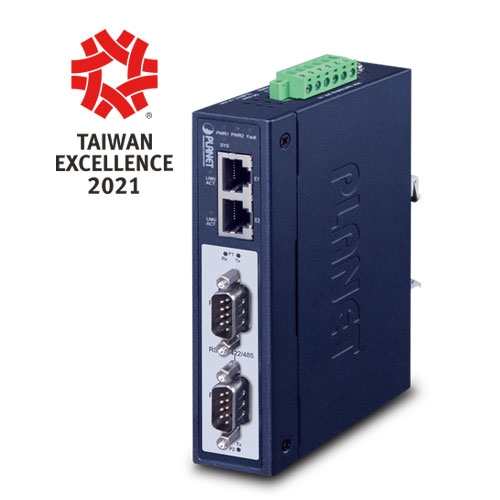
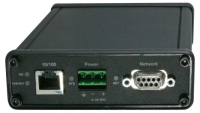
A fieldbus gateway is an industrial networking device that connects two automation networks speaking different protocols, for example PROFIBUS DP and EtherNet/IP, by terminating one protocol fully, holding the process data in an internal memory map, and re-encoding it on the other network. Unlike a repeater or a router, which only extend or forward traffic within a single protocol, a gateway performs protocol conversion up to the application layer, which is why it is also called a protocol converter.
Gateways exist because no single fieldbus ever won. Decades of PROFIBUS, DeviceNet, Modbus, CC-Link, and the later wave of real-time Ethernet, PROFINET, EtherNet/IP, and EtherCAT, left every brownfield plant with islands of incompatible equipment. The gateway is the pragmatic bridge that lets a new PLC talk to a legacy drive without rewiring the machine, and it is increasingly the on-ramp that lifts shop-floor data into OPC UA, MQTT, and the cloud.
Photo: Xqt, CC BY-SA 4.0, via Wikimedia Commons
This guide is written for industrial purchasing engineers and design engineers. It covers six chapters, from what a gateway is and where it sits in the network stack, through protocol families, conversion architectures, isolation and environmental construction, the spec-sheet numbers that actually drive selection, to a step-by-step decision sequence, plus seven selection FAQs and verified manufacturer comparisons. All parameters reference the IEC 61158 and IEC 61784 fieldbus standards, the IEC 61784-3 functional safety profiles, and the IEC 61000 electromagnetic compatibility series, cross-checked against published manufacturer datasheets.
Chapter 1 / 06
What is a Fieldbus Gateway
A fieldbus gateway is a networking device that interconnects two industrial communication networks that do not share a common protocol. It does this by acting as a native participant on each side at the same time: on one network it presents itself as a valid node of that protocol, on the other network it presents itself as a valid node of a second, unrelated protocol. Between the two it maintains an internal process data image, a block of input and output bytes that both sides read and write. The gateway is, in effect, a translator that speaks two industrial languages fluently and copies meaning from one to the other through a shared notebook.
To place the gateway correctly, it helps to compare it against the other devices on a control network by the OSI layer at which they operate. A repeater works at the physical layer and only regenerates the electrical or optical signal to extend distance; it understands nothing about the data. A bridge or industrial Ethernet switch works at the data link layer and forwards frames by hardware address within one protocol. An industrial router works at the network layer and forwards IP packets between subnets that already share a protocol such as Modbus TCP. A gateway alone reaches up to the application layer, where it can reinterpret the actual process payload and reissue it under a different protocol. This is the defining capability: a gateway is the only device that can connect networks that share nothing below the application data.
The industrial need for gateways is a direct consequence of history. In the 1980s and 1990s, dozens of fieldbuses competed: PROFIBUS in Europe, DeviceNet and ControlNet in North America, CC-Link in Japan, Modbus everywhere as a lowest common denominator, plus Interbus, CANopen, AS-Interface, and others. The IEC 61158 standard, rather than crowning one winner, codified many of them as numbered protocol types, and IEC 61784 grouped them into Communication Profile Families. When real-time Ethernet arrived after 2000, with PROFINET, EtherNet/IP, EtherCAT, and POWERLINK, it added new networks on top of, not in place of, the installed base. The result is a permanent multilingual landscape, and the gateway is the device that makes it workable.
The economic case for a gateway is usually avoidance of replacement. A plant that has standardized on Rockwell PLCs may acquire a machine built around a PROFIBUS network of drives. Rewiring or replacing those drives is expensive and risky; a PROFIBUS-master to EtherNet/IP-adapter gateway lets the existing machine, including its servo drives and variable frequency drives, join the corporate EtherNet/IP backbone with a single DIN-rail device and a few hours of byte mapping. The same logic drives the modern wave of OPC UA and MQTT edge gateways, which leave the control network untouched while exposing its data upward to MES and cloud systems. In both cases the gateway preserves working capital invested in equipment that would otherwise be stranded.
Four engineering properties determine whether a gateway is fit for a given duty: the protocol roles it can take on each side, the cyclic I/O data capacity it can transfer, the determinism and added latency it introduces, and its electrical and environmental robustness, including isolation and temperature range. The remaining chapters develop each of these in turn, because, as with most field instruments, the wrong choice rarely fails immediately; it fails subtly under load, temperature, or a protocol feature the gateway silently never supported.
Chapter 2 / 06
Protocol Families and Network Pairs
Selecting a gateway begins with naming the two networks precisely, because the protocol on each side, and the role the gateway must play in it, fixes most of the rest of the specification. The IEC 61784 standard organizes the major industrial protocols into Communication Profile Families (CPF), each built on numbered types from the IEC 61158 series. The table below summarizes the families a gateway buyer most often encounters, their physical layer, and indicative performance, so that two sides can be compared on equal terms.
Protocol
IEC 61784 family
Physical layer
Typical speed / cycle
PROFIBUS DP
CPF 3
RS-485, twisted pair
9.6 kbit/s to 12 Mbit/s
PROFINET RT / IRT
CPF 3
100 Mbit/s Ethernet
RT to 250 us, IRT to 31.25 us
EtherNet/IP
CPF 2
100 Mbit/s Ethernet
RPI typically 1 to 10 ms
DeviceNet
CPF 2
CAN, twisted pair
125 / 250 / 500 kbit/s
EtherCAT
CPF 12
100 Mbit/s Ethernet
cycle often below 100 us
CC-Link IE
CPF 8
Gigabit Ethernet
deterministic, sub-ms
Modbus RTU
Type 15
RS-232 / RS-485
9.6 to 115.2 kbit/s
Modbus TCP
Type 15
100 Mbit/s Ethernet
request / response, ms
The second and equally important axis is the role the gateway plays in each protocol. Every fieldbus has a controlling node, variously called master, scanner, controller, or client, and one or more subordinate nodes, called slave, adapter, device, or server, such as a remote I/O module. A gateway must be ordered with the correct role on each side. A unit that is a PROFIBUS master and an EtherNet/IP adapter behaves very differently from one that is a PROFIBUS slave and an EtherNet/IP scanner, even though both bridge the same two protocols. Choosing the wrong role is the single most common ordering error, and it cannot be reconfigured in software on most fixed gateways.
The breadth of role and protocol combinations is what gives a product line like the HMS Anybus X-gateway its catalog depth. The master versions support networks such as PROFIBUS, DeviceNet, and EtherNet/IP, while the slave versions support a long list including CANopen, CC-Link, ControlNet, EtherCAT, EtherNet/IP, Modbus RTU, Modbus TCP, PROFIBUS, and PROFINET IO. The integrator picks the pair of network interfaces that matches the two machines being joined, which is why these families are sold as dozens of distinct part numbers rather than one universal box.
Serial-to-Ethernet gateways are a large and distinct sub-class. Modbus is the dominant legacy serial protocol, and a great many gateways exist purely to lift Modbus RTU or ASCII off an RS-485 multidrop and present it as Modbus TCP, EtherNet/IP, or PROFINET. The Moxa MGate 5103, for example, converts among Modbus RTU/ASCII/TCP, EtherNet/IP, and PROFINET IO on a single platform. These devices are valued for breadth of supported serial framings and for tolerance of the imperfect, long, electrically noisy RS-485 runs typical of brownfield sites; where the requirement is only to tunnel raw serial data over Ethernet without protocol conversion, a simpler serial device server is the alternative.
OPC UA and MQTT edge gateways sit at the top of the stack and serve a different purpose. Rather than bridging two control networks horizontally, they pull controller data vertically upward. Products such as the Softing dataFEED uaGate read Modbus, Siemens S7, or EtherNet/IP controllers and expose the data through an integrated OPC UA server or an MQTT publisher, with TLS security, for consumption by MES, SCADA, ERP, and cloud platforms including Azure and AWS. These gateways add a semantic data model and security that flat byte-copy gateways do not provide, but they are not designed to live inside a hard real-time control loop.
Chapter 3 / 06
Conversion Architectures and Data Modes
Once the two protocols are fixed, the next question is how the gateway moves data between them. There are three broad architectures, and they differ sharply in what they can carry, how deterministic they are, and how much engineering they demand. Understanding which architecture a candidate gateway uses prevents the classic disappointment of buying a device that copies process values perfectly but silently drops the diagnostics or alarms the project actually needed.
Architecture
Data carried
Determinism
Typical use
Shared I/O image
Cyclic process data only
High
Control-to-control bridging
Object / tag mapping
Cyclic plus selected acyclic
Medium
Modbus and serial conversion
Semantic / model based
Tags, alarms, metadata
Low (best effort)
OPC UA and MQTT edge
The shared I/O image architecture is the workhorse of control-to-control gateways. The gateway maintains two memory blocks, an input image and an output image, and the byte content is copied flat between the two networks with no interpretation of engineering meaning. On the first network the upstream controller writes the output image cyclically; on the second network a controller reads the same bytes as native input data. Because the operation is a simple memory copy, it is fast and deterministic, and capacity is quoted directly in bytes. The Anybus X-gateway transfers up to 512 bytes in each direction, and the MGate 5103 likewise exposes 512 bytes of input and 512 bytes of output data, the practical ceiling for most cyclic applications.
The limitation of the flat image is precisely that it carries only cyclic process data. Acyclic services, the alarms, the diagnostic records, the parameter read and write requests that ride alongside cyclic data on PROFINET or EtherNet/IP, are not copied unless the specific gateway model adds explicit support. Engineers who assume a gateway is a transparent pipe are frequently caught when a device-level fault that would appear on the native network never propagates across the gateway. The remedy is to confirm, line by line on the datasheet, whether the diagnostics you care about are mapped.
The object and tag mapping architecture is common in Modbus and serial gateways. Here the integrator explicitly builds a table that maps, for example, Modbus holding registers to EtherNet/IP assembly instances or PROFINET input modules. The MGate 5103 supports up to 128 Modbus commands and can act as Modbus TCP client to as many as 16 servers, with mapping defined in the configuration tool. This architecture is more flexible than a flat image because the integrator decides exactly which registers map where, but it shifts the burden of correct addressing onto the commissioning engineer, and an off-by-one register map is a frequent commissioning fault.
The semantic, model-based architecture belongs to OPC UA and MQTT edge gateways. These devices do not merely copy bytes; they build an information model in which data points carry names, data types, units, and timestamps, and they publish that model securely. This is the only architecture that natively carries metadata and alarms upward to IT systems, and it is the foundation of Industry 4.0 vertical integration. Its cost is determinism: the publish-subscribe and request-response patterns of OPC UA and MQTT are best-effort with respect to timing, which is why these gateways belong above the control loop, not inside it.
A final architectural concept that every gateway buyer should understand is the black channel, defined in IEC 61784-3 for functional safety. Safety protocols such as PROFIsafe, CIP Safety, and FSoE wrap their safety payload in a container protected by a running sequence number, a timestamp, a unique connection identifier, and a CRC. A standard, non-safety gateway can carry that container transparently as opaque bytes, because the two safety endpoints, not the gateway, detect any corruption, delay, or loss. This is what allows safety-rated I/O, and the function it ultimately drives such as a hardwired safety relay circuit, to pass through ordinary gateways, provided the gateway forwards the container unaltered and adds no transformation of its own.
Chapter 4 / 06
Isolation, Environment, and Standards
A gateway lives at the boundary between two networks, which is exactly where electrical trouble accumulates. Two machines joined by a gateway frequently have separate power feeds and separate ground references, and that potential difference, plus switching transients from motors and drives, makes the gateway port a natural collection point for ground loops and surges. The most important construction features of an industrial gateway are therefore galvanic isolation, surge and EMC immunity, and an environmental envelope suited to the cabinet it will live in.
Galvanic isolation electrically separates the two network ports, and often the power input as well, so that no DC ground current flows through the gateway between networks. The Anybus X-gateway specifies galvanic isolation on both the bus and Ethernet sides. The Moxa MGate 5103 quotes 1.5 kV magnetic isolation built into its Ethernet ports and 2 kV isolation on its serial port. These figures matter because, without them, a few volts of ground offset between two machine frames can drive enough current through signal commons to corrupt data or destroy transceivers. Isolation is also what permits a single gateway to safely span an OT cell boundary.
Electromagnetic compatibility is governed by the IEC 61000 immunity series. The relevant tests for a panel gateway are electrostatic discharge under IEC 61000-4-2, radiated and conducted RF immunity under IEC 61000-4-3 and 4-6, electrical fast transient burst under IEC 61000-4-4, and surge under IEC 61000-4-5. A gateway installed near variable frequency drives, contactors, and welding equipment must survive this electrical environment; the EU CE mark and the EMC directive require manufacturers to declare conformance, but the buyer should still match the device immunity class to the severity of the installation.
The table below summarizes the environmental and electrical envelope of two representative DIN-rail gateways, drawn from their published datasheets, so that the kind of numbers a buyer should request can be seen side by side. These values are model specific and must always be confirmed against the exact part number being quoted.
Parameter
Anybus X-gateway
Moxa MGate 5103
Supply voltage
24 VDC
12 to 48 VDC
Power / current
150 mA typ, 300 mA max
455 mA at 12 VDC
Operating temperature
-25 to +65 C
0 to +60 C
Storage temperature
per datasheet
-40 to +85 C
Ingress protection
IP20
IP30
Mounting
DIN rail
DIN rail / panel
Isolation
Bus and Ethernet
1.5 kV Eth, 2 kV serial
Beyond electrical robustness, the gateway must be a conformant, certified node on each protocol, and this is administered not by IEC but by the protocol owner organizations. PROFIBUS and PROFINET conformance is certified by PI (PROFIBUS and PROFINET International), EtherNet/IP and DeviceNet by ODVA, and EtherCAT by the EtherCAT Technology Group. Certification produces the device description file, a GSD file for PROFIBUS and PROFINET, an EDS file for EtherNet/IP and DeviceNet, or an ESI file for EtherCAT, that the upstream engineering tool imports to recognize the gateway. A gateway without the correct, current device file will not integrate cleanly, regardless of how good its hardware is, so the buyer should confirm that the file exists and matches the firmware version shipped.
Chapter 5 / 06
Key Specification Parameters
Gateway datasheets list many lines, but only a handful drive the selection decision. The seven parameters below decode what a buyer must verify before committing to a part number. Each is explained with the reasoning behind it, because the failure modes of an undersized or mis-specified gateway are usually invisible until the machine is running under full load.
Protocol pair and role. The first and most consequential specification is which two protocols the gateway bridges and which role it takes on each. A gateway is ordered as a fixed combination, for example PROFIBUS master to EtherNet/IP adapter, and on most hardware this cannot be changed later. Confirm the exact protocol names, including variant, PROFINET RT versus IRT, EtherNet/IP adapter versus scanner, and Modbus RTU versus TCP, and confirm the master or slave role on each side against the two existing controllers.
Cyclic I/O data size. This is the number of input and output bytes the gateway can transfer cyclically, and it sets a hard ceiling on how much process data crosses the boundary. Industrial gateways such as the Anybus X-gateway and the MGate 5103 commonly provide 512 bytes in each direction. Count the actual bytes of the data you need to move, including any spare for future expansion, and confirm the figure is per direction, not a shared total, since some datasheets quote the sum.
Update rate and added latency. The end-to-end determinism of a bridged path is bounded by the slower of the two networks plus the gateway internal copy time. PROFIBUS DP at 12 Mbit/s runs roughly 1 to 10 ms cycles depending on node count, PROFINET RT can be configured down to about 250 microseconds, and PROFINET IRT to about 31.25 microseconds, but the gateway itself adds a few milliseconds of buffer-copy latency. For a control loop that must close across the gateway, sum the worst-case cycle of each network and the gateway latency; never assume the speed of the faster side.
Acyclic and diagnostic support. Verify explicitly whether the gateway carries acyclic services, parameter records, alarms, and device diagnostics, or only cyclic process data. Flat I/O-image gateways carry cyclic data only by default. If your upstream controller must see a slave-level fault, confirm that the specific model maps diagnostics across, because the absence of this mapping is a common and expensive surprise during commissioning.
Isolation and electrical immunity. Confirm galvanic isolation on each network port and, where relevant, on the power input, with figures such as 1.5 kV on Ethernet and 2 kV on serial. Confirm EMC immunity classes under the IEC 61000-4 series, especially surge under 61000-4-5 and fast transient burst under 61000-4-4, matched to the noise severity of the installation. A gateway placed next to drives without adequate immunity will log intermittent communication faults that are very hard to diagnose later.
Power, temperature, and ingress. Confirm the supply voltage range (commonly 24 VDC, or 12 to 48 VDC for wide-input models), the current draw for sizing the cabinet supply, the operating temperature range against the worst case inside the enclosure, and the IP rating, typically IP20 or IP30 for inside-cabinet units. For unconditioned or outdoor cabinets, select a wide-temperature variant rated to -40 to +75 degrees Celsius and check storage temperature against shipping conditions.
Configuration tool: confirm a free, supported configuration utility exists, such as Anybus Configuration Manager or the MGate web and Windows tools, and that it runs on a current operating system.
Device file: confirm the current GSD, EDS, or ESI file matches the shipped firmware and imports cleanly into your engineering software.
Certification: confirm protocol conformance from PI, ODVA, or the EtherCAT Technology Group, and any required hazardous-area or marine approvals.
Redundancy and security: for critical or IT-facing links, confirm media redundancy support and, for edge gateways, TLS and certificate handling.
Chapter 6 / 06
Selection Decision Factors
To turn the preceding chapters into a specific part number, follow the ordered decision sequence below. Most selection mistakes are not single wrong values; they are decisions made at the wrong level, such as fixing a vendor before the protocol roles are even named. This sequence doubles as a clean RFQ template.
Name both networks exactly: identify each protocol including variant (PROFINET RT or IRT, EtherNet/IP, Modbus RTU or TCP, PROFIBUS DP, EtherCAT, CC-Link IE). Ambiguity here invalidates every later step.
Fix the gateway role on each side: decide master/scanner/controller/client versus slave/adapter/device/server for each network, matched to the two existing controllers. This is usually unchangeable after purchase.
Size the cyclic data: count the input and output bytes to be transferred, per direction, and confirm the gateway capacity (commonly 512 bytes each way) covers it with spare for expansion.
Decide the data architecture: flat I/O image for control-to-control cyclic data, tag mapping for Modbus and serial, or semantic OPC UA / MQTT for vertical IT integration. Confirm acyclic and diagnostic needs are met.
Set the timing budget: sum the worst-case cycle of each network plus the gateway copy latency, and verify the total against any control loop that closes across the gateway.
Specify electrical robustness: galvanic isolation per port, EMC immunity classes under IEC 61000-4, and surge protection matched to the installation severity.
Specify the environment: supply voltage and current, operating and storage temperature, IP rating, and mounting. Choose a wide-temperature variant for unconditioned cabinets.
Confirm certification and files: protocol conformance from PI, ODVA, or the EtherCAT Technology Group, current GSD/EDS/ESI files matching firmware, and any safety, hazardous-area, or marine approvals required.
One last dimension that is easy to overlook is serviceability and lifecycle support. A gateway is a single point through which two machines communicate, so its mean time to repair directly affects line availability. Confirm that the vendor maintains local spare-part inventory, that firmware updates are available and documented, that the configuration tool will run on operating systems you expect to have in five years, and that the device files are archived. Established suppliers such as HMS Networks (Anybus), Moxa, Hilscher, Phoenix Contact, ProSoft Technology, Advantech, and Softing maintain long product lifecycles and conformance support, which is why they remain the default choice for projects that must run for a decade or more. A gateway that saves a small sum at purchase but is discontinued without a migration path can strand an entire production line when it eventually fails.
FAQ
What is the difference between a fieldbus gateway, a router, and a repeater?
The three devices operate at different layers of the network stack. A repeater works at the physical layer: it regenerates and retimes the electrical signal to extend cable distance but does not interpret data and cannot bridge two different protocols. A router works at the network layer: it forwards IP packets between subnets that already share a common protocol, such as two Modbus TCP segments. A fieldbus gateway works up to the application layer: it terminates one protocol completely, extracts the process data into an internal memory map, then re-encodes that data into a second, unrelated protocol. Only a gateway can connect, for example, a PROFIBUS DP master to an EtherNet/IP scanner, because the two networks share nothing below the application data. A gateway is therefore the correct device whenever the two sides speak different industrial protocols, not merely different IP subnets.
How does a fieldbus gateway actually convert one protocol to another?
Most industrial gateways do not translate frame by frame. They use a shared internal input and output buffer, often called an I/O image or process data map. On the first network the gateway behaves as a native node, a slave, adapter, or device, and the upstream controller writes cyclic data into the gateway buffer. On the second network the gateway behaves as a master, scanner, or another slave, and it reads that same buffer and presents the bytes as native data of the second protocol. The mapping between the two buffers is byte-oriented and configured by the integrator, with no semantic interpretation of engineering units. Because the transfer is a flat memory copy, gateways move cyclic I/O data efficiently but do not, by default, translate acyclic services such as alarms, diagnostics, or parameter records unless the specific model explicitly supports them.
What is the maximum data a fieldbus gateway can transfer, and how fast?
Cyclic I/O capacity is the headline number. A typical industrial gateway such as the Anybus X-gateway moves up to 512 bytes of input and 512 bytes of output per direction, while serial-class Modbus gateways like the Moxa MGate 5103 also expose 512 bytes of input and output data with up to 128 Modbus commands. The achievable update rate is bounded by the slower of the two networks, not the gateway processor. PROFIBUS DP at 12 Mbit/s runs cycle times near 1 to 10 ms depending on node count, PROFINET RT can be configured down to about 250 microseconds, and PROFINET IRT reaches isochronous cycles near 31.25 microseconds. The gateway adds its own internal copy latency, typically a few milliseconds, so end-to-end determinism must be calculated across both networks plus the gateway, never assumed from the faster side alone.
Can a fieldbus gateway pass functional safety signals such as PROFIsafe or CIP Safety?
Yes, under the black channel principle defined in IEC 61784-3. Safety protocols such as PROFIsafe, CIP Safety, and FSoE (Functional Safety over EtherCAT) wrap the safety payload in a safety container protected by a sequence number, timestamp, unique connection ID, and CRC. A standard, non-safety gateway can transport this container transparently as opaque payload bytes, because the two safety endpoints, not the gateway, are responsible for detecting corruption, delay, or loss. The gateway itself does not need a safety certificate when it only forwards the container unaltered. However, a gateway that converts one safety protocol into another, for example FSoE to PROFIsafe, contains a certified safety module and must itself carry an IEC 61508 SIL rating. Always confirm whether your gateway is a transparent black channel or an active safety converter.
What supply voltage, temperature, and protection rating should I specify for a panel-mounted gateway?
Most DIN-rail industrial gateways accept a wide DC input. The Anybus X-gateway runs on 24 VDC at roughly 150 mA typical and 300 mA maximum, while the Moxa MGate 5103 accepts 12 to 48 VDC and draws about 455 mA at 12 VDC. Standard models are rated IP20 or IP30 for inside-cabinet use and rely on the enclosure for ingress protection. Operating temperature for standard units is commonly around -25 to +65 degrees Celsius, with the MGate 5103 rated 0 to 60 degrees Celsius and wide-temperature variants of comparable families extending to -40 to +75 degrees Celsius. For outdoor or unconditioned cabinets, specify a wide-temperature model and confirm storage temperature, often -40 to +85 degrees Celsius, against your shipping and standby conditions.
Do I need galvanic isolation between the two networks, and how much?
Isolation matters whenever the two networks have separate ground references, which is normal across machine boundaries and between OT cells. Industrial gateways provide galvanic isolation on the bus and Ethernet ports to block ground loops and surge currents that would otherwise couple noise or destroy transceivers. Typical figures are 1.5 kV magnetic isolation on Ethernet ports and around 2 kV on serial ports, as published for the Moxa MGate 5103, with the Anybus X-gateway specifying galvanic isolation on both bus and Ethernet sides. When the gateway crosses into a hazardous area or a high-energy power section, also verify surge immunity to the IEC 61000-4-5 series and confirm that shield grounding follows a single-point scheme to avoid defeating the isolation you paid for.
Which standards govern fieldbus gateways and the protocols they bridge?
The umbrella standards are IEC 61158, which defines the physical, data link, and application layer types for fieldbus and real-time Ethernet, and IEC 61784, which groups those types into Communication Profile Families. PROFIBUS and PROFINET fall under CPF 3, EtherNet/IP and DeviceNet under CPF 2, EtherCAT under CPF 12, CC-Link and CC-Link IE under CPF 8, and Modbus is published as IEC 61158 Type 15 and the open Modbus Application Protocol. Functional safety layers are standardized in IEC 61784-3, and explosion and EMC behavior reference the IEC 61000 immunity series. A gateway does not certify a protocol by itself; it must be conformance tested by the relevant organization, PI for PROFIBUS and PROFINET, ODVA for EtherNet/IP, and the EtherCAT Technology Group for EtherCAT, so that its GSD, EDS, or ESI device file is accepted by upstream engineering tools. When choosing among a fixed-pair gateway, a configurable multi-protocol gateway, and an OPC UA or MQTT edge gateway, match the device class to the integration boundary: fixed pairs are lowest cost and risk for known stable protocols, configurable units standardize one spare part across machines, and edge gateways add semantic modeling and TLS security for vertical IT integration but are not deterministic cyclic devices.
Fieldbus Gateway Manufacturers
Source-backed product routes. Open a company dossier for procurement scope and cited evidence.


.jpg)