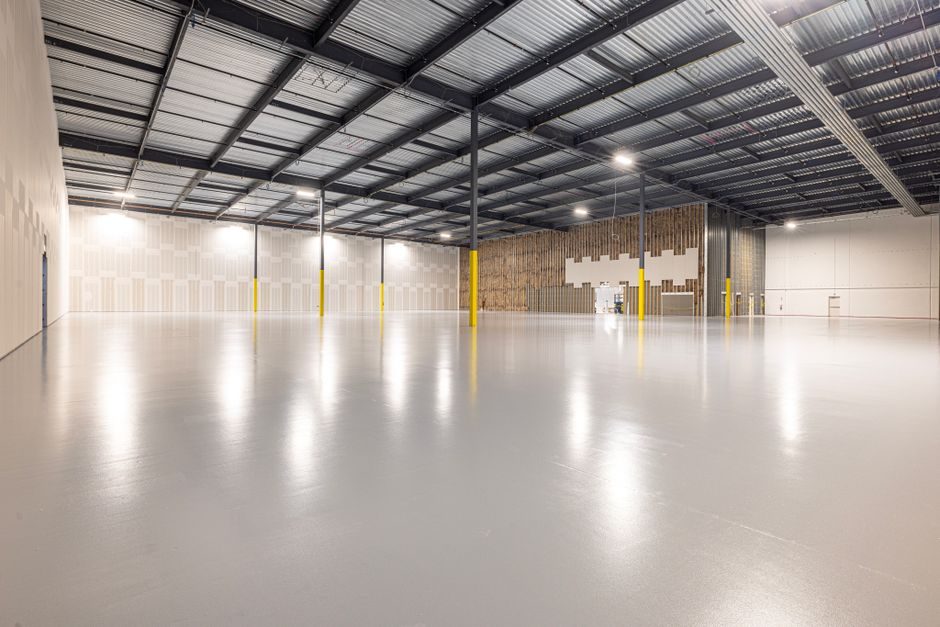
Specifying an industrial floor in 2026 reduces to a weighted decision matrix of seven operating axes — substrate condition, traffic class, chemical attack, thermal cycling, slip resistance, hygiene class, and allowable downtime — and the dominant resin systems (epoxy, polyurethane, polyurethane-concrete, MMA, vinyl) trade off against that matrix in different quadrants [S7][S8].
UK specialist contractors report a working band of 25–40 years of installation experience in the segment, with site surveys offered free of charge to lock the resin thickness (typically 2–9 mm) and broadcast aggregate to substrate condition before quote [S3][S4][S8]. US applicators mirror that model, pairing nationwide installation with concrete sealing and polished-concrete overlays for light-to-medium commercial duty [S5][S6].
Substrate and Traffic Class: Where the Matrix Starts
A floor that carries 1.5 t pallet-truck wheels and 80 °C washdowns needs a different resin build than a 0.3 t foot-traffic showroom, and that delta is set by substrate prep class and traffic class before chemistry is even discussed [S7][S8]. Surface preparation is most commonly referenced against concrete profile classifications (CSP 3–CSP 9, with CSP 5–CSP 7 the working band for most resinous industrial floors) because the resin bond is mechanical as much as chemical [S8]. Heavy-duty screeds such as PU-concrete are typically laid at 6–9 mm to absorb forklift point loads and thermal shock, while self-smoothing epoxy at 2–3 mm covers warehouses and electronics assembly where the load is on the wheels, not the floor [S7][S8].
For plants converting conventional cement flooring or tile to a dust-free monolithic finish, contractors universally recommend a moisture-tolerant primer and a 100–200 micron primer sweep, with the body coat broadcast to refusal using 0.4–1.2 mm quartz or aluminium-oxide aggregate where R10–R13 slip ratings are required [S7]. Established UK industrial flooring contractors, such as IFC with over 40 years' experience, offer free site surveys as a standard preliminary service before specifying a system [S3][S8].
Chemical Resistance and Thermal Cycling
PU-concrete systems tolerate steam cleaning at 90–100 °C and resist organic acids, sugars and fuels where standard bisphenol-A epoxies craze and discolour, which is why they dominate food-and-beverage and pharma washdown zones [S7]. Epoxy's weakness is its glass-transition ceiling — most unmodified epoxies begin to soften at 60–70 °C continuous service, while a filled PU-concrete will hold 90–100 °C and tolerate 6–8 °C thermal-shock swings during CIP cycles [S7].
For battery, plating and chemical-processing halls where sulphuric, hydrochloric and caustic splash is a daily event, novolac vinyl-ester and novolac epoxy topcoats are specified over an epoxy primer to push chemical resistance to the high end of the matrix, accepting higher material cost and tighter cure-window in exchange [S7]. The Chemoxy OSR (oil-spill resistant) and Chemoxy WR (water-resistant) ranges in the Indian market illustrate the broadcast of variants: same resin family, different filler and surface-treat package tuned to the spillage profile [S7].
Slip Rating, Hygiene and Static Control
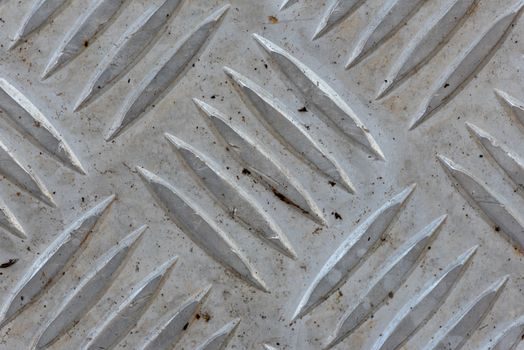
Slip resistance is quantified under pendulum test classes — UK practice maps roughly to R10 (light wet), R11 (general industrial), R12 (oily/wet production) and R13 (heavy grease, fish/meat processing) — and the rating is set by aggregate size and broadcast rate, not by resin choice [S7][S8]. R12–R13 floors typically take a 0.7–1.2 mm aluminium-oxide broadcast at 1.5–2.5 kg/m², then a clear sealer, to hold coefficient of friction in the HSE-relevant range for wet production zones [S7].
Hygiene-critical spaces (pharma, semiconductor, food) layer in a third variable: cleanability and static dissipation. A standard self-smoothing epoxy gives a seamless, non-porous surface suitable for routine washdown, while an ESD-grade epoxy at 10⁶–10⁹ Ω adds a conductive primer and copper tape grid to bleed static to ground — a separate spec axis from chemistry and slip rating [S7][S8]. The application overlap is what makes the industrial flooring decision non-trivial: any two of slip, hygiene, chemistry and conductivity can be combined, but each adds cost and reduces the number of viable resin families.
System Comparison on Five Decision Criteria
Five resin families cover roughly 90% of industrial installations in 2026: epoxy, polyurethane, polyurethane-concrete, methyl methacrylate (MMA), and heavy-duty vinyl (PVC/LVT industrial grade). The comparison below lines them up against the criteria that drive purchase orders [S7][S8]:
1) Compressive and flexural strength: PU-concrete highest (typically 50–80 N/mm² compressive), then epoxy (55–70 N/mm²), then PU (40–55 N/mm²), with MMA and vinyl lower but adequate for lighter duty. 2) Temperature ceiling: PU-concrete 90–100 °C continuous, epoxy 60–70 °C, PU 70–80 °C, MMA 60–80 °C, vinyl 40–60 °C. 3) Chemical resistance: novolac vinyl-ester and PU-concrete lead against organic and inorganic acids; standard epoxy good against alkalis and solvents, weak against strong acids; MMA tunable but limited thermal headroom. 4) Downtime tolerance (return-to-service): MMA fastest at 1–2 hours, fast-cure PU at 4–6 hours, standard PU 12–24 hours, epoxy 24–48 hours, vinyl overlay immediate. 5) Unit-cost band (installed, mid-2026, indicative): vinyl £15–£35/m², epoxy £25–£55/m², PU £40–£70/m², PU-concrete £60–£110/m², MMA £70–£120/m² — figures vary by thickness and prep class, but the ranking is stable across UK and US quotes [S4][S5][S8].
For spec work this maps to a one-line rule: if the floor takes hot water and chemicals, choose PU-concrete; if it takes forklifts and solvents on a tight capex, choose epoxy; if the line cannot shut down, choose MMA; if it is a back-of-house office or retail backroom, choose heavy-duty SPC flooring or industrial vinyl [S4][S5][S7][S8]. The same matrix logic that drives resin selection is also why pre-finished rigid-core floors have eaten the light-commercial end of the spec — a 4–8 mm SPC flooring install at 24-hour turnaround is hard to beat on capex per square metre when chemistry is not the binding constraint.
Substrate Prep, Moisture and Bond Failure Modes

The most common premature failure on a resin floor is not chemistry — it is moisture-vapour blistering caused by a slab that was not tested, primed or vapour-barriered before the system went down [S7][S8]. Concrete subfloors in new-build warehouses often exceed 75% relative humidity at the surface, which is the working threshold for vapour-impermeable topcoats; above that, an epoxy DPM or PU primer at 150–250 microns is mandatory or the system will blister inside 6–18 months [S7].
Joint detailing is the second dominant failure path: saw-cut control joints must be honoured through the resin with a flexible fill (typically PU or polysulphide), otherwise the joint propagates as a crack through the floor within the first seasonal cycle [S8]. Edge termination at drains, kerbs and door thresholds is the third — a resin turned up a stainless termination bar at 50 mm height gives a hygienic cove that survives washdown, while a feathered edge is the first place a spec will fail an audit [S7][S8]. Installation sequencing ties directly back to those details: a 2–3 mm self-smoothing epoxy on a 1000 m² warehouse typically installs in 3–5 days, while a 9 mm PU-concrete in a 200 m² process room runs 5–7 days including cure [S4][S8].
Where industrial flooring and industrial adhesive Specs Intersect
Resin systems are bonded to the slab with a primer that is itself a low-viscosity variant of the same chemistry, so the industrial adhesive spec and the floor spec are usually the same document written twice. PU-concrete is bonded with a PU primer dosed at 0.25–0.40 kg/m²; epoxy is bonded with a solvent-free epoxy primer at 0.15–0.30 kg/m²; MMA is bonded with a catalysed MMA primer that can return-to-service in 30–60 minutes [S7][S8].
For tile, vinyl and rubber overlays on industrial subfloors, the industrial adhesive is a separate line — typically a two-part PU or epoxy-polyurethane hybrid at 1.0–1.5 kg/m² for full-spread, with conductive variants loaded with carbon fibre or carbon black for ESD spaces [S7]. The same logic shows up in unrelated specification domains: when the capex envelope is set by the adhesive bond strength rather than the face material, a process engineer walks the same decision tree used in protective clothing vs hearing protector spec cuts — pick the load-bearing axis first, then match the secondary axes against it.
Sourcing, Standards and Cost Anchors
UK and US applicators generally quote site-survey-led, with free survey and competitive pricing as the norm; contract length is typically 30+ years of trading, with contractor teams of 10–50 installers and a working geographic radius of 50–150 miles from depot [S3][S4][S5][S6][S8]. Vendor-direct channels in the Indian and Asian markets — Chemoxy and equivalents — offer both installation and supply-only, with technical reps running a resin-selection matrix against duty, temperature and chemistry inputs [S7].
Standards to anchor in the spec: EN 13892 (resin screed mechanical properties), EN 13529 (chemical resistance classification), DIN 51130 / BS 7976 (slip rating), and FeRFA (Federation of Resin Flooring Association) type classifications 1–8 covering seal coats through heavy-duty PU-concrete at 6–9 mm [S7][S8]. Cost-anchoring in mid-2026: £15–£120/m² installed across the system range, with prep class, thickness and broadcast rate accounting for 40–60% of the variance rather than the resin itself [S4][S5][S8].
The next data point to track is the slip-rating harmonisation between BS 7976 pendulum and DIN 51130 ramp — pendulum test classes (PTV) are still being mapped against R10–R13 in 2026, and most UK specs quote both. Watch also for MMA's 1–2 hour return-to-service claim migrating into data-centre white-space builds where the 24-hour epoxy downtime is the binding capex penalty, and for PU-concrete extending its temperature ceiling from 100 °C toward 120 °C in next-generation filled systems [S7][S8].