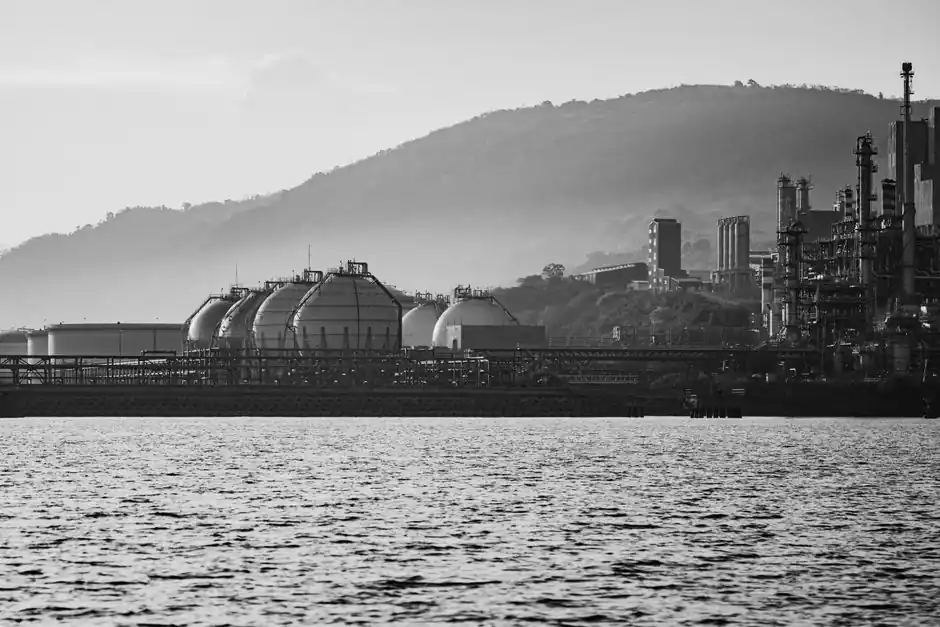
Marine engineering now treats industrial gas selection as a compliance problem first and a fuel-economics problem second, with MARPOL Annex VI NOx tiers and ECA sulfur caps driving the fuel choice before horsepower and range are even sized [S3].
Selection work spans LNG-fueled ocean vessels, LNG carriers using cargo boil-off, CNG bunker barges, and emerging hydrogen fuel-cell drive packages reviewed by the U.S. Coast Guard Marine Safety Center against Title 46 CFR equivalency and Policy Letter 01-12 [S2][S3].
MARPOL Annex VI: The Numeric Gates That Pick the Fuel
Annex VI's tiered NOx limits, expressed in g/kW·h and indexed to engine speed (n, rpm), are the first hard gate any marine gas selection must clear, with Tier III applying inside designated Emission Control Areas and Tier II applying globally outside ECAs [S3]. Sulfur oxide limits are imposed primarily through fuel sulfur cap, with the tightest values inside ECAs and progressively looser values on the global fleet, and the U.S. implements the same Annex VI numbers through the Act to Prevent Pollution from Ships [S3]. The ECA geometry itself is a numeric spec: a 200-nautical-mile band around most of North America and the Hawaiian Islands, narrowing to 40-50 nautical miles around Puerto Rico, which sets the operating envelope the gas-fuel system must meet [S3].
Because these tiers phase in over a multi-year Annex VI timeline, vessel designers use a dual-fuel arrangement (LNG pilot + diesel/gasoil backup) so the same hull can move between ECA and non-ECA waters without re-fueling, and the natural-gas fuel mode carries the NOx/SOx compliance load while the pilot fuel handles transient load [S3].
LNG vs CNG vs Boil-Off vs Dual-Fuel: Decision Criteria Compared
Four marine gas options compete, and the choice is driven by storage energy density, bunker transfer time, and methane slip, not just fuel cost. LNG dominates oceangoing tonnage because at near-atmospheric pressure storage at around -162 °C, LNG delivers roughly 600 times the volumetric energy density of the same volume of standard natural gas, which makes hull-tank sizing feasible for shipboard bunker tanks [S3]. CNG at 200-250 bar is reserved for shorter routes and shuttle vessels where the energy-density penalty of compressed storage is tolerable. Boil-off gas (BOG) from an LNG cargo's insulation losses is the oldest marine use of natural gas, with LNG carriers using cargo boil-off to fire main boilers for over 45 years [S3].
Decision-criteria comparison for the four marine gas options:
- **LNG (cryogenic, ~-162 °C, 1 atm)**: Highest volumetric energy density; requires IGC Code Type C or Moss-type tank; methane slip 1-3% typical; default for newbuild deep-sea tonnage [S3].
- **CNG (200-250 bar, ambient T)**: Lowest volumetric energy density; cheaper bunkering infrastructure; viable for harbor shuttles; not economic for transoceanic routes [S3].
- **BOG from LNG carrier cargo**: Free fuel; useful only on LNG carriers; flow rate is set by tank insulation design, not propulsion demand; pre-combustion or gas-only boilers handle the load [S3].
- **Dual-fuel (LNG pilot + diesel/gas-oil pilot)**: Compliance-flexible; switches between ECA and non-ECA without refuel; engine-rated power typically derated 10-15% versus pure diesel; default for OSVs, Ro-Ro, and tugs [S3].
Class and Flag: USCG NVIC 01-12, IGC Code, and 46 CFR Equivalency
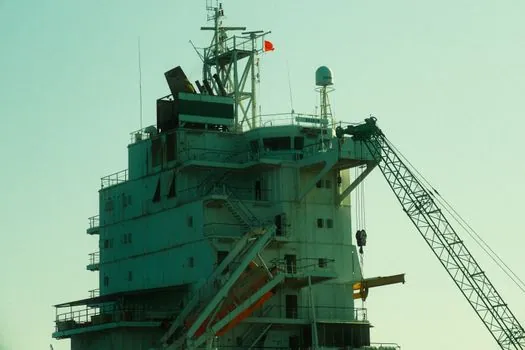
For U.S.-flag vessels, the gas-fuel system must clear a layered review: USCG Marine Safety Center concept review under Policy Letter 01-12, an equivalency demonstration against Title 46 CFR for any rule the design cannot meet literally, and class society alignment (ABS, DNV, LR) with the IGC Code for the storage and processing sections [S2][S3]. The U.S. Coast Guard reports that LNG-fueled ship concepts have been reviewed across passenger vessels, ferries, offshore supply vessels, container Ro-Ro ships, and towing vessels, with detailed designs now reaching the Marine Safety Center stage [S3].
Norway is the reference operational regime, having authorized LNG-fueled ships to operate in its waters since 2000 and accumulating the longest design/inspections dataset in the world; U.S. reviewers explicitly draw on this record when processing equivalency requests [S3]. The U.S. Coast Guard Liquefied Gas Carrier National Center of Expertise, housed under the Outer Continental Shelf NCOE, is the technical authority that consolidates lessons across gas carriers and gas-fueled ships, and it is the first stop for designers chasing a NVIC 01-12 path [S2].
Storage, Bunkering, and Materials Compatibility
Cryogenic fuel storage drives the materials and valve selection, not the engine. For LNG containment the marine valve set must work at -162 °C service with austenitic stainless trim and low-temperature carbon steel bodies, and the IGC Code Type C independent tank is the dominant hull-tank choice for fuel-bunker service because it tolerates higher working pressure than Type A and supports PRV settings compatible with engine demand [S3]. BOG handling needs a gas combustion unit (GCU) sized to the worst-case thermal in-leak plus compressor return, otherwise the tank pressure will lift the relief valves and waste fuel. For engine rooms, the hazard classification follows standard marine practice, with marine HVAC ventilation capacity sized to the gas-detection layout and the number of air-changes per hour required by class and USCG.
For a related engineering-plastic selection problem on the same hull, see the ball spline selection logic used in packaging lines, which illustrates how a different mechanical component is gated against washdown, lubrication, and diameter criteria on the same vessel.
Emissions Verification: Stack Testing and Methane Slip
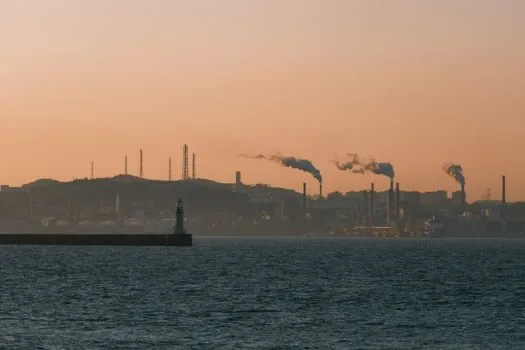
Compliance is not a one-time spec gate; it is a measurement program. Annex VI NOx and SOx values are verified by EIAPP engine certification (NOx) and by bunker-fuel delivery records plus bunker-delivery-note sulfur analysis (SOx), with on-board gas analyzer sampling the post-combustion exhaust at the IMO-mandated measurement points and a gas chromatograph used in lab verification of methane slip and unburned hydrocarbon emissions during sea trials [S3]. Methane slip is the parameter that can defeat a Tier III NOx win because unburned CH4 still carries global-warming potential, and dual-fuel engine makers now publish slip curves in g/kW·h so operators can verify life-cycle CO2e.
Selection Criteria Summary and Trackable Signals
For a marine engineering gas decision, the ordered gate set is: (1) Annex VI NOx tier and ECA sulfur cap met at the worst-case operating point, (2) USCG CG-ENG concept-review path (NVIC 01-12 or full 46 CFR) lined up before keel-laying, (3) storage system matched to route length via LNG vs CNG vs BOG logic, (4) class society IGC Code alignment for tank and processing, and (5) methane-slip and EIAPP paperwork scheduled alongside the gas chromatograph sea-trial plan [S2][S3].
Trackable signals to watch over the next 6-12 months: USCG Marine Safety Center published list of approved NVIC 01-12 concept designs, IMO MEPC outcomes on methane slip regulation, and any updates to Annex VI Tier IV discussions, plus the next round of USCG Liquefied Gas Carrier NCOE guidance bulletins posted under CG-ENG-1 [S2].