
Wind turbine gearboxes step the rotor's ~10-20 rpm up to ~1500-1800 rpm generator speed, and the global market for these units reached USD 25.69 billion in 2025, on track to USD 45.48 billion by 2033 at a 7.4% CAGR [S1].
Most installed utility-scale turbines use a multi-stage planetary + helical (or in some designs, planetary + bevel-helical) configuration because it offers the highest torque density per unit mass, while a smaller share of newer direct-drive turbines eliminates the gearbox entirely in favor of a permanent-magnet generator [S1]. Specification work in 2026 focuses on three things: matching the gearbox to the rotor's torque spectrum, picking a lubricant that passes the FZG scuffing test, and aligning the unit with the industrial gear classification the OEM actually builds.
Why a Gearbox (or Not) on a Wind Turbine
A wind turbine gearbox does not shift gears; it maintains a single fixed ratio between rotor and generator, typically on the order of 1:80 to 1:120 for a 3-stage planetary + helical unit [S1]. Without it, a direct-drive generator would have to be roughly 100x larger in diameter to extract the same shaft power at low rpm.
Direct-drive designs remove the gearbox but pay for it with a much heavier, larger-diameter generator and a full-rated power converter, which is why direct-drive penetration is higher offshore (where nacelle weight is less constrained than on tall onshore towers) and lower in the legacy onshore fleet. For a 3-4 MW onshore turbine in 2026, the geared drivetrain remains the lower-cost-per-kWh option in most markets.
Main Drivetrain Architectures on the Market
Three drivetrain families cover essentially all utility-scale wind turbines shipping in 2026: geared with planetary + helical stages (the volume leader), geared with planetary + bevel-helical (used where a compact nacelle is needed), and direct-drive (mostly offshore, permanent-magnet generator). Each has a different torque density, mass, and maintenance profile, and the choice is driven as much by tower and nacelle logistics as by aerodynamic performance. [S2]
A 2026 selection almost always starts with the rated rotor torque and the generator's nominal speed, then picks the architecture that delivers the required ratio with the lowest gearbox mass.
Specification Criteria That Drive Selection

Torque density (kNm per kg of gearbox mass), gear-mesh efficiency, and 20-year design life are the three load-bearing specs on a 2026 wind gearbox data sheet. Wind turbine maintenance studies show that 25% of gearbox damage records involve the gears themselves, ahead of bearings and seals, so the gear stage is the riskiest subassembly to under-spec [S2].
Selection work breaks into four criteria. First, torque rating: design margin should cover the 50-year extreme load case, not just the mean operating torque. Second, gear type: planetary stages handle the high-torque low-speed end, while helical stages finish the speed increase with better efficiency and lower noise than spur or bevel. Third, lubricant: the oil must pass the FZG scuffing test (DIN ISO 14635-1 / ASTM D5182) at stage 12 minimum, with premium formulations reaching stage 13 or higher, and also pass the FVA 54/7 micropitting test to survive the high-cycle, high-load meshing that defines wind duty [S3].
Comparison of Gear Types Used in Wind Drivetrains
Spur gears (50-90% efficiency) are too noisy for a wind nacelle and are not used in utility wind gearboxes. Bevel gears (50-95%) are used only where the drivetrain needs a 90° shaft change, most often in compact nacelles and some pitch-control and yaw drives. Worm gears (50-90%) are avoided in the main power path because sliding contact generates heat and limits continuous-duty power.
The typical 3 MW onshore unit therefore stacks: 1st-stage planetary (low-speed) → 2nd-stage planetary (intermediate) → helical (high-speed) feeding the generator. The offshore 8-15 MW class often uses a medium-speed permanent-magnet generator with a single planetary stage + helical, trading some efficiency for a lighter, smaller-diameter generator.
Lubrication and Oil Testing
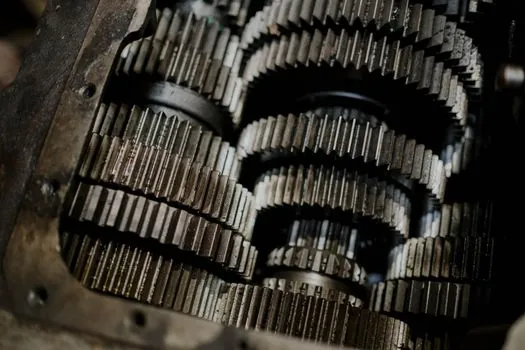
Gear oil is the single most common root cause of premature wind gearbox failure, and modern wind turbine gearboxes operate under punishing conditions including fluctuating temperatures, high loads, variable speeds, moisture ingress, and long 18-24 month drain intervals [S3]. A balanced additive package has to deliver anti-wear, oxidation control, foam suppression, and corrosion protection without trading one for another, which is why multi-test qualification (not a single pass/fail) is the procurement standard in 2026.
Three test families gate oil approval for wind duty. The FZG scuffing test (DIN ISO 14635-1, ASTM D5182) ramps load until the lubricant film breaks; stage 12 has been the historical benchmark, with premium synthetics now hitting stage 13 or higher. The FVA 54/7 micropitting test measures fatigue resistance under repeated high-cycle loading, the exact stress pattern a wind gear sees. Foam control, water separation, and rust prevention round out the qualification, and oil sampling intervals of 6 months are now standard for failure-mode trending on a fleet of more than ~20 turbines.
Reliability Data and Known Failure Modes
Wind gearbox reliability in 2026 is constrained by three well-documented failure modes: gear tooth macropitting and micropitting on the high-speed helical stage, white-etching cracking on rolling-element bearings driven by sliding under low-speed high-torque conditions, and oil degradation from moisture ingress through the breather. Industry data places gears themselves as the largest damage category at 25% of gearbox failure records, with bearings second [S2].
Modern wind gearboxes are designed for a 20-year operational life with one major overhaul around year 7-10, typically a high-speed stage bearing and gear replacement. Operating temperatures are kept below ~80-90°C sump for the synthetic PAO or PAG oils used, and the bearing housings often run a separate oil circuit with finer filtration (3-6 micron) to extend bearing life.
Standards, Sourcing, and Aftermarket

Wind gearboxes are commonly built to AGMA 2001 or ISO 6336 for gear strength rating, with the lubrication regime referenced to DIN 51517-3 (CLP) for mineral and synthetic oils. Major OEMs specify their own duty cycles, but the procurement baseline in 2026 reads: FZG ≥12, FVA 54/7 passed, AGMA 2001-D4 minimum reliability target, and a 20-year design life. Aftermarket suppliers such as Falk offer replacement planetary, helical, and parallel-shaft gear units for legacy fleets, with product lines including Falk Helical Gearboxes, Falk Planetary Gearboxes, and Falk Parallel Gearboxes for power and energy operators [S4].
For a working engineer in 2026, the practical sourcing map is: 1) lock the rotor torque and rotor-generator ratio first, 2) pick the architecture (planetary + helical dominates), 3) require FZG ≥12 and FVA 54/7 oil qualification in the spec, 4) confirm AGMA 2001 / ISO 6336 compliance and a 20-year design life, and 5) plan the major overhaul at year 7-10. For related selection work outside the wind niche, the mining gearbox selection guide covers helical, bevel, and planetary units under very different load profiles, and the material handling gear selection guide handles conveyor and hoist duty cycles.
Spec-level background on the components involved: power cable, and power distribution.