An industrial gearbox quote allocates roughly 50-65% of unit cost to gears, bearings, housings, and shaft stock, with raw forging and casting stock alone at 20-30% and gear machining and finishing at 25-35% of the bill of materials [S4]. Plant-level operating economics push raw materials even higher, to 65-75% of OpEx, for a category whose finished unit price spans $300 for a small worm reducer to above $250,000 for a custom-engineered parallel-shaft or planetary gearbox built for steel, cement, or mining duty [S2][S4].
The other structural lines are heat treatment (8-15%), bearings (10-18%), housing and shafts (8-15%), assembly labor (5-10%), QC and certification (3-7%), and paint, packaging, and freight (3-6%) [S4]. Within those eight buckets, four are negotiable on batch size and grade, and four are largely structural, and that distinction matters more than the top-line number on the quote sheet.
Eight-Line BOM Breakdown: What Each Line Actually Buys
The BOM line that most often gets quietly downgraded is gear machining and finishing, at 25-35% of unit cost, because two variables compound: a one-step precision upgrade on a one-unit order can double the machining-line cost versus the same grade on a 500-unit batch [S4]. Stepping from DIN 8 to DIN 6 (roughly AGMA Q10 to Q12) adds about 150% in machining time from extra finishing passes and slower feed rates, plus roughly 200% in inspection cost from profile verification at high precision [S4]. A buyer who specs AGMA Q12 when Q10 meets the service factor is overpaying on the BOM line where grade swings cost the most.
Broaching tooling alone runs $70,000 to $100,000 and is amortized across production runs of 10,000 to 80,000 parts, putting per-part broaching cost at $0.60 to $5.00; a one-unit order eats the entire amortization, while a 500-unit batch with optimized fixturing cuts unit cost by roughly 20% on the gear line [S4]. Heat treatment distortion in mass production can scrap more than 8% of material before inspection even begins, a hidden cost most initial quotes do not carry [S3]. Bearings, though only 10-18% of unit cost, are structural on brand tier: a Tier-3 swap for an SKF, NSK, or FAG equivalent looks identical on the BOM but behaves differently under shock load [S4]. For buyers comparing supplier quotes on similar 7.5 kW helical gearboxes, two quotes 15% apart with the same structural lines represent real negotiation room, while the same 15% delta with different structural lines is a different product wearing the same model number [S4].
Price Tiers by Gearbox Type and Duty
Light-duty gearboxes for conveyors and small packaging equipment typically range from $300 to $800, medium-duty units for agricultural, food-processing, or robotics applications often cost $800 to $2,500, and heavy-duty gearboxes for mining, marine, or defense operations commonly start around $3,000 and can exceed $10,000 depending on torque and environmental protection requirements [S1]. A broader industry breakdown puts small worm gear reducers at $300-$2,500, helical inline units at $800-$8,000, bevel gearboxes at $1,000-$10,000, and shaft-mounted reducers at $700-$7,500 for aggregate and bulk-handling conveyors [S2].
At the high end, parallel-shaft gearboxes for heavy conveyors, extruders, and crushers run $2,500-$30,000+, planetary gearboxes for high-torque drives, mobile equipment, and robotics run $3,000-$50,000+, and custom-engineered units for steel mills, cement plants, mining, and marine applications can hit $15,000-$250,000+ [S2]. A gearbox rebuild or repair typically lands at 30-70% of new cost, which is why the rebuild-versus-replace decision is the single largest TCO lever most plants have on existing drivetrains [S2]. Reference data for gearbox selection criteria puts the same unit-price tiers against torque density, service factor, and mounting style, not against horsepower alone.
Cost Drivers That Move the Quote 15-40%

Design complexity is the first cost driver, with a single-stage helical gearbox cheaper to produce than a multi-stage planetary gearbox that must deliver precise motion and high torque density [S1]. Material composition matters because standard cast-iron housings are economical and durable, while stainless-steel or aluminum housings used in corrosive or hygienic environments increase production cost; surface coatings such as nickel plating or epoxy paint add protection but also raise the price [S1]. Performance specifications such as torque, shock-load rating, and continuous-duty capability directly influence component sizing, and bearings, seals, and heat-treated gears built for 24/7 industrial workloads cost more but last longer, lowering lifetime expenses [S1].
Certifications and compliance, including ATEX for hazardous environments, ISO quality systems, and NSF for food-grade safety, require additional testing and documentation that contribute to the overall industrial gearbox cost breakdown [S1]. A common procurement trap is cross-standard grade quoting, where AGMA grades ascend (Q3 to Q15) while ISO and DIN grades descend, so a buyer comparing Q12 against a "Class 6" part may be looking at two very different precision tiers under the same model number [S4]. Quote variance for the same drawing routinely runs 40-60%, and stepping one precision grade can add up to 80% in price, with standards such as IATF 16949 and IAQG adding their own audit and traceability overhead that must be priced in from the first RFQ [S3].
Total Cost of Ownership: Downtime Is the Hidden Line Item
Downtime cost is calculated as Lost Production per Hour plus Labor Cost plus Scrap and Waste plus Expedited Costs plus emergency logistics, and on a steel mill or cement line this number dwarfs the gearbox purchase price within the first hour of an unplanned stop [S2]. A modular gearbox that costs 20% more upfront can outperform a cheaper unit and save thousands in unplanned downtime over its service life, because production scale, customization, and lead-time pressure all move the same variables: steel grade, bearing brand, heat-treatment case depth, and inspection sampling rate [S1].
A practical TCO framework weighs purchase price against service life, energy efficiency, rebuild cost (30-70% of new), and mean time between failures, with the four structural BOM lines deciding how long the gearbox lasts in service and the four negotiable lines deciding how much the supplier wants the business [S4]. Buyers specifying industrial adhesive for housing seals or additive manufacturing material for prototype housings should fold those sub-component costs into the same line-item review, because they sit inside the housing and shafts bucket at 8-15% of unit cost. For more on raw-material cost stacks in adjacent industrial categories, see the Seamless Steel Pipe Total Cost of Ownership reference, which uses the same OpEx-versus-CapEx split for forged tube products.
When to Repair, Rebuild, or Replace
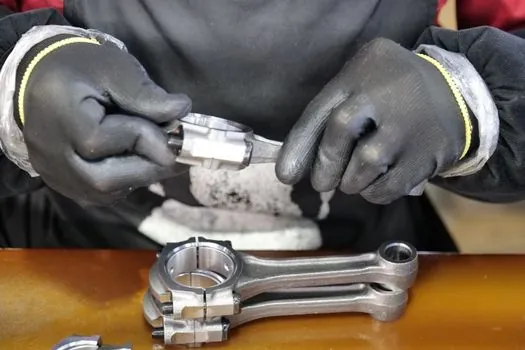
Even the best gearboxes eventually wear, and the rebuild-versus-replace decision hinges on the 30-70% rule: a repair or rebuild typically lands at 30-70% of new cost, so a unit with significant gear or bearing damage below that threshold is a rebuild candidate, while anything above it is usually a replacement [S2]. Custom one-off builds lack the economies of scale found in high-volume production, while expedited orders or overnight replacements typically carry premium surcharges, and these surcharges can erase the savings of choosing a cheaper supplier within a single incident [S1].
For high-volume OEM lines, plant-level economics for the category run raw materials at 65-75% of OpEx, with gross profit margins of 30-40% and net profit margins of 15-22% across a 100,000-500,000 unit annual capacity range [S5]. The APAC region accounts for 42.9% of the global gearbox market, and that share maps directly to where batch amortization, broaching tooling spreads, and heat-treatment furnace capacity concentrate, which is why two quotes from different regions for the same drawing can diverge by 40-60% even before currency or freight is applied [S3][S5]. A useful next step for any procurement team is to lock the four structural lines (raw stock, gear machining grade, heat-treatment spec, bearing brand) before asking suppliers to re-quote, and to require each supplier to state what AGMA or DIN grade they produce to and which batch size they amortized the quote against [S4].
Trackable signals to watch over the next two quarters: published 2026 AGMA and ISO gear-grade revision drafts, and quarterly raw-material surcharge indices for alloy steel and bearing-grade bar stock, both of which move the 20-30% raw-forging line faster than any negotiated discount [S4].