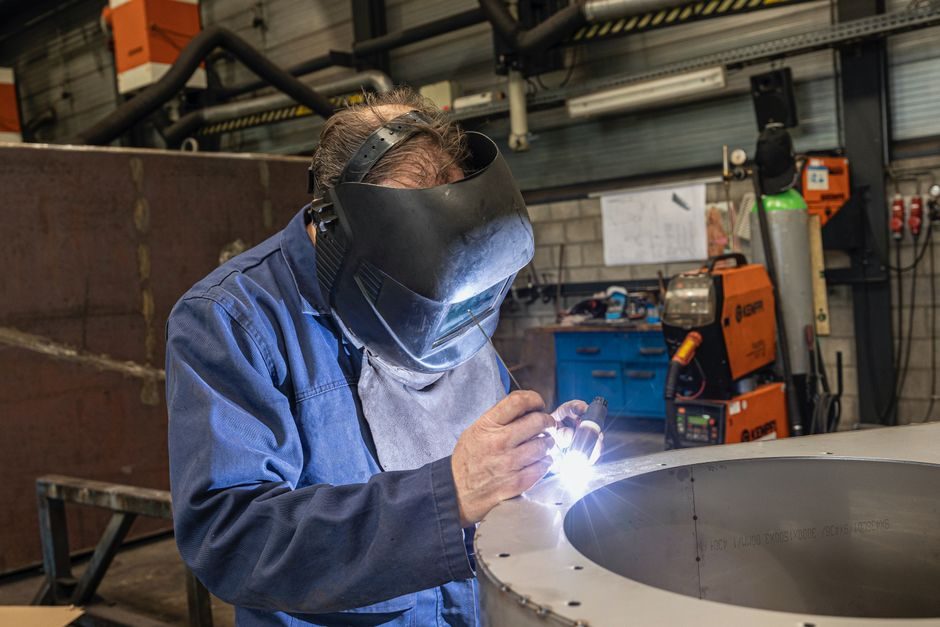
Welding robot value chains in mid-2026 split cleanly into three tiers: upstream robot arm OEMs and welding power-source suppliers, midstream workstation integrators, and downstream fabrication end-users in structural steel, automotive, and pressure-vessel work [S3].
Upstream payloads now span 8 kg collaborative cells to 210 kg heavy spot-welding arms, with stated repeatability of ±0.06 mm and IP65 wrist protection on production spot-welding models [S1]. Downstream, regional integrators report 300+ machine installed bases over 20-year operating histories, with active project lists in cable supports, hydraulic cylinders, scaffolding, and wheelbarrow frames [S2].
Upstream: Robot Arms, Power Sources, and Positioners
Upstream supply begins with the articulated arm itself: a 6-axis spot-welding model in the 2026 Troy catalogue posts 210 kg rated payload, 2658 mm working range, ±0.06 mm repeat positioning accuracy, floor-mount installation, and IP65 wrist protection [S1]. The same catalogue lists SCARA, delta, cartesian, and 4/6-axis arms under a unified industrial-robot category, confirming the welding cell draws on the same servo and reducer supply chain as adjacent articulated robot platforms [S1].
Welding-specific upstream components include the welding power source (FANUC SFP-350iB is one named example paired with the M-10iD/8L and M-10iD/12 arms in active 2026 integration listings), the torch-cleaning station, the wire feeder, and the positioner or rotary table that orients the workpiece [S3]. Double-station rotary welding tables and dual-positioner cells appear as standard catalogue items from Chinese integration houses, with B-series (B1, B2, B5, B6, B8) and C-series (C5, C6) workstation models offered at MOQ 1 piece on B2B sourcing portals [S3].
Midstream: Integrators and Welding Workstation Builders
Midstream integrators in the 2026 sourcing data are typically 20-year-old engineering firms delivering 300+ machine installed bases in their home markets, with workflow stages numbered one through six: site visit, discussion and brainstorming, design and concept proposal, fabrication and assembly of jigs, integration and installation, and delivery with workforce training [S2]. This six-step process is the de facto SOP for Malaysian and Chinese robotic-welding integrators, with Arcmatic's published project list spanning cable-support welding with automated unloaders, hydraulic-cylinder welding on robot tracks, water-cylinder circumferential welding, scaffolding-parts cells with custom positioners, and school-table/chair frame welding with custom jigs [S2].
Chinese integration houses in 2026 are exporting across North America, South America, Eastern Europe, Southeast Asia, Africa, Oceania, the Middle East, and Western Europe, with named robotic-welding categories covering arc welding manipulators, collaborative magnetic-suction welders, and desktop-move robotic welding cells [S3]. For shops weighing articulated arms against automated guided vehicles for material flow around the cell, the selection trade-off is covered in this 2026 spec-first comparison, which pairs payload and reach against AGV tow ratings and navigation protocol.
Downstream End-Users by Industry Vertical
Downstream demand in 2026 is concentrated in six fabrication verticals. Construction and structural steel covers scaffolding, wheelbarrow frames, school-table and chair frames, and steel-table frames welded with customized fixtures [S2]. Automotive and automotive-tier suppliers draw on heavy spot-welding arms in the 210 kg payload class for body-in-white and chassis sub-assemblies [S1].
Pressure-vessel and tank fabrication is a heavy downstream user of circumferential-seam welding cells with rotary positioners, exemplified by water-cylinder tank automated systems and hydraulic-cylinder welding cells on robot tracks [S2]. Electrical and cable infrastructure uses robotic welding for cable-support systems with automated unloaders [S2]. Heavy-machinery and formwork fabricators specify pile-cap forming and welding with custom bending machines paired to robot arms [S2]. The MIG process sits at the centre of most of these downstream cells; process selection by material thickness and joint geometry is mapped in this MIG welding spec-first guide, which lines GMAW short-circuit, globular, and pulse modes against sheet and plate thickness bands.
Selection Criteria: Payload, Reach, Repeatability, Process Match
Selection on the upstream side starts with four numeric gates: rated payload (8 kg for collaborative desktop cells, 12 kg for light M-10iD-class arms, 210 kg for heavy spot-welding arms), working range (1440 mm on the SA6/1440H collaborative welder, 2658 mm on the 210 kg spot-welding model), repeat positioning accuracy (±0.06 mm is the stated 2026 production figure), and ingress protection (IP65 at the wrist for spot-welding service) [S1][S3].
Process match is the second gate: arc-welding manipulators pair with MIG/MAG or TIG power sources, while spot-welding arms pair with resistance transguns and mid-frequency direct-current welders [S1][S3]. Cell layout is the third gate: floor-mount, inverted-mount, or track-mounted arms, plus single- versus double-station positioner tables, set throughput and footprint [S3]. The fourth gate is the integration scope: jig and fixture design, automated unloaders, and on-site training bundled in versus supplied as a bare arm [S2]. For broader capacity planning beyond a single cell, the 2026 industrial-robot capacity-planning map lines cycle-time, OEE, and utilisation against shift-pattern assumptions.
Comparison: Upstream OEM vs Midstream Integrator vs Downstream End-User
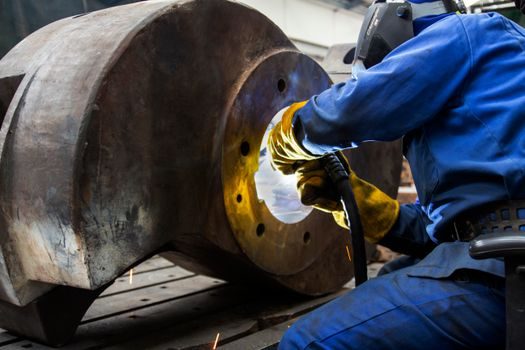
The three tiers separate on four decision criteria. On the spec-definition axis, upstream OEMs (FANUC, KUKA, ABB, Yaskawa, plus Chinese 6-axis suppliers) publish payload, reach, and repeatability; midstream integrators define the workstation envelope, jig design, and positioner selection; downstream end-users define the welded product, batch size, and cycle-time target [S1][S2][S3].
On the commercial axis, upstream arms transact at piece-level MOQ with negotiable pricing on B2B portals, midstream workstations transact as engineered packages with site-survey and training bundles, and downstream fabricators buy either a turnkey cell or a custom-engineered line [S2][S3]. On the geographic axis, upstream supply is concentrated in Japan, Germany, and China; midstream integration is regional (Malaysian integrators serve ASEAN, Chinese integrators export across nine global regions); downstream demand is global with structural-steel and tank fabrication heaviest in developing-market construction cycles [S2][S3]. On the service axis, upstream OEMs supply warranty and spare parts, midstream integrators supply on-site installation and workforce training, and downstream end-users own the production ramp and quality system [S1][S2][S3].
Limitations, Failure Modes, and Sourcing Constraints
Welding-robot cells carry three documented constraint classes. Mechanical constraints: 6-axis articulated arms need a minimum 1.5 m clear envelope around the workpiece, and double-station rotary tables require floor-loading verification for the combined positioner-plus-fixture mass [S1][S3]. Process constraints: collaborative magnetic-suction welders and desktop-move cells are limited to thin-gauge sheet and small-batch work, while 210 kg spot-welding arms are overkill for sub-50 kg fabrications [S1][S3].
Supply constraints: Chinese 6-axis arms and workstations ship at MOQ 1 piece on B2B sourcing portals, but lead times stretch when matched power sources, positioners, and jigs are sourced separately rather than as an integrated cell [S3]. Sourcing-portal listings in 2026 show negotiable pricing and MOQ 1 piece across FANUC M-10iD/12, M-10iD/8L, SA6/1440H collaborative, and STEP 6-axis arm integrations, with delivery terms depending on power-source and fixture country of origin [S3]. Adjacent process equipment, including fibre-laser cutting machines that feed blanks into robotic welding cells, follows a similar MOQ-1 sourcing pattern documented in the 2026 China laser cutting supplier map.
Sourcing Signals and Trackable Next Nodes

Two trackable signals will define the second half of 2026. First, integrator installed-base disclosures: Arcmatic's published 300+ machine count over 20 years is the benchmark mid-market integrators will be measured against as Chinese suppliers expand into ASEAN and African structural-steel markets [S2]. Second, workstation catalogue breadth: B-series and C-series double-station rotary tables shipping at MOQ 1 piece in 2026 indicate Chinese integrators are pushing modular cell design, and any new C-series or B-series model release on B2B portals will be an early read on whether the modular approach is displacing custom-engineered cells [S3]. Buyers specifying new welding cells in 2026 should request the integrator's reference list with cycle-time data, the arm's repeatability certificate, and the positioner's payload-versus-offset curve before locking the purchase order.
Component reference pages worth checking: agv robot, and amr robot.