
According to Xinhua, China's installed capacity of industrial robots currently accounts for more than 50 percent of the world's total, thanks to the rapid growth of industrial robot production capacity [S1][S2].
More than 1.5 million industrial robots are now operating in Chinese factories, roughly twice the European installed figure, and in 2023 China alone installed more than half of the world's new industrial robots, per the International Federation of Robotics [S1][S2].
Installed Base and Density Anchors for Capacity Models
Robot density in China's manufacturing sector reached 392 units per 10,000 workers in 2022, the figure cited by MIIT as the world's largest national market [S1][S2]. A decade ago, Weichai Power needed five years to develop a new powertrain product; with the robotised line, the development cycle has compressed to 18 months, and the green-energy engine line runs with one-fifth of the prior workforce at a 99% equipment automation rate [S1][S2].
For capacity planners, the lesson is that 5-axis welding cells, AGV-linked assembly, and machine-tending cells together cap manning rather than throughput, so ROI gates pivot off headcount delta and cycle-time compression, not pure machine cost. Procurement teams weighing this against alternative automation should treat industrial camera inspection and industrial coating cells as parallel bottlenecks when modelling line balance.
Domestic OEM Capacity Targets: Who Is Adding What
Estun Automation's Nanjing plant, co-designed with Bosch Rexroth, started production with an annual capacity of 9,000 industrial robots and pieces of equipment (2018-01) [S4]. Midea Group in 2018 announced a fourfold capacity expansion to 100,000 units per year by 2024, with a new Shunde plant adding 75,000 units and three Kuka joint ventures covering smart manufacturing, smart healthcare, and smart logistics (2018-03) [S3].
More recently, Zixi Technology lists a 35,000 m² manufacturing base with three intelligent workshops and a stated total production capacity of 200,000 pieces per year across industrial and collaborative robot families, plus grippers and protection accessories (2026-07) [S5]. Independent-component makers such as FAIR Innovation (Zibo) cover payload classes from 3 kg to 30 kg and supply controllers, reducers, and motors in-house, reducing bill-of-materials exposure for integrators [S1][S2].
Selection Criteria: Payload, Reach, and Integration Stack
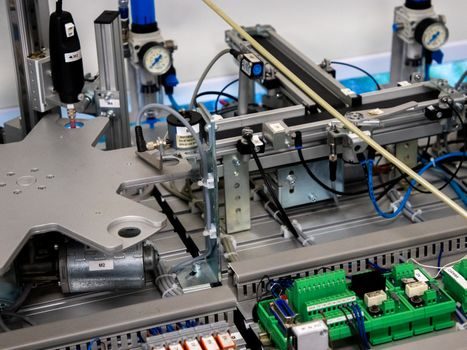
Specifying a robot cell starts with three numeric gates: payload in kg, reach in mm, and repeatability in mm. FAIR Innovation's 3-30 kg payload band is a useful floor for general welding, spraying, precision processing, and catering service robots (2019-founded) [S1][S2]. Epson's 40-year SCARA and 6-axis line targets automotive, medical, semiconductor, and food applications with vision-guided precision, the framing on its US automation portal (2026-07) [S6].
Beyond mechanics, the planning question is the integration stack: in-house controllers versus open ROS-2 drivers, on-board vision versus external industrial camera tracks, and whether the cell needs an industrial adhesive dispense head or industrial coating spray path. The order matters: payload and reach bound cell layout, then controller architecture, then peripherals, not the other way around.
Capacity Planning Levers: Line Balance vs Cell Density
Weichai's 99% equipment automation rate, combined with QR-code-guided AGV parts delivery, shows that bottleneck relief comes from coupling transport and process cells rather than densifying any one station (2024-07) [S1][S2]. Where vision inspection, leak testing, or nondestructive examination are on the critical path, planners commonly insert a separate industrial borescope station and a leak-test booth with a discrete industrial buzzer to flag reject events, so the robot cell does not stall on quality gating.
Three concrete levers consistently show up in 2026 capex plans: (1) a 5:1 headcount-to-throughput ratio target for new greenfield lines [S1][S2]; (2) 18-month new-product introduction cycles enabled by reconfigurable cells versus 5-year legacy cycles [S1][S2]; and (3) dual-sourcing between a domestic payload specialist and a Western SCARA vendor to keep lead times under 12 weeks. A robotic production line design build map walks through how those levers interact when the cell count exceeds 20.
Limitations, Failure Modes, and Where Robots Don't Pay
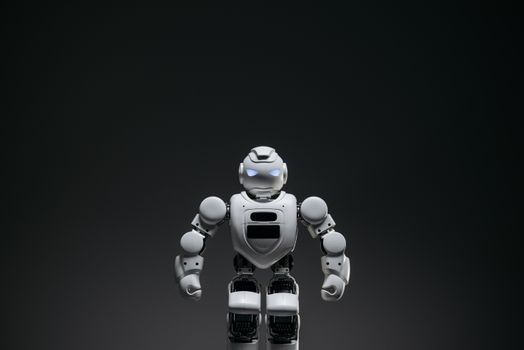
Industrial robots underperform where lot size is below roughly 50 units, where fixturing cost per SKU exceeds robot cost, or where the process tolerates only sub-second human judgement. The Weichai line only works because the engine family is high-volume and the AGV routes are stable; low-mix electronics assembly typically stays manual or partial-automation for this reason [S1][S2].
Plan a 10-15% integration contingency and a dedicated EOL tooling budget separate from the robot PO.
Sourcing Signals and Standards Watch
Three trackable signals matter for 2026 sourcing: domestic OEM annual capacity (Estun 9,000 units at Nanjing [S4]; Zixi 200,000 pieces across three workshops [S5]); Midea-Kuka joint-venture output flowing into smart manufacturing, smart healthcare, and smart logistics segments [S3]; and whether the buyer can dual-source across 3-30 kg payload classes for welded structures [S1][S2].
On standards, ISO 9283 governs robot performance criteria including repeatability and path accuracy, ISO 10218 covers robot system safety requirements, and ISO/TS 15066 addresses collaborative robot safety — these are the baseline references any capex review should cite. A robotics manufacturing cost breakdown rounds out the TCO picture for integrators weighing remanufactured arms against new cells, and a robotics manufacturing quality standards spec map shows the conformance gaps that show up in PPAP audits. The next node to watch: 2026 H2 announcements from Midea-Kuka on the three JV production ramps in healthcare and logistics robotics, and any follow-on plant from FAIR Innovation in Zibo adding payload classes above 30 kg.