
The global industrial robotics market was valued at USD 23.71 billion in 2024 and is forecast to reach USD 85.63 billion by 2034, expanding at a 13.7% compound annual growth rate from the 2024 base year [S1].
For 2026 specifiers, the operational question is no longer whether to automate but which robot class — articulated, SCARA, delta, or collaborative — fits the cell, the payload, and the available industrial coating footprint of the existing line.
Market Size Anchors and 2026 Baseline Numbers
Zion Market Research sizes the 2024 base at USD 23.71 billion with a 2034 endpoint of USD 85.63 billion at 13.7% CAGR, a 3.6× revenue multiplier over the decade [S1]. Allied Market Research uses a wider 2020 anchor of USD 38 billion and a 12.6% CAGR through 2032, reaching USD 163 billion. The two series diverge because Allied bundles service revenue, system integration, and aftermarket spend, while Zion tracks robot unit and controller OEM revenue. For a 2026 capex baseline, expect annual global revenue in the USD 32–40 billion band depending on the inclusion of integration and software, with the lower bound representing OEM-only and the upper bound system-integration-inclusive.
The discrepancy is not analyst noise — it defines how engineers and procurement teams should read any pitch deck. A 13.7% CAGR against a USD 23.71 billion base implies roughly USD 41.4 billion in 2028; a 12.6% CAGR against USD 38 billion implies roughly USD 56.4 billion in 2028, a 36% gap on the same calendar year [S1]. Treat the published CAGR as a directional envelope, not a contract quantity.
Segment Stack: Articulated, SCARA, Delta, Collaborative, Mobile
Articulated 6-axis arms dominate the high-payload bracket (typically 10–800 kg), used in gravity die casting cells, automotive welding, and palletising. SCARA units own the high-speed small-payload assembly tier (1–20 kg, cycle times below 0.3 s), and delta robots lead pick-and-place on conveyor lines at 100+ picks per minute. Collaborative arms (cobot payload typically 3–35 kg) carry power-and-force-limiting joint designs and ISO/TS 15066-aligned safety stops, removing the need for fenced cells when risk assessment passes. [S1]
Mobile logistics robots, a sibling segment, are valued at USD 2,420.7 million in 2017 with a projected USD 11,269.1 million by 2025 at 21.2% CAGR, the fastest growth band inside the broader automation stack [S6]. Where the 2026 spec converges, it is on the hybrid cell: a mobile platform carrying parts to a stationary cobot, rather than two isolated cells. The Business Research Company frames the parent industrial automation market — which includes robots, HMI, sensors, and SCADA — as the umbrella envelope that engineers should consult when sizing a plant-level digital twin [S4].
Selection Criteria: Payload, Reach, Repeatability, IP Rating
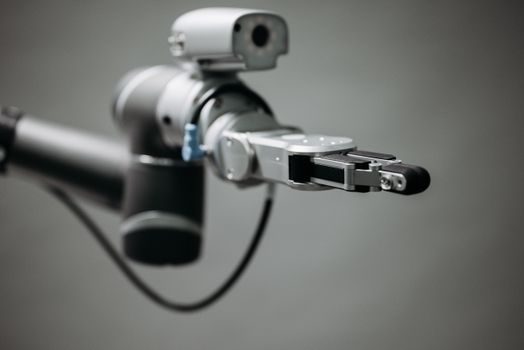
Selection begins with four hard numbers: payload (kg), reach (mm), repeatability (mm, typically ±0.02 to ±0.1 for industrial arms), and ingress protection. Automotive welding cells spec IP65 or higher; food and pharmaceutical end-of-line packaging typically demands IP67 or IP69K on the wrist and tool side. Cleanroom-rated units (ISO Class 5 or better) carry stainless hardware and particle-shedding limits relevant to semiconductor and medical-device lines. [S2]
Cycle time, defined as the time to complete a defined motion sequence at rated payload, separates SCARA and delta from articulated: SCARAs routinely deliver 0.25–0.40 s cycles for 1–3 kg pick-and-place, while 6-axis articulated arms trade cycle speed for kinematic flexibility. Repeatability is the better fidelity metric — published values of ±0.02 mm are credible for high-end SCARAs and small-payload articulated arms; ±0.05 mm is the practical floor for cobots; ±0.1 mm is the typical envelope for general 6-axis units above 20 kg payload. Standardisation sits behind many of these claims: ISO 9283 defines the test conditions for pose accuracy and pose repeatability, and ISO 10218-1 / ISO 10218-2 govern the safety requirements for industrial robot cells.
Standards, Safety, and the Cobot Question
ISO 10218-1 (robot itself) and ISO 10218-2 (integration) remain the governing safety standards for industrial robots, with ISO/TS 15066 defining collaborative-mode limits including the 150 N quasi-static contact force threshold and 120 N transient force threshold on the operator-contact side. Power-and-force-limiting (PFL) cobots integrate torque sensing at each joint so that a detected stop triggers category 0 or category 1 stop, depending on the OEM's risk assessment. [S3]
For 2026 procurement, the cobot-versus-fenced-arm decision is not a safety-versus-cost trade but a risk-assessment-driven one. A cobot cell still needs a documented risk assessment per ISO 12100 and ISO 10218-2, even with PFL hardware in place. The practical signal in 2026 is that cobot pricing per kilogram of payload has fallen materially since 2020, while fenced articulated arms remain the only path for high-payload (above 35 kg), high-speed, or hazardous-environment cells where collaborative mode cannot be demonstrated as safe.
Use Cases Mapped to 2026 Cell Designs

Three use cases dominate 2026 robot purchase orders. First, automotive body-in-white and EV battery tray welding, where 6-axis articulated arms at 50–800 kg payload dominate; second, e-commerce fulfilment and warehouse picking, where mobile logistics robots integrated with stationary arms run the AMR-cobot hybrid cell [S6]; third, machine tending for CNC and die-casting, where 6-axis arms at 20–100 kg payload swap finished blanks and load raw stock, increasingly as part of a smart factory digital twin.
Adjacent verticals are scaling fast. Food and beverage, pharmaceutical fill-finish, and consumer electronics assembly each spec IP65+ or cleanroom-rated arms, often with vision-guided pick-and-place. Magnesium die-casting is one structural driver on the materials side: the die-casting segment is projected to lead the magnesium metal market with a dominant 37% share in 2026, driven by rising demand from the automotive and electronics industries for lightweight, high-strength components [S2].
Limitations, Failure Modes, and Total-Cost Realities
Robots do not eliminate labour; they reallocate it. A 6-axis cell with a 0.5 s cycle still needs upstream part presentation, downstream fixturing, vision calibration, and a programmer — the hidden cost that doubles or triples the OEM sticker price over the integration period. Vibration, EMC interference, and thermal drift at the wrist degrade repeatability over a shift; specifying industrial borescope inspection intervals for end-effector bearings every 2,000 hours is common in high-cycle cells. [S4]
Failure modes in 2026 track to encoder degradation, harmonic-drive backlash beyond 0.1° after 20,000 hours, and cable carrier fatigue on the axis-6 harness — the single most replaced spare part on 6-axis fleets. Spare-part availability now drives brand choice: lead times of 6–12 weeks for obsolete controllers are forcing buyers to standardise on platforms with 10-year controller support commitments, a procurement gate that did not exist a decade ago.
Comparison: Articulated vs SCARA vs Delta vs Cobot vs AMR
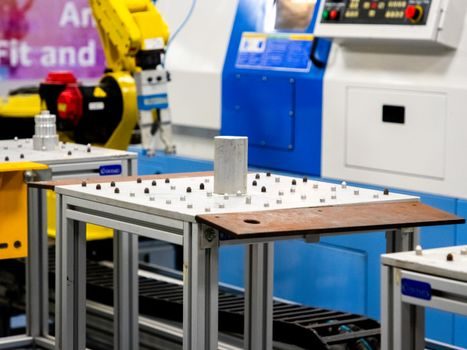
On the four decision criteria that drive 2026 spec — payload range, typical repeatability, cycle-time class, and cell-fencing requirement — articulated 6-axis units cover 10–800 kg payload at ±0.05 to ±0.1 mm repeatability and require fenced cells; SCARAs cover 1–20 kg at ±0.02 to ±0.03 mm and require light guarding or risk-assessed guarding; deltas cover 0.1–8 kg at ±0.05 to ±0.1 mm with overhead-mount guarding; cobots cover 3–35 kg at ±0.05 to ±0.1 mm and run fence-free under PFL; AMRs (mobile logistics robots) carry 100–1,500 kg payloads, follow virtual paths, and are governed by ISO 3691-4 for driverless industrial trucks [S6].
Mobile logistics robots carry a different cost logic — typically USD 25,000–75,000 per unit plus fleet software — and the payback model is fleet-density driven rather than per-cell.
Sourcing and Vendor Stack Signals
Where the 2026 procurement signal is clearest, it is in the second-source question. Single-platform dependence has become a board-level risk, and procurement teams are now asking for open controllers, ROS 2 compatibility, and documented spare-part pricing through year 10. Standardised spare-part catalogues with harmonic drives, servo motors, and teach pendants priced per SKU reduce integration risk when the cell eventually migrates to a new OEM. [S5]
Trackable signals to watch: (1) the 2026 European cobot price per kg of payload, which is the single fastest-moving spec; (2) AMR-cobot hybrid cell deployment counts in automotive tier-1 suppliers, where the hybrid cell replaces a fenced 6-axis arm and an AMR loop; (3) the magnesium die-casting cell growth, which is pulling demand for high-temperature wrists and industrial camera vision systems rated to 80 °C ambient, with the 37% die-casting segment share in 2026 acting as the leading indicator [S2].