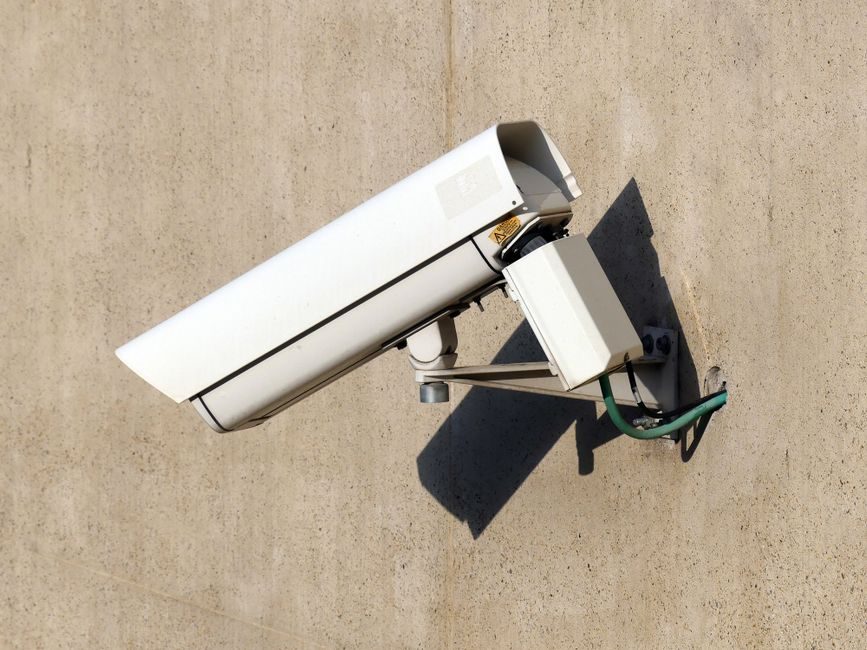
Industrial surveillance camera buying in 2026 hinges on four hard spec gates — sensor thermal sensitivity (NETD in millikelvin), ingress and impact rating (IP66/IP67 plus IK10), PoE class (IEEE 802.3af/at/bt), and ONVIF Profile S/T/G conformance — before any brand, lens, or analytics feature is discussed [S1][S2].
For a process engineer or facility security lead, the category now spans three price tiers: entry IP network cameras from Chinese OEMs at roughly US$24-35 per piece FOB Shenzhen for 4K/8MP fixed-lens bullet or mini-dome housings [S6]; mid-band industrial units such as the PHOTONIS SmartIR640 with 30 mK NETD cooled sensor for low-light and perimeter thermal imaging [S1]; and integrated NVR kits like the Synology BC500 HDR surveillance camera bundled with Synology's Surveillance Station software stack [S2]. A spec-first filter eliminates roughly 60% of catalog noise on platforms like DirectIndustry and Made-in-China before price or vendor reputation enters the conversation.
Sensor and Imaging Specs That Decide the Shortlist
Sensor selection is the first hard filter, and 2026 industrial SKUs split along three lines: standard CMOS IP cameras at 4MP/8MP resolution, low-light CMOS with starlight or HDR stacking as on the Synology BC500 [S2], and cooled/uncooled thermal imagers where NETD defines the grade — the PHOTONIS SmartIR640 advertises 30 mK sensitivity, a figure that places it in the cooled thermal band typically used for long-range perimeter and fire-detection roles [S1]. For a perimeter over 200 m at night, anything above ~50 mK NETD will miss a human heat signature against a warm background.
Resolution by itself is a weak gate; a 4K 8MP sensor with a poor lens and no HDR is outperformed by a 2MP starlight sensor. Synology's BC500 is explicitly marketed as an HDR surveillance unit, meaning the sensor reads two exposures per frame and merges them, preserving detail in both backlit entrances and shadowed loading bays [S2]. Buyers should demand the exact sensor part number and the minimum illumination figure in lux, not just a "starlight" label. For thermal units, request the NETD value, the lens focal length, and the detection/recognition/identification (DRI) ranges — PHOTONIS publishes SmartIR640 product data on DirectIndustry with a 30 mK figure but DRI must be cross-checked against the chosen lens [S1].
Lens and field-of-view trade-offs matter as much as the sensor. Fixed-lens 2.8 mm or 4 mm domes cover 90-110° horizontal FOV for room-scale coverage; varifocal 2.7-13.5 mm motors cover corridors and gate lines; 25-50 mm telephoto lenses are the only choice for perimeter lines past 80 m. A typical Shenzhen OEM 4K 8MP bullet with smart IR lands in the US$24-26 / piece MOQ-1 band on Made-in-China, while PTZ 4X/10X motorised units climb into the US$60-120 band [S6]. The industrial camera encyclopedia entry covers the broader machine-vision comparison, but for security rather than inspection, the relevant sub-classes are network IP, thermal, and PTZ.
IP, IK, and Operating-Temperature Gates for Harsh Sites
Industrial sites — foundries, chemical plants, oil and gas pads, food processing — demand IP66 minimum on the housing, with IP67 the practical floor where wash-down or prolonged rain is routine. IK10 (impact resistance to 20 joules, equivalent to a 5 kg object dropped from 400 mm) is the standard for any camera mounted below 3 m in a reachable area. These are not optional gates; a camera without IK10 at forklift-aisle height will be destroyed within the first year [S1][S3].
Operating temperature envelopes split the catalog. Commercial-grade cameras are typically rated -10 °C to +50 °C, which fails in unheated warehouses in northern winters or on refinery stacks in summer sun. Industrial-grade units extend to -30 °C to +60 °C or -40 °C to +70 °C with internal heaters — Shenzhen CCDCAM Technology's 2026 product catalogue explicitly markets an "Industrial Temperature" surveillance camera line, indicating heaters and wider-tolerance components rather than standard commercial BOMs [S3]. PHOTONIS's thermal camera line is specified for industrial and surveillance use, implying an extended thermal envelope, but buyers must request the explicit test report rather than infer it [S1].
Corrosion and chemistry add a third axis. Coastal, chemical, and waste-water sites should specify 316L stainless mounting hardware and salt-spray-tested (ASTM B117, 1000 h) housings. For explosive atmospheres, the camera must carry an Ex d or Ex tb marking under IEC 60079-1 / IEC 60079-31, or ATEX category 2/3 equivalent — this is a separate certification chain from IP and IK, and a vendor quoting "IP67 industrial" cannot be assumed Ex-rated. A surveillance camera deployment on a Class I Division 2 site without an explicit rating is a procurement error, not a cost optimisation.
Network, Power, and ONVIF Conformance
Power over Ethernet has settled into three power classes that map directly to camera choice. IEEE 802.3af (Type 1, 15.4 W) covers fixed-lens IP cameras and small domes. IEEE 802.3at (Type 2, 30 W) covers PTZ units with heaters and IR illuminators. IEEE 802.3bt (Type 3, 60 W; Type 4, 90 W) covers heavy PTZ with continuous IR and blowers. The Synology BC500 operates as a standard IP camera and is powered and connected through the same PoE switch infrastructure [S2]; industrial PTZ units with heaters often need 802.3bt to start cold without a separate 24 V AC supply.
ONVIF conformance is the interoperability gate that decides whether a camera will work with an existing VMS (video management system). Profile S covers video streaming and is the baseline; Profile T adds H.265, audio streaming, and analytics; Profile G covers recording, search, and playback. A 2026 procurement line should refuse any quote that does not declare ONVIF Profile S and T on the datasheet. The Synology BC500, for instance, integrates with Synology Surveillance Station, and third-party ONVIF conformance is what lets it sit on a Genetec, Milestone, or open-source ZoneMinder stack [S2].
Bandwidth and storage are the hidden costs. An 8MP 4K H.265 stream at 15 fps runs at roughly 4-6 Mbit/s; thirty cameras at that rate need a 200 Mbit/s uplink and 30-50 TB of storage per month at continuous recording. Motion-triggered recording, variable bitrate (VBR), and H.265+ / Smart Codec features cut storage by 50-70% in typical industrial scenes. The smart-home Tuya ecosystem mentioned in the CCDCAM 2026 catalogue [S3] is a different buyer lane from enterprise VMS — Tuya works for SMB retail but is rarely the right choice for a 100-camera plant.
Comparing the Three Buyer Lanes
The 2026 industrial camera market resolves into three lanes that line up cleanly against four decision criteria — cost per channel, environmental tolerance, low-light performance, and integration effort: [S1]
Entry IP network lane (Shenzhen OEM, MOQ 1-100 pieces, US$24-35 per piece FOB for 4K/8MP fixed-lens bullet and mini-dome). Cost per channel: lowest. Environmental tolerance: IP66 typical, -10 to +50 °C, no IK10 default. Low-light: standard IR 20-30 m, no thermal. Integration: ONVIF Profile S/T on most models, but firmware support is the weak link. Source: Made-in-China product listings from vendors such as SECUMATE in Shenzhen [S6].
Mid-band industrial/security lane (Synology BC500-class and similar HDR IP units, US$200-500 per channel packaged with NVR software). Cost per channel: mid. Environmental tolerance: IP66/IP67, -20 to +50 °C typical, IK10 on premium SKUs. Low-light: HDR sensor, smart IR to 30 m. Integration: ONVIF S/T, native VMS support from Synology Surveillance Station, Axis, Hikvision, Dahua [S2].
Thermal/rugged lane (PHOTONIS SmartIR640-class cooled thermal imagers, US$5,000-30,000+ per channel). Cost per channel: highest. Environmental tolerance: industrial and surveillance-rated housing, Ex marking on selected SKUs. Low-light: 30 mK NETD thermal, day/night CMOS secondary channel on integrated units. Integration: ONVIF on most modern units but proprietary control SDKs for thermal palettes and DRI [S1].
For a typical 30-camera plant deployment, the entry lane covers 80% of cameras, the mid-band covers entrance/exit and license-plate lanes, and the thermal lane covers perimeter and fire-detection. A buyer that tries to run all three lanes through one VMS should validate ONVIF profile parity before signing the PO.
Use Cases by Industry
For a manufacturing plant floor, the dominant requirement is dust and impact protection rather than analytics. Fixed-lens IP66/IP67 domes at 4MP with IK10 housings mounted at 2.5-3 m cover aisle surveillance, and a separate set of varifocal bullet cameras covers loading-dock approaches. PTZ units add value at intersections and yard zones but only if 802.3bt power is provisioned [S6].
For oil and gas, perimeter and flare-stack monitoring are the thermal camera's domain. The 30 mK NETD class (PHOTONIS SmartIR640 line) gives a 5-6 km human-detection range with a 100 mm lens, and integrated visible-light channels cut the number of separate housings on the pole [S1]. Any Ex-rated deployment needs a vendor-supplied IECEx or ATEX certificate, not a marketing claim.
For warehouses and logistics, ceiling-mounted PTZ domes with wide dynamic range handle the lighting contrast between dock doors and interior racking. The Synology BC500-class HDR IP camera is a reasonable mid-band fit, particularly when paired with Synology NAS-based NVR storage and Surveillance Station software [S2]. Entry-lane Shenzhen OEM units suffice for aisle coverage at a fraction of the cost, and many integrators run a mixed fleet with ONVIF tying them together [S6].
For SMB retail, the CCDCAM Tuya-ecosystem product line [S3] offers a low-friction path: cameras ship with QR-code onboarding to a phone app and cloud storage. This is a different value proposition from an industrial VMS and should be evaluated on total cost of ownership over five years, not on the unit price alone.
Limits, Failure Modes, and Common Sourcing Traps
The dominant failure mode on industrial sites is not the camera but the connector. IP67 rating on the housing is wasted if the installer uses a standard RJ45 plug instead of an IP67-rated coupler. Cable glands, conduit seals, and surge protection on the PoE line are the installer's responsibility but should be specified in the PO. A second common failure is IR reflection at night from nearby walls or windows — a dome with smart IR that adjusts LED intensity in zones is the only fix, and entry-lane units at US$24-35 rarely have it [S6].
Sourcing traps include: (1) "industrial" labels without temperature-range data on the datasheet, (2) ONVIF claims without a profile letter (a vendor that says "ONVIF" without naming Profile S/T/G is signalling legacy firmware), (3) 4K resolution claims backed by a 1/3" sensor that simply cannot resolve 4K detail at the lens's aperture, and (4) thermal cameras marketed in millikelvin NETD but tested only at the sensor, not at the system level including lens transmission losses [S1]. A buyer should require the full datasheet, the ONVIF conformance certificate, and a sample unit for a 30-day pilot before bulk release.
Lead time and MOQ matter in 2026 sourcing. Made-in-China listings show 1-piece MOQ on most Shenzhen OEM SKUs, with FOB Shenzhen pricing and 7-15 day production lead times for stock models, longer for OEM/ODM builds [S6]. Industrial thermal units and Ex-rated cameras run 4-12 week lead times even from PHOTONIS-class vendors, so thermal/Ex SKUs should be ordered ahead of civil works [S1].
Sourcing Standards and Documentation Checklist
The standard stack a 2026 buyer should reference on the datasheet: IEC 60079-0 and IEC 60079-1 for Ex d flameproof enclosures where the camera is in a hazardous area, IEC 60529 for the IP code, IEC 62262 for the IK code, ONVIF Profile S/T/G for VMS interoperability, and IEEE 802.3af/at/bt for PoE power class. For NVR-side storage, RAID configuration and surveillance-rated HDD lines (e.g. WD Purple, Seagate SkyHawk) are the relevant data points. The Synology BC500 is documented as pairing with Synology Surveillance Station for the NVR layer [S2], and the CCDCAM 2026 catalogue provides an "Industrial Temperature" product line and a 2026 PDF catalogue that engineers can request directly from the vendor [S3].
A 2026 procurement checklist: (1) sensor part number, lux rating, and NETD if thermal; (2) IP and IK rating printed on the datasheet; (3) operating temperature envelope with cold-start behaviour; (4) PoE class and maximum power draw; (5) ONVIF profile letter; (6) warranty term and RMA location; (7) for Ex sites, valid IECEx or ATEX certificate number; (8) for thermal, NETD figure and DRI at the chosen lens. Vendors that cannot produce all eight on request are not yet procurement-ready for an industrial site. Buyers running a pneumatic system on the same plant should be aware that vibration from compressors can loosen camera mounts over time, so anti-vibration brackets are a worthwhile line item on the same order.
Trackable signals for the next 6-9 months: PHOTONIS-class thermal camera vendors continuing to push NETD below 25 mK as cooled sensor yields improve; Shenzhen OEM 4K/8MP pricing on Made-in-China tightening below US$20 per piece as the 2026 capacity wave lands [S6]; ONVIF Profile M (metadata) gaining traction on AI-overlay analytics cameras through 2026; and ATEX/IECEx-certified industrial IP cameras from established European vendors remaining in the 8-12 week lead-time band as the only viable path for Zone 1/Class I Div 1 sites.
For component-level specifications, see linear guide.