
Industry 4.0 in lithium processing is a holistic automation and manufacturing-execution architecture linking IIoT sensors, cloud analytics, AI/machine learning and cyber-physical systems to deliver real-time decision making across spodumene conversion, brine evaporation, and cell-assembly lines [S2].
The German High-Tech Strategy 2020 framed Industry 4.0 as a fourth industrial revolution built on cyber-physical systems and the Internet of Things, targeting make-to-order production of quantity one at mass-production cost through embedded processing and machine-to-machine communication [S1]. For lithium processors, that goal translates directly into faster grade switching between battery-grade Li2CO3 / LiOH·H2O and technical-grade material without breaking campaign economics.
Definition and Scope for Lithium Plants
Industry 4.0 is synonymous with smart manufacturing, defined by IBM as the digital transformation of the field that delivers real-time decision making, enhanced productivity, flexibility and agility [S2]. The same IBM reference notes the four industrial revolutions running from late-18th-century water/steam power, through 20th-century PLCs and ERP, to today's cyber-physical systems [S1][S2].
Lithium facilities apply this stack across both process and discrete segments: hydrometallurgy reactors, crystallisers, calcination kilns, electrode coating, and cell formation all sit inside the same digital thread. ISA's framing highlights integrated inbound logistics, production, marketing, outbound logistics and service as the scope boundary that lithium converters and cell makers should map first [S1].
Selection Criteria: Which Lithium Lines Benefit First
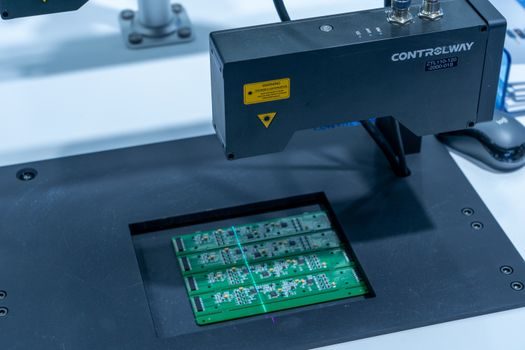
High-mix, high-throughput lines are the first movers: AI visual-inspection retrofits for electrode coating and winding pay back fastest because they replace manual inspection with cloud-connected cameras, catching defects that would otherwise surface at formation [S2].
Bulk-chemical lines (acid-roast, leach, purification, carbonation) gain more from pressure transmitter and flow-meter digital twins tied to a PLC layer than from robotics, because the bottleneck is reaction control, not pick-and-place. ISA's view that Industry 4.0 is about end-to-end integration across company boundaries — suppliers, customers, service — argues against piloting IIoT in a single isolated unit [S1]. Start where data is richest: kiln temperature, reagent dosing, and pH/conductivity loops.
Core Technology Stack and Decision Matrix
ISA's German-origin framework specifies IoT, web services and communications as the connective tissue between smart machines, warehousing and production facilities [S1]. IBM extends that stack with cloud computing, analytics, and AI/ML as the decision layer on top of the IoT fabric [S2].
For lithium, a practical matrix lines the main enabling technologies against four decision criteria:
IoT/edge sensors — best for continuous process lines (conversion, calcination), lowest unit cost, integrates directly with pressure sensor and flow-meter loops. Cloud analytics — best for cross-plant visibility, scales across brine and hard-rock sites, but requires OT/IT governance. AI visual inspection — best for electrode coating, slitting and winding, can use a smartphone connected to the cloud for low-cost entry per IBM guidance [S2]. An IBM Institute for Business Value study found that smart manufacturing can improve production yields by 20 percent.
Documented Benefit Bands and Where the Numbers Land
IBM's Institute for Business Value study work cites improvement in production defect detection of as much as 50 percent and improvement in yields by 20 percent when smart-manufacturing patterns are applied [S2]. Predictive maintenance on rotating equipment — kiln drives, compressors, pumps — is framed as the clearest downtime reducer, with sensor data feeding ML models that flag bearing and seal wear before failure.
Real-time visibility of manufacturing assets is the single largest source of new efficiency: the IBM position is that analysing big data from factory-floor sensors minimises equipment downtime and underpins predictive maintenance [S2]. For lithium, this maps onto impurity-trending across crystalliser trains, where a 10-20 ppm shift in Na/Ca/Fe can be detected by inline sensors hours before offline ICP confirms it.
Integration With Existing Control Assets

The third industrial revolution — PLCs, numerical control, direct digital control and ERP — remains the substrate Industry 4.0 layers onto [S1][S2]. New IIoT work should not rip out functioning PLCs; it should expose their tag databases via OPC UA or MQTT and feed them into the analytics layer.
Industrial valve actuators with HART or Foundation Fieldbus diagnostics, smart servo-motor drives on coating lines, and digital flow-meter outputs are the practical data sources for an Industry 4.0 retrofit in an existing lithium plant. ISA's view is that Industry 4.0 is a vision of integrated industry where people, machines, equipment, logistics systems, and work-in-process components communicate and cooperate directly [S1] — meaning brownfield serial-bus upgrades, not full control-system replacement.
Standards, Sourcing and Pilot Boundaries
No new IEC or ISO standard is required to begin an Industry 4.0 pilot; the technology stack is vendor-neutral, anchored on common IT protocols and existing process-instrumentation buses [S1][S2]. Sourcing decisions therefore reduce to data-quality and lifecycle questions: which sensor vendors expose clean OPC UA, which cloud platforms support on-premise edge gateways, and which AI/ML toolchains integrate with existing historians.
Lithium producers planning 2026 capacity expansions should treat Industry 4.0 as a specification item on new lines rather than a retrofit decision, embedding IIoT gateways, smart instruments and cloud connectors into the EPC scope from day one. For related planning context on cell, pack and hydroxide spec bands, the 2026 production-capacity article walks through the matching volume bands; for trade-flow impact, the China lithium battery export flow analysis tracks how smart-manufacturing yield gains reshape global mix. The Industry 4.0 spec walkthrough for GPU process plants also covers parallel selection criteria for the digital-thread layer that lithium converters will share.
For related coverage, see Lithium Production Capacity Planning: 2026 Cell, Pack and Hydroxide Spec Bands.