
On a demolition site the phrase "infrared" covers two unrelated tools: an infrared level that projects a self-leveling beam for layout, and an infrared emitter that radiates heat to soften coatings, release adhesives, or dry substrates before mechanical separation [S2]. Crews that conflate the two routinely buy the wrong tool, so the rest of this article separates the spec gates for each.
The two devices share a physics label and nothing else. A line laser is an optical instrument with a diode, pendulum compensator, and detector compatibility; an infrared emitter is a thermal source characterized by watt density, emitter temperature, and spot size, used as a conditioning step ahead of hydraulic cutters, splitters, and shears [S2].
What an Infrared Line Level Actually Does on a Demolition Site
A line laser used during demolition work projects a horizontal or vertical reference plane so saw cuts, slab removals, and partition openings stay true across long runs; typical working range with a detector sits between 100 and 165 ft, while naked-eye visibility without a detector drops to roughly 30-40 ft in low-light conditions [S1]. That ratio, detector-on versus detector-off, is the single most useful spec gate when comparing two lasers that otherwise share a price band.
For interior strip-outs the 30-40 ft naked-eye band is usually enough, so crews can skip the detector. For long exterior cuts, alignment of formwork, or any run past 50 ft, plan on a detector and budget the 100-165 ft figure into the layout geometry [S1]. Beam color (green versus red) and pulse mode for detector pickup are the next two decision points; green beams read better in daylight but draw more current, which matters on battery-only shifts.
What an Infrared Emitter Actually Does on a Demolition Site
An infrared emitter raises the surface temperature of a target without an open flame, making it suitable for local heating tasks such as releasing coatings, freeing adhesive joints, and drying substrate before mechanical removal [S2]. Unlike flame torches, infrared radiates heat to the surface and minimizes ignition risk on coated or bituminous layers, which is why safety officers prefer it for indoor and confined-space work.
In a sequenced deconstruction workflow, heat is almost never the separation step itself; it conditions the material so a downstream tool, a demolition hammer, a concrete pulverizer, a steel shear, or a splitter, can do the cut with lower force and less vibration [S2]. Treat the emitter as a preparatory stage, then size the mechanical tool to the post-heated material state.
Spec Gates for the Infrared Line Level

Line laser selection for demolition is dominated by four numbers: working range with detector, accuracy (commonly expressed as ±X mm at Y m), self-leveling range of the pendulum compensator, and IP rating for dust and water. Most current line lasers cluster between 100 and 165 ft detector range and 30-40 ft visible range [S1], so accuracy and IP become the differentiators on a dusty, wet, high-vibration jobsite.
Accuracy bands typically run from about ±1.5 mm at 5 m for pro-grade cross-line lasers down to ±3 mm at 10 m for entry units. Below ±3 mm at 10 m the unit is no longer fit for saw-cut layout on slabs or for aligning long partition frames. Pulse mode for detector compatibility and 360-degree line emission are the next two features to check; a single-line unit forces repeated repositioning on long runs, which costs labor hours.
Battery platform and drop rating round out the spec. M12, M18, and similar 12-18 V Li-ion packs are the de facto standard for trade tools, and a 1 m drop rating on concrete is the floor for anything that will live on a demo site. For a wider view of how laser tools fit alongside other measurement gear on a job, see this landscape laser distance meter outdoor spec map 2026 for adjacent selection logic.
Spec Gates for the Infrared Emitter
Emitter selection turns on three figures: electrical power input (W), radiated surface temperature (°C), and effective heating area or spot size (cm² or mm diameter). The unit must also be rated for the orientation it will be used in, since some quartz emitters fail in a downward-firing position because of convection cooling of the reflector. [S2]
Power density is the working spec: low-W handheld units cover paint softening on small patches; mid-W (1.5-3.0 kW class) industrial emitters cover adhesive release on larger façade or floor sections. The radiated wavelength matters when the substrate is transparent or reflective: short-wave emitters bite into dark or coated surfaces, while medium-wave units give a more even soak for thicker adhesive beds [S2].
Pair the emitter with thermal monitoring (an infrared thermometer or contact probe) and a defined standoff distance. Without a temperature target, crews either under-heat and waste cycle time or over-heat and drive vapor pressure in concrete capillaries high enough to spall the surface [S2]. On coated concrete, spalling risk is the reason heat input is intentionally moderate and the mechanical step does the actual separation.
Comparison: Infrared Line Level vs Infrared Emitter on a Demo Site
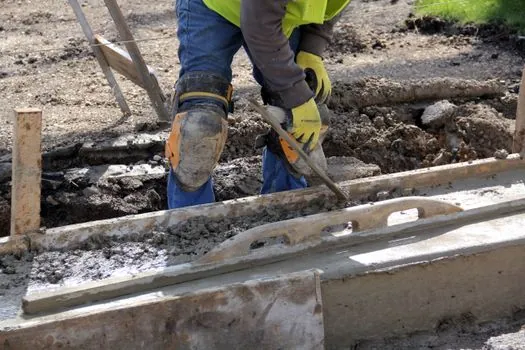
The two tools do not compete; they sit at different points in the workflow. The comparison below is the one safety planners actually run when a crew asks for "an infrared tool" without specifying which: [S2]
Primary function: line level projects a reference plane; emitter raises surface temperature. Output medium: line level emits a visible laser diode, typically around 510-635 nm; emitter emits broadband infrared radiation in the short to medium wavelength range [S2]. Key spec: line level is gated by working range (100-165 ft with detector, 30-40 ft naked-eye) [S1]; emitter is gated by power density and target temperature. Failure mode: line level fails by beam dimming in daylight or by compensator drift after a drop; emitter fails by spalling, delamination, or coating ignition when watt density is misapplied. Operator PPE: line level needs laser safety glasses matched to the diode wavelength; emitter needs heat-rated gloves and shielding for bystanders.
The split, then, is by job step: layout versus conditioning. On a slab-removal project a crew might use a line laser to mark the cut, an emitter to soften an adhesive layer, and a truck-mounted concrete pump to clear the spoil, three different tools in sequence, none of which substitute for another.
Limits, Failure Modes, and Site Constraints
Line lasers fail on demo sites in three predictable ways: compensator lockout after a drop, beam washout in direct sunlight past the 30-40 ft visible band, and detector interference from highly reflective dust [S1]. The fix is procedural, not technical: drop-test the unit daily, switch to a detector beyond 50 ft, and clean the receiver window before each shift.
Infrared emitters fail by the opposite mode: too much heat, too fast, on the wrong substrate. Rapid heating of concrete raises vapor pressure in capillaries and can spall the surface; on multilayer systems, mismatch of thermal expansion between layers can drive delamination outside the planned separation zone [S2]. The fix is a controlled ramp, a defined standoff, and a target surface temperature measured at the part, not at the emitter.
Site constraints shape the choice as much as the spec sheet. Confined indoor spaces push the workflow toward infrared emitters over flame for fire-load reasons. Long exterior runs push the layout tool toward a pulse-mode line laser with a detector. Where the two meet, a large floor-plan strip-out, the spec maps stack: a 100-165 ft line laser for layout, a 1.5-3.0 kW infrared emitter for adhesive release, a mechanical demolition hammer for the actual breakout.
For related selection logic on adjacent demolition-support equipment, the truck-mounted concrete pump spec map for demolition projects covers the spoil-handling side of the same workflow, and the heat detector selection for firefighting 2026 hazard map covers the thermal-sensing side that pairs with any infrared emitter on site. Track the next revision of IEC 60825-1 for laser classification updates that will affect how line-level diodes are labeled, and watch for any infrared-emitter efficiency moves out of the mid-W industrial band (1.5-3.0 kW) that have been the workhorse range through 2026-08.