Green-beam cross-line tools (Class II 515-532 nm) give 30-40 m visible and 300-600 m with a matched detector, with 1-3 mm deviation at 30 m and 500-1500 USD list price as the typical 2026 pro tier for outdoor layout work [S6].
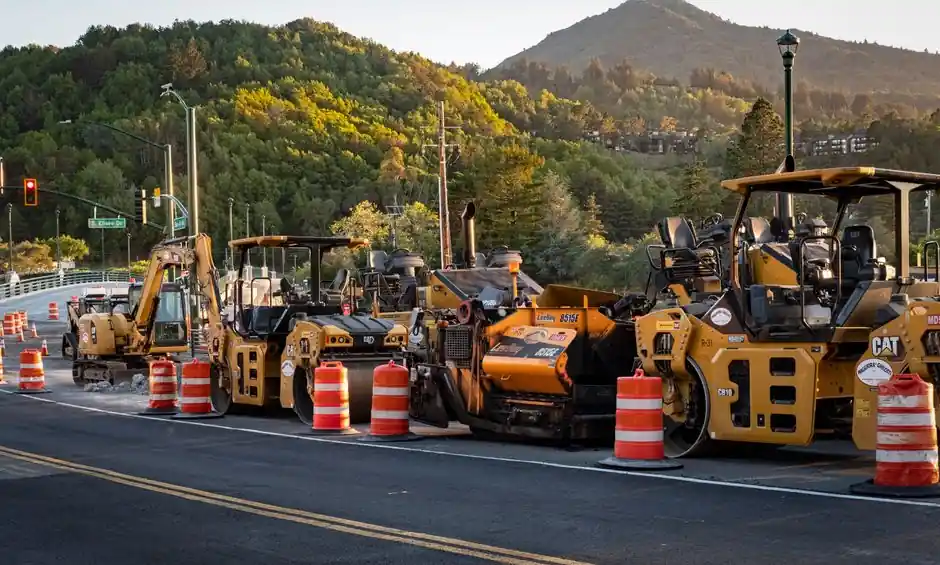
Road maintenance layout is dominated by 30-80 m runs of asphalt patching, curb reveal, drainage invert, and formwork: short enough for a line laser, long enough that handheld accuracy evaporates without a detector, and dirty enough that IP65 and a pendulum lock beat any premium for a higher wavelength number [S1][S2].
Wavelength and Color: Why Green Wins Asphalt and Concrete Work
The 532 nm green line reads roughly 4-6× brighter to the human eye than 635 nm red at equal optical power, because the eye peaks near 555 nm and falls off sharply past 600 nm; on a sunlit patch job the difference between a line you can see and one you cannot is exactly that factor [S3][S6]. 2026 road-maintenance crews should default to green unless there is a specific reason not to, and the two reasons that come up are budget (green diode modules cost more) and battery life (green tools typically run shorter per charge than red at the same mAh) [S3].
For runs above roughly 30 m or in direct afternoon sun, a 532 nm unit still needs a matched green detector to recover the beam; neither color is reliably visible to the unaided eye above 50 ft of ambient illumination, and a detector is mandatory for stakeout and formwork beyond that point [S4]. A common procurement error is buying a green line laser and a red-only line receiver; the photodiode bandpass filter on the receiver is wavelength-locked, so a 532 nm beam is invisible to a 635 nm-tuned detector and the unit will not pick up [S2].
Accuracy Bands: ±0.2 vs ±0.3 vs ±0.5 mm/m on Patch and Curb Work
Three accuracy bands dominate 2026 line-level SKUs: ±0.2 mm/m (precision cabinetry, drywall reveals), ±0.3 mm/m (general interior layout), and ±0.5 mm/m (rough plumbing, mechanical rough-in, exterior formwork) [S2]. For road maintenance, ±0.5 mm/m is the right ceiling for asphalt patch and curb formwork because the formwork tolerance on a 10 m pour is already ±10 mm, and a tighter number on paper buys nothing the substrate can hold [S2].
On a 30 m run, the deltas are 6 mm, 9 mm and 15 mm respectively; on a 10 m run they are 2 mm, 3 mm and 5 mm, which is the gap between a curb reveal that closes and one that daylights along a kerb line. Field reality from 2026 service data: ±0.2 mm/m units are sensitive to tripod flex and thermal expansion of the housing itself, so the gain over ±0.3 mm/m disappears if the unit is handheld or mounted on a flexible signpost; calibration intervals of 6-12 months are typical, with factory flat-rate fees in the 30-80 USD band [S2].
IP, Power, and Working Range: Roadside Conditions

IP54 is the de-facto floor for jobsite use, but road maintenance is a wet, dusty, vibration-loaded environment, so IP65 is the right spec gate for any unit that cycles in and out of a truck bed; the difference is dust-tightness and resistance to low-pressure water jets, both of which a kerb-laying crew hits weekly [S2][S5]. Running temperature spans usually land in the −10 °C to +45 °C window, with some pro SKUs extended to −20 °C, which covers most temperate paving seasons; cold-storage yards and northern-winter pours need the extended SKU [S2].
Rated range on a 2026 line laser is almost always quoted two ways: visible line (typically 20 m to 30 m red, 30 m to 50 m green, in bright interior conditions with a target plate) and detector range (typically 50 m to 80 m red, 80 m+ green with a matched line receiver) [S2][S5]. Power is almost universally a 3.7 V Li-ion pack with USB-C charging on mid and pro tiers, and AA × 3 or AA × 4 on entry tiers; for a road crew that runs a full shift, a USB-C Li-ion pack is worth the small price step because AA cells drop voltage on cold mornings and the line dims as the cells sag [S5].
Visible vs Infrared-Only: Who Needs the IR Channel on a Road Job
Most road maintenance layout is human-readable, so a visible red or green beam is the correct spec, and the infrared channel (typically 808 nm or 850 nm) only earns its BOM cost where a machine-vision system, photoelectric sensor, or ceiling-mounted line detector is the actual consumer of the line [S2][S5]. For a kerb-and-gutter crew, AGV-dock paving stringline, or automated formwork sensor, the 850 nm or 940 nm channel is what lets the camera lock on a beam the operator's eye ignores; on a purely manual patch and tie-bar job it is dead cost [S2].
Mixing the two on a jobsite causes procurement friction: an IR-only unit without a matched detector is functionally invisible, and a visible-beam unit cannot drive a vision system tuned to 808/850 nm. Buyers should check the datasheet for separate visible and IR laser-class entries; a credible 2026 sheet cites the visible class (commonly Class 2) and the IR class (often Class 1) separately, because the IR channel is invisible and the legal exposure limit under IEC 60825-1 is tighter at longer wavelengths [S2][S3].
Cost Bands and Sourcing Gate for 2026

FOB-Ningbo 500-piece MOQ listings on Asian B2B platforms in mid-2026 landed infrared and visible-beam line lasers in a $23-$54/pc band, with three tiers: entry (2-line, plastic body, AA batteries) at $23-$32/pc, mid (3-line, 360°, IP54, Li-ion) at $33-$45/pc, and pro (multi-line green, magnetic mount, hard case) above $45 up to $54 [S5]. For road maintenance, the mid tier is the procurement baseline; the pro tier is justified only if the crew also does interior fit-out and amortises the green-beam premium across both workloads [S5].
Standard MOQ sits at 500 pieces with 1,000,000-piece-per-month supply from the major Ningbo and Shenzhen OEM lines, payment terms TT or LC at sight, and FOB Ningbo as the default incoterm; lead time on a 500-piece OEM order runs 15-25 days for stocked SKUs and 30-45 days for custom-color, custom-logo, or private-mold runs, and sample policy is typically 3-5 sample units at cost, refundable against a PO above 1,000 pieces [S5]. For a quick cross-reference on accuracy and IP vocabulary used in optical-automatic instruments, the infrared level encyclopedia entry lays out the same numbers in a broader instrument context.
Selection Comparison: Three Common Road-Maintenance Layout Cases
Case 1: asphalt patch and tie-bar layout on a 15-30 m closure, daytime, two-person crew. Tool: mid-tier 3-line 360° green-beam, IP54, Li-ion, ±0.5 mm/m. Cost band: $33-$45/pc FOB Ningbo. Detector: not required on most shifts. Failure mode to watch: pendulum lock not engaged before transport, which knocks the compensator out of calibration and shows up as 5-10 mm drift on the next setup [S2][S5].
Case 2: kerb and gutter formwork on a 50-80 m run, direct sun. Tool: pro-tier green-beam cross-line, IP65, matched green detector, ±0.3 mm/m. Cost band: $45-$54/pc tool plus a 150-300 USD detector. Failure mode: detector tuned to 635 nm red, so the green beam is invisible to it; the receiver must be specified for 515-535 nm [S4][S6]. For crews that also handle HVAC laser distance meter duct layout, the same green-detector compatibility logic applies and the same detector SKU can be shared across tools.
Case 3: AGV-dock or machine-vision stringline on a paving train. Tool: dual-emission unit with visible green reference plus a co-aligned 850 nm IR channel, IP65, ±0.3 mm/m, separate Class 1 IR rating on the datasheet. Cost band: pro tier, often configured to order. Failure mode: IR channel power set without a matched IR detector on the vision side, so the camera cannot lock on a beam the operator also cannot see; this is the classic 808/850 nm mismatch that turns a line laser into a parts inventory problem [S2][S5].
When Not to Use a Line Laser on a Road Job
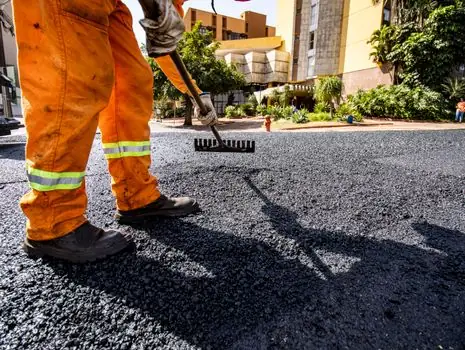
A line laser is the wrong tool when the run is over 150 m, when the line has to hold grade through a vertical curve, or when the substrate tolerance is already looser than the instrument's accuracy budget [S1]. For long-haul stakeout, an automatic optical level on a 1 km closed-loop spec of ±1.0 to ±2.5 mm per DIN 18723 / ISO 17123-2 is the right instrument, and the two accuracy systems are not interchangeable: a line level that quotes ±2 mm at 10 m extrapolates to ±200 mm per km, four orders of magnitude worse than a survey automatic level [S1]. The automatic molding line selection map and the broader molding line reference sit far from this application, but they are the same class of decision: pick the instrument by the spec band the job actually demands, not by the highest number on the sheet.
For procurement, trackable signals for the rest of 2026 are: vendors that publish ISO 17123-2 / DIN 18723 test certificates with their automatic level shipments, and line-level vendors that publish a wavelength band, an output power in mW, and a detector-matching spec on the same datasheet page [S1]. A 2026 spec sheet that only lists "laser line" with no wavelength data is a red flag; credible sheets cite the visible class and the IR class separately, and the receiver SKU on the same quote [S2].