
Specifying an industrial infrared thermometer is a five-axis decision: D:S (distance-to-spot) ratio, spectral response, emissivity handling, response time, and environmental compensation [S3][S5]. Get any of these wrong and the same gun that reads a motor winding to ±2 °C can miss a furnace tuyere by 80 °C.
The product class crossed USD 870.87 million in 2025 and is forecast to reach USD 1,274.28 million by 2030 at a 7.91% CAGR, driven equally by predictive maintenance retrofits and food/pharma process digitization [S2]. For buyers, that growth means more vendor SKUs in the same price tier, not a step-change in measurement physics.
D:S ratio and target size: the single most expensive mistake
D:S ratio defines the cone of view a thermometer sees at a given standoff — a 12:1 unit reads a 1 cm spot at 12 cm, 25.4 cm, and so on [S3][S5]. Field engineers routinely oversize D:S because the datasheet looks generous, then find the instrument averages in cold background, especially on reflective stainless headers.
Rule of thumb: target spot should fill at least 50% of the optical field, and D:S must be doubled for moving webs, conveyor belts, or anything vibrating in the stand. For a 5 mm roller surface at 30 cm, that means 60:1 or tighter — a class that usually requires a close-focus optic or a fiber-coupled head, not a general-purpose 12:1 pistol.
Spectral response: 8–14 µm versus short-wave 1.0/1.6 µm
Long-wave 8–14 µm detectors dominate general-purpose industrial SKUs and are the spectral band most consumer-grade units share [S3]. The band works well above 200 °C on matte metals, asphalt, ceramics, and food, but it is essentially blind through flame, plasma, or quartz windows that absorb long-wave IR.
Short-wave 1.0 µm and 1.6 µm detectors, paired with high-temperature detectors, handle molten metals, glass, and furnace interiors because peak black-body emission shifts to shorter wavelengths as temperature climbs [S5]. A general-purpose 8–14 µm gun aimed at a 1200 °C blast furnace tuyere will under-read dramatically; a 1.0 µm unit is the correct call. International detection standards covering IR thermometers group into thermometry and electrical-measurement buckets, which is why vendors often carry dual certification footprints [S4].
Emissivity: the dial that decides whether the reading is real
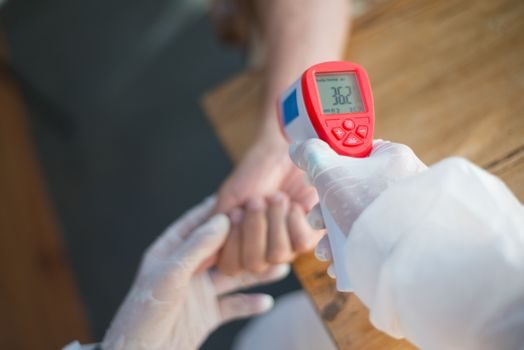
Emissivity (ε) adjustment from 0.10 to 1.00 is mandatory on any unit destined for metal, glass, or polished surfaces — fixed-ε 0.95 units are acceptable only for paper, food, rubber, and painted steel [S3]. A polished aluminum reflector at 200 °C with ε = 0.05 returns a black-body-equivalent temperature of roughly 50 °C if the gun is left at 0.95.
For unknown surfaces, a two-step field check still pays for itself: tape a small patch of high-ε electrical insulation tape (ε ≈ 0.95) over the target, let it equilibrate, set ε to 0.95, then take a contact reading through a thermocouple to back-compute the bare-surface ε. This is the same calibration logic used in industrial heat-treatment shops and is the only reliable way to fill a custom-ε table in the meter's memory.
Response time, optics, and laser sighting
Industrial-grade units publish response times under 500 ms; handheld consumer units often sit at 800 ms to 1.5 s [S3]. For a static bearing housing, that gap is irrelevant. For a high-speed can-seam or a rotating kiln shell, 500 ms is the threshold where the gun stops smearing across a feature.
Laser sighting is convenience, not accuracy — single-laser units mark the optical center, dual-laser units bracket the actual measurement cone, and crosshair units only show where the operator is aiming. None of the three changes the underlying optics. When comparing to wired instrumentation, thermocouple vs infrared thermometer: selection, specs, and tradeoffs walks through the same D:S/response-time logic against contact probes.
Environmental limits: ambient, humidity, and atmospheres
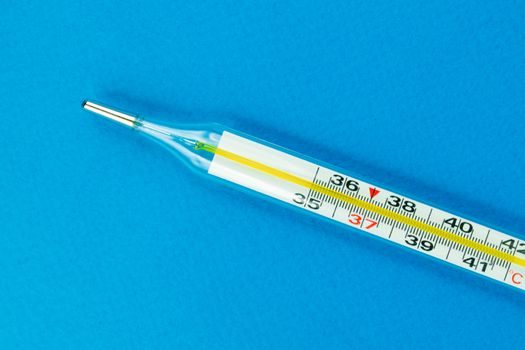
Working ambient on most handheld industrial units runs 0 °C to 50 °C operating and −20 °C to 60 °C storage, with relative humidity 10% to 90% non-condensing [S3]. Above those limits, the housing drifts, the detector cold-junction compensation loses linearity, and the laser pointer output can violate eye-safety classes.
Atmospheric compensation matters even at short range: steam, dust, and combustion gases each have IR absorption bands that can clip 5% to 15% off a reading across a 1 m to 3 m path. In steam-heated food lines or paper dryers, shorten the path and re-zero against a known reference before trusting trend data. Humidity logs and ambient-temperature logging inside the instrument are now standard on mid-tier units and should be on the BOM for any GMP or HACCP application [S5].
Output, data logging, and integration
Holding/min/max/avg, differential mode, and 100-group data logging are baseline on industrial SKUs and are useful for walking an electric panel with a clipboard [S3]. For permanent mount, look for 4-20 mA, RS-485 Modbus, or Ethernet outputs, and confirm the manufacturer publishes a transducer block or GSD file rather than a closed proprietary protocol.
Power is usually 9 V battery for handheld or 24 VDC for fixed mount; on a 24 V loop, derate the supply against inrush if multiple units share a PSU. For a process plant that already runs industrial valve positioners and flow meter heads on 24 VDC, mounting an IR head on the same bus cuts commissioning time noticeably.
When an infrared thermometer is the wrong tool

IR thermometers measure surface radiative temperature, not internal temperature, and they cannot see through glass, water, or most plastics in the 8–14 µm band [S3][S5]. A sealed autoclave, a vacuum furnace interior, or a liquid in a glass-lined vessel all need contact probes — typically a mineral-insulated thermocouple sheath or an RTD — not a hand-held gun.
They are also the wrong tool for shiny metals in reflectively heated environments without a high-ε coating or a black-body target. In those cases, the IR gun will report the reflected background, not the workpiece. For process lines that already use pressure transmitter loops and level instrumentation, the same caution applies: IR is a complement, not a replacement, for inline sensors.
Selection checklist and traceability
A working procurement spec for an industrial IR thermometer should lock down six items before model selection: D:S ratio against the smallest expected target, spectral band against the lowest expected surface temperature, ε range and resolution, response time against process speed, output type against the existing DCS/PLC, and a calibration certificate traceable to a national lab. Skip any one of these and the bid review will collapse to price, which is how plants end up with 50 unspec'd units in a drawer [S3][S4][S5].
Watch for: ISO/IEC standards on thermometry under the infrared thermometer detection classification, and CE/RoHS documentation on every shipping unit. For a sanity-check of the chosen model, the consumer market's best infrared thermometers of 2026 roundup is a reasonable cross-reference for the consumer-tier SKUs that show up on Alibaba and Made-in-China, even if the industrial class is rated separately [S1][S6]. For adjacent instrumentation, the differential pressure transmitter buying guide: 2026 spec comparison uses a similar five-axis rubric and is a useful template to reuse for an IR bid.