Insulated hand tools for welding work should be specified to IEC 60900 with a 1,000 V AC / 1,500 V DC working rating and an individual dielectric test at 10,000 V, the 10:1 safety ratio that UL requires for any tool labelled "insulated" [S4][S5]. On the welding side, OSHA 29 CFR 1910.255(b)(2) requires stored-energy and capacitor-discharge resistance welding equipment operating above 550 V to be fully insulated, enclosed, and interlocked, with a manual discharge device wired in addition to the mechanical interlock [S1].
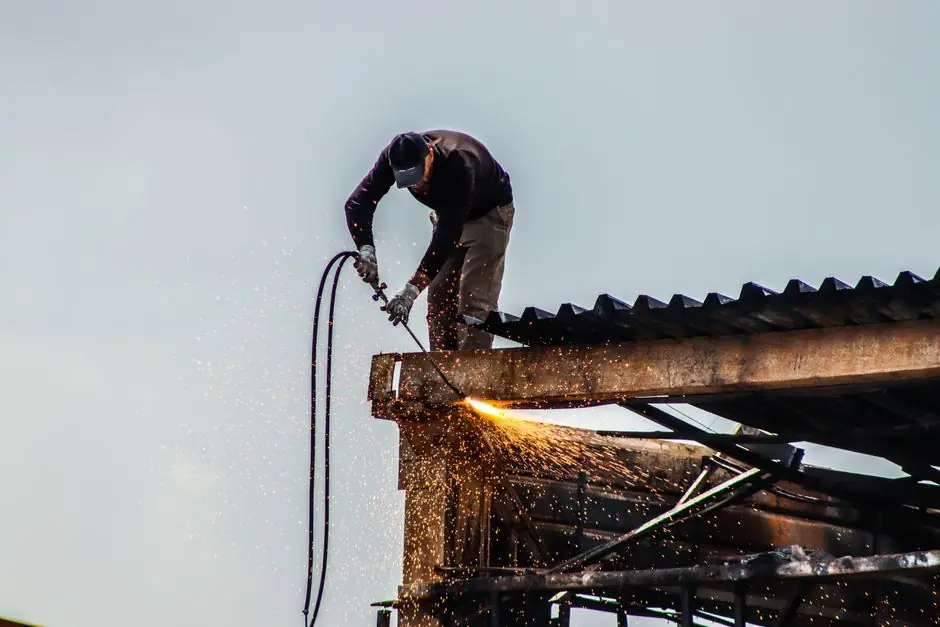
Welding work straddles two hazard families: the arc-welding side (striking voltage, secondary current, hot metal, spatter) and the live-electrical side (panel servicing, electrode holder wiring, capacitor banks, robotic weld controllers). A useful insulated tool kit addresses the second family, while standard welding PPE, gloves, chipping hammers, and grinders covers the first [S6].
Voltage rating, dielectric test, and what the marking actually means
A 1,000 V-rated insulated tool from a UL-listed manufacturer must survive a 10,000 V dielectric withstand test on every individual unit, a 10:1 safety margin that is the de-facto benchmark for "insulated" claims in IEC 60900 and in the U.S. market [S4]. Many professional lines are dual-marked 1,000 V AC and 1,500 V DC, the latter reflecting DC-bus work on solar, battery, and EV drive systems [S5].
The rating is only a first filter. A tool marked 1,000 V does not address arc-flash energy, restricted-approach boundaries under NFPA 70E, or the fault current available at the bus being worked on, so the rating must be combined with a site-specific arc-flash study and the PPE it implies [S4][S5]. The same tool used on a 480 V motor control centre and a 1,500 V DC battery string carries very different incident-energy exposure even when the insulation rating is identical.
Where insulated tools fit on a welding floor, and where they do not
OSHA 1910.335(a)(2)(i) requires insulated tools or handling equipment whenever an employee works near exposed, energised conductors or circuit parts and contact is possible, and NFPA 70E places that obligation inside the restricted-approach boundary for qualified electrical workers [S4]. On a welding line that triggers three routine tasks: servicing the resistance-welding control panel, troubleshooting a robot weld controller, and changing electrode cables on a live fixture.
Insulated tools are not the right control for the arc-welding hazards themselves. Striking voltage, infrared and UV radiation, spatter, and secondary current are managed by the electrode holder, welding helmet, leather welding gloves, flame-resistant clothing, and local exhaust ventilation, not by 1,000 V handle insulation [S6]. Insulated screwdrivers, pliers, wrenches, nut drivers, and cable cutters belong on the panel side of the cell, not on the stinger or the work clamp [S7].
Dipped versus injection-moulded insulation: process choice, not brand choice
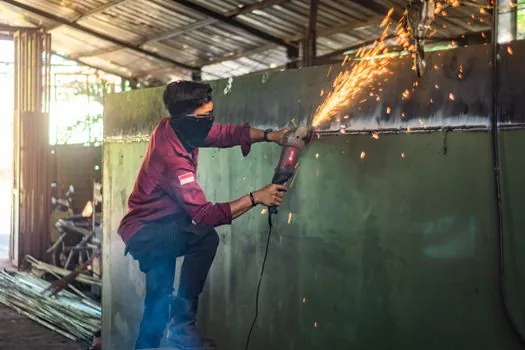
Two manufacturing routes dominate the market. Dipped insulation submerges the tool in a liquid dielectric (historically vinyl, now typically a polymer blend) and cures it, producing a dual-layer covering with a contrasting inner colour so a breach is visible [S4]. Injection-moulded insulation forms a single coloured plastic skin around the tool under controlled pressure, giving more consistent wall thickness than dip-curing, where the resin runs unevenly as it sets [S4].
ASTM F1505 (the manufacturing standard cited for insulated hand tools) requires that if two or more layers are used, the colours must contrast, typically orange over yellow, so a worn-through outer skin exposes a visible inner layer before the conductive steel shows [S4]. Buying decisions should look for: (a) the IEC 60900 or ASTM F1505 mark, (b) the 10,000 V test statement, (c) the dual-layer contrasting colour, and (d) traceability to a third-party certificate number on the tool or its packaging [S3][S5].
OSHA 1910.255 specifics: the rules a welding panel must already meet
29 CFR 1910.255(b)(2) is the operative clause for any stored-energy or capacitor-discharge resistance welding equipment operating above 550 V: it must be "suitably insulated and protected by complete enclosures, all doors of which shall be provided with suitable interlocks and contacts wired into the control circuit (similar to elevator interlocks)" [S1]. The same paragraph requires a manual switch or positive device as an added safety measure to discharge every capacitor when a door opens, on top of the interlock itself [S1].
Adjacent clauses set the rest of the panel ruleset: 1910.255(b)(1) caps external weld-initiating control circuits at 120 V for operator safety, 1910.255(b)(3) keeps access panels locked and interlocked against unauthorised entry, 1910.255(b)(6) guards every foot switch against accidental operation, and 1910.255(b)(7) requires at least two emergency-stop buttons on multi-spot and press welders [S1]. These are panel-builder obligations, but they are the reason a technician opening a 600 V weld control cabinet needs a verified de-energised state, a V-rated insulated toolset, and arc-rated PPE before any work begins.
Selection criteria by job, with comparison against alternatives
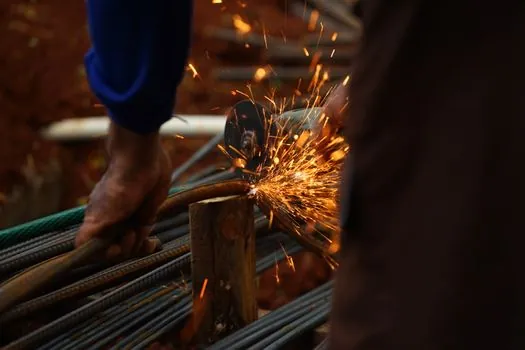
For a given live-side task, four decision points drive the tool choice: working voltage, available fault current, access geometry, and the standard required by site policy. A 1,000 V AC / 1,500 V DC IEC 60900 tool fits panel and motor-control work; a 1,000 V-only rated tool is acceptable for purely AC work but disqualifies itself for DC-bus and battery-string jobs [S5].
For cutting and stripping, an insulated cable cutter is the right tool because its jaw geometry and edge clearance are designed for copper and aluminium conductors; an insulated combination plier is not, even if its handles carry the same voltage mark [S5]. For terminal work, an insulated socket or nut driver is preferred over an open-end wrench on a crowded bus, because the socket fully encloses the fastener and reduces the chance of a short to an adjacent live part. For confined cabinet work, an insulated T-handle or low-profile ratchet beats a long extension, which makes contact more likely [S3][S5].
Non-insulated "1000 V" comfort-grip tools, plastic-dipped handles without the dual rating, and unmarked imports fail the first gate and should be removed from any cabinet that may see live work [S3][S5].
Inspection, storage, and retirement: the part most crews under-do
Insulated tools have a service life, and it is not "until they break." A torn outer sleeve on a dual-layer tool exposes the contrasting inner colour, which is a mandatory retirement signal, not a cosmetic issue [S4][S5]. Recommended practice: a documented visual inspection before each shift, a dielectric re-test on a defined interval (commonly annual in heavy-industrial service), and storage in a dry, temperature-stable kit that prevents the insulation from crushing against sharp edges [S2][S5].
Trackable signals to watch: a steady shift of procurement toward injection-moulded insulation over dipped vinyl in new U.S. and EU specifications [S4]; expanded metric and custom-tool ranges for solar, wind, and EV battery work [S4]; and tighter integration of NFPA 70E approach-boundary calculations with tool-selection matrices on multi-employer job sites. For procurement teams standardising across plants, locking the inventory to a single IEC 60900-marked kit and a single inspection cadence is the simplest way to keep the spec, the training, and the audit trail aligned. For the broader specification of welding-side equipment, the welding and cutting tool category covers the non-insulated side, including electrode holders, ground clamps, and chipping hammers that work alongside the insulated set.
Related analysis: LiDAR sensor suppliers in 2026: a spec-first shortlist for automotive, industrial, and.