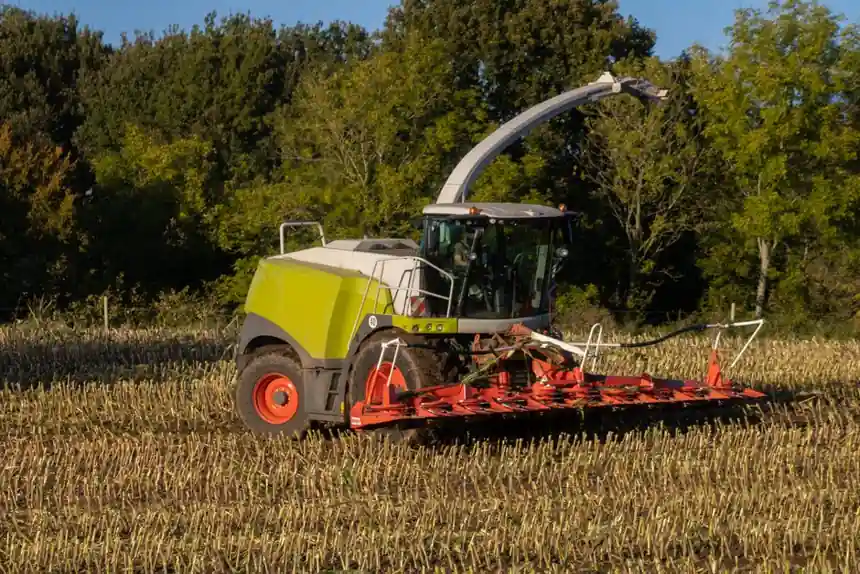
A standard Lovejoy L-090 with an SOX (NBR) spider handles roughly 18 N·m continuous torque, which is enough for a 1 hp pump or NEMA 23 servo drive, while the full Lovejoy jaw-coupling family spans 24 sizes from 3.5 in-lbs (0.4 Nm) up to 170,004 in-lbs (19,209 Nm) with bore diameters from 0.125 in (4.45 mm) to 7 in (178 mm) [S1]. That envelope covers almost every tractor-driven PTO pump, auger motor, and mixer gearbox a row-crop or livestock operation will bolt up.
Jaw couplings, a category of jaw coupling three-piece flexible couplings, transmit torque by compression through an elastomeric spider sandwiched between two metal hubs, with no metal-to-metal contact, no lubrication, and a fail-safe characteristic that keeps the drive turning even after the spider wears out [S1][S3]. On farm equipment, where mud, manure, fertilizer splash, and seasonal temperature swings are normal, that combination of contamination tolerance, vibration damping, and overload forgiveness is the reason the construction machinery and equipment sector has standardised on this geometry.
Selection Criteria Driven by Field Conditions, Not Catalog Hype
Three numbers drive the spec: continuous torque, peak misalignment, and RPM. Agricultural drivelines typically see torque peaks 1.5× to 2× the running average, so sizing the catalog rating against peak, not average, prevents premature spider shear [S2]. The continuous catalog torque of a Lovejoy L-090 at 18 N·m matches a small hydraulic pump or feed-auger gearmotor; the L-series ceiling is 12,500 in-lbs (1,412 Nm) at a 2.875 in (73 mm) max bore, while the high-torque C-type reaches 37,800 in-lbs (4,271 Nm) at a 4.000 in (102 mm) bore [S1].
Misalignment limits are equally concrete: 1° angular and 0.4 mm parallel offset are the reference values at which jaw coupling angular and parallel utilization each reach 100% [S5]. On a tractor-mounted pump skid, where the chassis flexes and the implement drifts with soil load, holding alignment inside those numbers is the difference between a spider that lasts multiple seasons and one that sheds black rubber dust within weeks. For comparison context across flexible coupling families, see the coupling clutch reference and the disc coupling and gear coupling entries.
Hub and Spider Materials Matched to Farm Exposure
Hub material choice on the farm is a corrosion-versus-cost decision. Aluminum hubs (Lovejoy AL-type, 2,268 in-lbs / 256 Nm max torque, 1.875 in / 48 mm max bore) are passivated and shed moisture well, which suits pivot-irrigation drives and sprayer pumps that live outdoors [S1]. Sintered-iron L-series hubs are the workhorse default for barn-side conveyors and feed mixers, where cost per horsepower matters more than weight. Stainless steel SS-type and RRS hubs (3,708 in-lbs / 419 Nm, 1.875 in / 48 mm) are specified for fertilizer and ammonia-exposed locations where plain steel would pit within a season [S1][S3].
Spider material sets the personality of the driveline. A 98 Shore A red urethane gives high torsional stiffness, the right pick for servo-driven metering rolls where backlash matters. A 92 Shore A yellow urethane is the general-purpose middle ground. A Hytrel 55D spider tolerates temperatures up to 121 °C and high shock loading, the right call on diesel-driven pumps and PTO-driven fluid coupling input shafts [S3][S5]. Neoprene (NBR) is the default for light steady loads and is the SOX compound shipped with most stock L-series spiders; for submerged or wet service Hayes specifies Hytrel, and for internal-combustion drives the neoprene-with-metal-ring variant limits over-flex and extends insert life [S4].
Comparison of Common Spider Compounds for Farm Drives
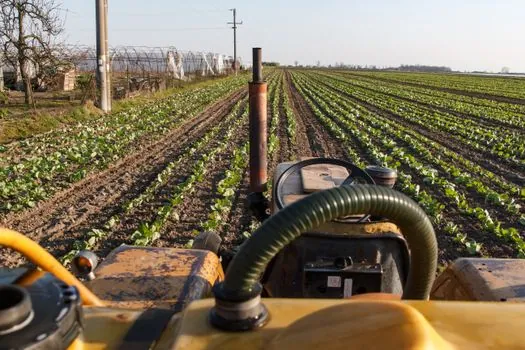
Putting the common spider choices side by side makes the trade-off visible: NBR (SOX) is rated for light to moderate steady torque with good oil resistance; urethane 92 Shore A handles higher torque with stiffer response; urethane 98 Shore A trades damping for precision, suiting servo-driven metering; Hytrel 55D covers temperatures up to 121 °C and the heaviest shock loads, the reason diesel-driven pumps and hay balers default to it; bronze spiders are specified for high-temperature or spark-resistant locations where an elastomer would fail [S1][S3][S5].
The fail-safe behaviour is identical across compounds: when the elastomer eventually wears or breaks, the metallic jaws lock together metal-on-metal and keep transmitting torque, which is why jaw couplings are accepted on safety-heavy agricultural loads like auger drives and feed-mixer gearboxes where a shear-type decoupling would leave the operator stranded [S3]. That continuity-of-drive behaviour, combined with the standard's tolerance for oil, dirt, sand, moisture, and grease, is the technical reason a jaw coupling is the default shaft-to-shaft connector on most tractor-driven implements [S1].
Sizing, Alignment, and RPM Limits Specific to Farm RPM Profiles
RPM limits vary by geometry, not just by size. The Lovejoy SW radially-removable spider design is capped at 1,750 RPM, while the LC version with the same removable spider geometry raises that ceiling to 3,600 RPM, and both still allow an open centre for minimal shaft separation in confined skid builds [S1]. Standard L and C types are rated for higher shaft speeds within their torque envelope. On tractor PTO-driven pumps running at 540 or 1,000 RPM engine-side and stepping up through gearboxes, the limiting factor is almost always torque, not RPM.
Bore selection follows AGMA, SAE, and DIN keyway and spline patterns, with Lovejoy's standard bore program covering all three, and more than 850,000 stock bore/keyway combinations available across the jaw-coupling family [S1]. Hayes L-series is offered in English and metric bores across L035 to L225, drop-in interchangeable with other domestic L-series brands, with a full set of splined bores for taper-lock mobile-market applications [S4]. For hay tools and harvesters where shaft sizes follow metric ISO patterns, that interchangeability removes a stocking headache for the dealer network.
Standards, Failure Modes, and the Spec Audit
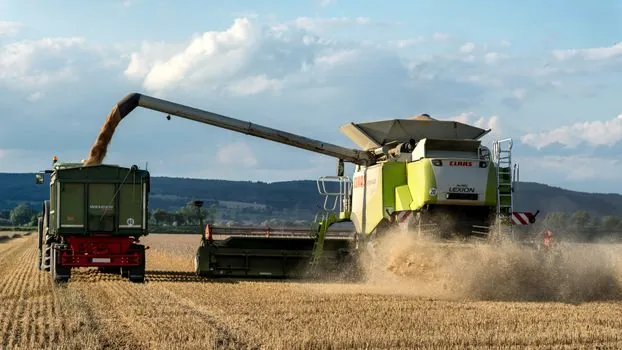
There is no single ISO or AGMA standard that "covers" the jaw coupling as a whole component; instead, conformance runs through the bore and keyway standard (AGMA 9002, SAE J499, DIN 6885), the elastomer specification, and the user's machinery directive. For ATEX-classified grain-handling or fertilizer plants the elastomer must meet the relevant ignition-risk requirements, and for food-grade or pharma-adjacent agricultural lines a stainless-hub Hytrel-spider combination is the safe default [S3][S4]. Misalignment beyond 1° angular or 0.4 mm parallel offset is the dominant field failure mode, raising spider-leg loading toward 70% on the most-loaded leg and overheating that leg until the elastomer sheds black dust [S5].
The second most common failure is spider-element mismatch: specifying a soft 80 Shore A spider on a diesel-driven baler where a 55D Hytrel is the correct call cuts service life by an order of magnitude. The third is hub material under-spec, plain steel on a manure pump or ammonium-nitrate conveyor where 304/316 stainless would survive multiple seasons. Get those three right and a jaw coupling will run for years with no attention beyond a feeler-gauge alignment check, which on the farm is the only maintenance format that actually happens.
Trackable signals to watch over the next sourcing cycle: L035 to L190 stock-bore availability from at least two domestic suppliers (Lovejoy, Hayes, compatible imports) for direct interchangeability; bore/keyway standard compliance to AGMA, SAE, or DIN per the driven shaft; and elastomer compound datasheet that explicitly states the temperature ceiling, with 121 °C as the Hytrel benchmark for diesel-driven farm machinery [S1][S4][S5]. For a related decision framework on agricultural safety PPE that pairs with driveline selection, see the Safety Shoes Selection for Work at Height: S3/S5, SRC, Ankle Support reference.