
Industrial labeling machines are classified first by container handling architecture (inline linear, rotary, wrap-around, top/bottom) and second by label format (roll-fed, pre-cut, shrink-sleeve, RFID/EAS) [S4][S5][S6]. MarCoPack's published model range — SET 200 for medium cylindrical work, MCP 300T for one-or-two-label round/square dispensing, MCP 400T for tamper-evident seals, and MCP 600T for above-and-below tray labeling — illustrates the throughput-driven segmentation used across the industry [S4].
Selection of a labeling machine is driven by four binding constraints: container diameter and surface profile, label stock (roll vs pre-cut vs shrink sleeve), required accuracy at line speed, and the available factory footprint for inline integration. The most common architecture on FMCG lines remains the inline linear conveyor system, because it accepts cylindrical, oval, square, and flat containers with the same base frame by swapping only the label head and orienting wheels [S5].
Inline (Linear) Labeling Machines: The Default for Cylindrical and Flat Containers
Inline labelers run containers on a single-pass conveyor with a stationary dispense head, with side, wrap-around, top, and bottom configurations available as model options [S5]. Prosource's catalog lists typical model codes — 132M, 040M, 152C, 152E for wrap-around, 362M/362E/362C for side labeling, and 452C/552C/652C for top-and-bottom work — giving buyers a stable naming convention to cross-reference when RFQing [S7].
Inline machines cover the widest speed band, with semi-automatic benchtop units for ~600–1,500 bottles/hour stepping up to fully automatic inline systems that consistently clear 10,000–30,000 units/hour on stable cylindrical SKUs [S4][S5]. A common gotcha on square and tapered bottles: orientation must be solved by a screw, star-wheel, or vision-correction module upstream of the dispense head; specifying wrap-around without this frequently yields misregistered labels at high speed [S5].
Rotary Labeling Machines: High-Speed Continuous-Motion Workhorses
Rotary labelers move containers on a rotating turret past multiple fixed dispense heads, which is why they dominate wine, beverage, cosmetic, and chemical bottling at sustained speeds above 20,000 units/hour [S5]. The continuous-motion path eliminates the start-stop acceleration spikes of inline designs, which matters for glass containers where neck-finish stress and label scuff are recurring rejects.
Capital cost is the trade-off: rotary cells typically price 2–4× the equivalent inline system and demand a fixed number of heads matched to the SKU, so changeover to a new label count is a mechanical job rather than a recipe change [S4][S5]. For plants running three or more bottle formats in steady rotation the rotary is justified; for SKUs that change weekly, an inline system with quick-release heads is the better answer.
Specialty and Pre-Cut Applicators: Roll-Fed, Shrink-Sleeve, Tamper-Evident, RFID
Pre-cut label applicators (also called cut-and-stack labelers) handle stacks of individually die-cut labels and are the default for tamper-evident neck seals and small-batch promotional runs where a printed roll is uneconomic [S6]. Roll-fed labelers separate labels from a continuous printed web and are the workhorse of beverage and personal-care lines because the reel format gives the lowest per-label material cost at high volume [S6].
Beyond these, Prosource documents three specialty categories that are now routine on 2026 lines: shrink-sleeve applicators that pass a printed polymer sleeve over the container and shrink it via heat tunnel, RFID encoders that write and apply smart labels in-line, and EAS (Electronic Article Surveillance) applicators for retail anti-theft tags fitted after filling and sealing [S6]. The decision axis here is purely label format — if the spec is a full-body shrink sleeve, only a sleeve applicator plus steam/heat tunnel can do the job, regardless of throughput target.
Wire, Cable, and Small-Diameter Labeling: A Niche Architecture
Wire and cable labelers are a sub-class defined by the very small, often flexible substrate: typical wire diameters are 0.5–25 mm, label accuracy target is ±0.5 mm, and the dispense head must accommodate curved, deformable product without crushing the insulation [S1]. WireLabelingMachine's 25-year-old custom shop publishes the envelope — wire diameter, required accuracy, and target speed are the three parameters the buyer must supply before a quote is meaningful [S1].
For medical, pharmaceutical, and electronics wire harnesses, coding machines and wire-specific labelers are frequently specified side-by-side, since wire jackets often need both a printed code and a wrap-around identifier. Hangzhou Sanyou's explosion-proof labeler line extends this architecture into hazardous-area plants, where ATEX/IECEx-certified electrical enclosures become mandatory [S2].
Selection Criteria and Decision Map

Four criteria reliably separate the four main architectures, and laying them out side-by-side is the fastest way to down-select during RFQ: container geometry (round/oval/square/flat vs wire), required throughput (under 5,000, 5,000–20,000, above 20,000 units/hour), label format (roll-fed, pre-cut, shrink sleeve, RFID), and available floor footprint plus changeover frequency [S4][S5][S6]. Inline systems win on flexibility, rotary on sustained speed, pre-cut on short runs and tamper-evident seals, and specialty (sleeve/RFID) wherever the label format itself dictates the architecture.
Buyers running a capping and sealing machine downstream of the labeler should match conveyor height and indexing pitch between the two cells — mismatched pitches are the most common cause of label-to-cap registration drift on integrated lines. For plants already running a vision inspection stage, a machine vision system can retro-fit any of these architectures to verify label presence, position, and OCR-legible code in a single pass. Where the upstream process is a filling machine running variable viscosities, container stability through the labeling station is the silent failure mode — wet bottles on the labeling conveyor are the leading cause of wrinkled labels and scrap rate spikes above 1.5%.
Safety, Standards, and Sourcing Signals for 2026
Three standards govern the electrical and hazardous-area envelope of any 2026 labeler: CE for European market access, IEC 60079 for explosive atmospheres (referenced alongside ATEX 2014/34/EU for EU-zone plants), and IECEx for IEC-member countries outside the EU [S3][S2]. The Hoffmann Enclosures reference cited in the Skemman bottle-labeler thesis treats CE and IEC classifications as the baseline for enclosure ingress and zone rating, and any labeler specified for Zone 1/Zone 2 chemical or pharmaceutical lines must carry the matching certification on the nameplate [S2][S3].
Sourcing signals published through 2026-07-22 show Hangzhou Sanyou and similar Chinese OEM shops holding national explosion-proof certificates plus more than a dozen patents and exporting to Southeast Asia, Europe, and the US — useful context for buyers qualifying dual-source suppliers [S2]. On the application side, Matthews' MPERIA A-Series T63 with FlexWipe applicator lifted one Swedish palletizing line from 100 to 200 pallets/hour by replacing single-pallet hand labeling, a 2× throughput case worth citing when justifying capital on the pallet-labelling side of the plant [S8].
Limits, Failure Modes, and What to Watch Next
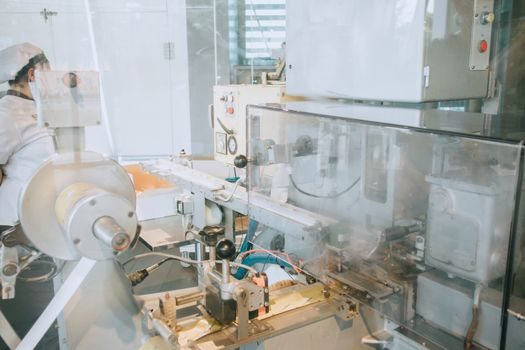
The structural limit of every class is the same: label placement accuracy degrades as line speed rises, and on square or tapered containers the drop-off is non-linear past 15,000 units/hour unless a vision-correction stage is added. Pre-cut applicators reject most often on label-feed jams and double-picks; inline linear systems reject on container orientation drift; rotary cells reject on turret indexing errors that show up only after a head-bearing wear cycle of typically 18–24 months. Buyers should treat these three failure modes as the standard MTBF/MTBR checklist items during FAT. [S6]
For plants planning a 2026 capex, the next verifiable decision node is the container-format audit: lock the SKU list, container diameter, and label stock, then RFQ against the four-architecture matrix above with a hard 18-month payback threshold. Trackable signals worth watching are CE/IEC certificate renewal cycles from EU-resident labeler builders and the next round of OEM datasheet refreshes for rotary throughput above 40,000 units/hour, which several Chinese shops are now advertising but have not yet published audited cycle-time data for.