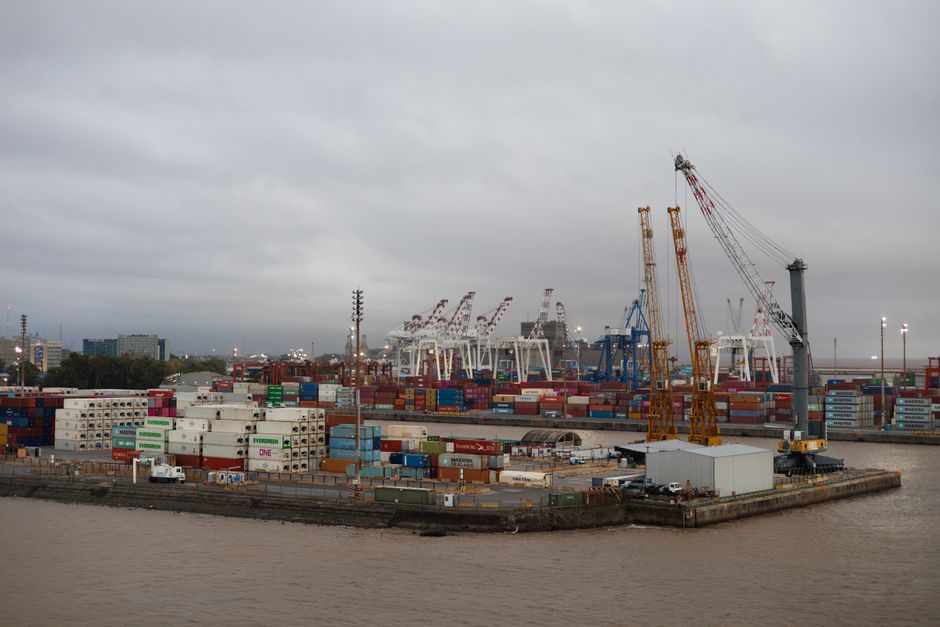
Port-yard compaction is one of the harshest duty cycles any road roller will see: mixed fills, high moisture, continuous cycle work, and operators who rarely leave the cab, which makes the spec sheet the only reliable filter between machines.
For container terminals, bulk-stockpile yards, Ro-Ro ramps, rail-mounted gantry (RMG) runways and quay-side back-up aprons, the road roller selection question is really a question of linear static load, drum width, frequency/amplitude pairing and traction control on loose or saturated bases.
Why port yards are not a highway job
Port and terminal pavements carry quasi-static stacking loads from reach stackers, rubber-tyred gantry (RTG) cranes and terminal tractors, with wheel loads of 50–80 kN per corner common in modern container yards, far above the 10–20 kN wheel loads typical of a road roller pass itself [S2].
The Chinese port-planning reference *Port Planning and Layout* (Chen Yimei, Liao Peng, Southeast University Press, 2009, ISBN 9787564118969) frames the work as terminal hinterland operations tied to throughput forecasting, classifying the land-side yard as a critical working surface whose stiffness governs crane travel speed and RTG productivity [S2]. That is the right frame: the roller is not compacting for a car lane, it is compacting the floor that a gantry crane will ride for the next 30 years.
Standard highway specifications such as those derived from 95% Modified Proctor (AASHTO T180) or 98% Standard Proctor are starting points, but reclaimed-cement-stabilised bases in stockyards, and bitumen-stabilised bases under RTG runways, often need 3–5% higher density targets to control elastic deflection under corner loads [S2].
The decision variables, ranked
Operating weight, drum width, and centrifugal force per drum are the three numbers that move selection more than any marketing claim: a 12–14 t single-drum vibratory road roller typically delivers 240–300 kN of centrifugal force at 28–32 Hz, which is the right band for 300–500 mm lifts of granular sub-base in container yards. [S1]
Linear static load — operating weight divided by drum width — is the single most-cited gate: single-drum soil compactors sit at 30–55 kg/cm, while tandem asphalt rollers for quay-side bitumen runs are tuned to 25–35 kg/cm to avoid crushing aggregate.
Frequency/amplitude pairing matters more than peak kN: high amplitude (1.8–2.0 mm) at low frequency (28 Hz) is for deep lifts of rock fill; low amplitude (0.4–0.8 mm) at high frequency (40–50 Hz) is the finishing pass on asphalt aprons and RMG concrete-block runways.
Traction matters when the surface is wet reclaimed aggregate or sea-sand fill: all-wheel drive with an articulated oscillation joint plus a no-spin rear axle keeps the drum from polishing, which is a common failure mode cited by port equipment operators.
Drum configuration: single, tandem, or combo

Single-drum vibratory rollers (one smooth or padfoot drum, four rubber tyres) are the default for bulk-yard, Ro-Ro ramp and unpaved hardstand work; padfoot drums deliver 15–25% higher dry density in cohesive fills than smooth drums on the same pass count.
Tandem vibratory rollers (two steel drums, articulated) are the right call for finished bitumen or concrete-block surfaces, where both drums must oscillate to keep surface waviness below 3 mm over a 4 m straightedge; static tandem models without vibration are obsolete for any port bitumen job above 5,000 m².
Pneumatic-tyre rollers (7–11 rubber wheels, 12–25 t) are the finishing pass for bitumen aprons, seating aggregate without cracking the mat, and are the standard complement to a tandem vibratory unit on quay-side pavements.
Combo (steel front, pneumatic rear) units save a machine on tight sites but are a compromise: expect to give up 10–15% productivity versus a dedicated pneumatic roller on large quay runs.
Selection by terminal use case
Container-yard hardstand: a 16–20 t single-drum vibratory roller with padfoot or smooth drum option is the workhorse choice, typically matched to a 2.0–2.2 m drum width so the compaction pattern covers 4 passes per RTG block in a 30 m runway.
Bulk-stockpile pad: a 14–18 t single-drum unit with high-amplitude (1.8–2.0 mm) vibration handles coal, iron-ore and clinker bases where lift thickness can exceed 400 mm and where padfoot is preferred in cohesive layers.
Ro-Ro ramp and link-span transitions: a 12–16 t tandem vibratory roller with dual amplitude and an infra-red temperature sensor (for bitumen ramps) is the right call, because slope and tie-in compaction cannot tolerate over-vibration.
RMG runway and crane-beam corridor: a tandem roller with 2.13 m drum width and an automatic compaction control (ACC) system that records CMV/Evib stiffness is increasingly specified, because uniformity is what controls gantry-trolley wear over decades of operation.
Power, telematics, and operator constraints
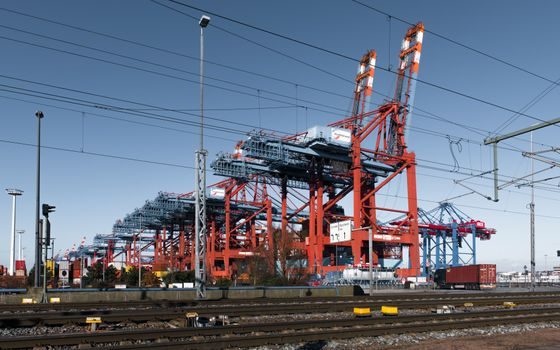
Diesel Stage V / EPA Tier 4 Final engines at 75–160 kW are now standard for the 12–20 t class; port procurement teams are increasingly asking for Stage V ready units because terminal operators expect 1,500–2,000 engine hours per year.
Cab ergonomics matter: 24-hour shift operation in port terminals means ROPS/FOPS cabs with sound levels below 78 dB(A), and a reversible seat/console is a real spec line, not a comfort extra, because operators rotate directions every cycle.
Limitations, failure modes, and when not to specify
Road rollers do not fix poor subgrade: if the fill is below CBR 5% or moisture is more than 2% over optimum, no roller in the catalogue will hit 95% Modified Proctor and the result is rutting under RTG corner loads within 6–12 months.
Vibration near sensitive structures is a real constraint: keep padfoot vibratory rollers at least 15–20 m from operational quay walls, fender piles, and live instrumentation, and switch to static or pneumatic-tyre compaction within that band, per typical port-construction method statements.
Single-drum padfoot units are the wrong call on finished concrete-block pavers and on the top 50 mm of any asphalt mat; they will crush the surface and the rework cost is far higher than the rental saving.
For very small repairs under 200 m², a 3–4 t walk-behind tandem roller or a 1.5–2.5 t ride-on tandem will outperform any 12 t unit on cycle time, because the larger machine spends more time reversing than compacting.
Sourcing, standards, and verification

Compaction verification is governed by in-situ density tests (sand replacement, nuclear gauge) and by modern stiffness-based systems such as the Terrameter or equivalent CMV/Evib continuous compaction control, tied to the calibration strip at job start.
Procurement teams should pin the spec to: (1) operating weight ±5% tolerance, (2) centrifugal force per drum at declared frequency, (3) drum width, (4) linear static load range, (5) engine emission tier, and (6) ROPS/FOPS certification, with the supplier obligated to demonstrate on-site before payment milestone release.
Lead times in the 12–20 t class for 2026 delivery are 60–120 days ex-China for major OEMs, longer for Tier 4 Final / Stage V configurations in Europe and North America, so terminal expansion schedules should be locked at least one quarter before the paving contractor mobilises.
One trackable signal to watch: 2026 Stage V successor-emission guidance in the EU, which is likely to tighten NOx limits on the 75–130 kW class and force spec revisions on the next tender cycle, while Chinese OEM exports continue to push the 14–18 t single-drum segment on price per kN of centrifugal force.
Detailed specification references: terminal block, and roller bearing.
Background reading: Control Cable Selection Guide: Spec Gates for 2026 Sourcing.