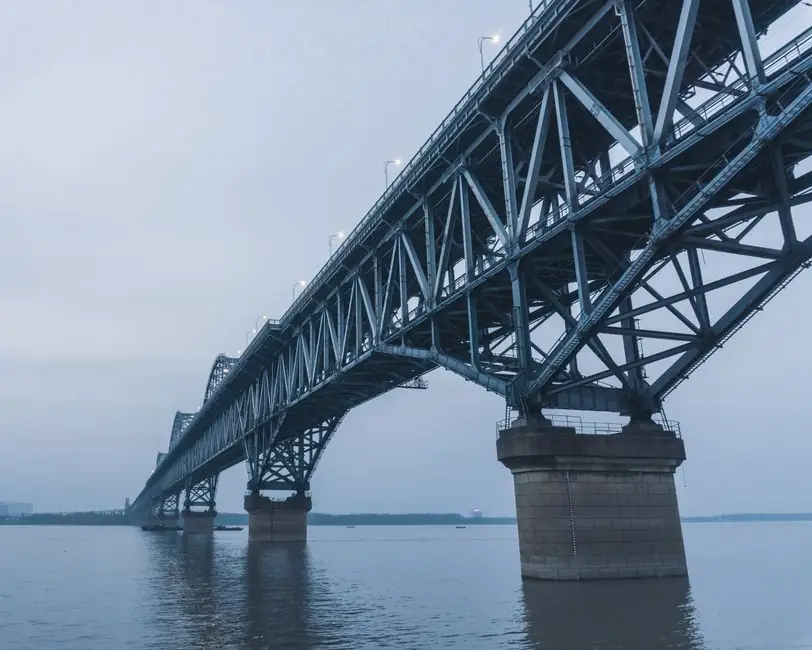
Handheld laser distance meters specified for bridge construction in 2026 commonly cover 0.05–250 m with standard accuracy between ±1 mm and ±3 mm, sealed to IP54–IP65 for outdoor and elevated-deck use [S2][S3].
For long-span and deflection monitoring, fixed high-precision laser distance sensors push the envelope to 100 m natural targets (up to 500 m with a reflector), 10–250 Hz sampling, and a −40 °C to +60 °C operating window [S3]. The basic principle remains a phase-shift or time-of-flight return measurement, with built-in tilt sensors resolving horizontal, vertical, and slope distance from a single slope reading [S1][S5].
Range vs Accuracy: Handheld Class vs Fixed-Install Class
Handheld units commonly used on bridge sites cap at 50–250 m, with the Leica DISTO X6 reaching 250 m and IP65, the Fluke 424D reaching 100 m with a tilt sensor, the Huepar LM120A at 120 m, and the DeWalt DW03050 at 50 m [S2]. Bosch GLM 165-40 and Milwaukee 150 m units target a 50–165 ft (roughly 50 m) class aimed at interior and steel-erection work [S2].
Fixed-install sensors, by contrast, are specified to ±1–5 mm (2σ) over 0.05–100 m on natural surfaces, and ±0.3–1.8 mm (2σ) repeatability; the standard 140 × 78 × 48 mm housing weighs 350 g and outputs analog, RS-232C, RS-422/RS-485, or SSI [S3]. That combination suits structural health monitoring where the meter is bolted under a girder and left in place for weeks of continuous traffic loading.
Bridge-Specific Use Cases: Deflection, Clearance, and Cable Length
Deflection measurement under live traffic is the dominant bridge-specific use case: a sensor installed directly or diagonally below a girder continuously reads distance to the structure as vehicles cross, and outputs the deflection in real time [S3]. When the displacement exceeds a management threshold, a rotating alarm light triggers work-stop decisions, replacing manual optical surveys that require lane closure [S3].
Bridge clearance is the other recurring task. Long-range handheld laser rangefinders can read the underside of a high deck at distances up to roughly 1.5 km (about 1600 yards) under ideal reflective conditions, allowing the operator to stand clear of live traffic lanes and still capture vertical clearance values [S4]. Surveying teams also use laser distance meters to record pier spacing, abutment offsets, and deck elevation differences to feed GIS-based as-built records, with values typically resolved to a few millimetres [S1][S5]. For ground-truth on how these readings feed a wider structural check, the rebar cutter maintenance protocol for bridge sites covers adjacent field tooling.
Selection Criteria: IP Rating, Tilt Sensor, Interface, and Update Rate
Four specs decide a bridge-appropriate pick. First, sealing: bridge sites expose meters to rain, dust, and concrete slurry, so IP54 (Milwaukee 150 m, dust-protected and splash-resistant) is the practical minimum and IP65 (Leica DISTO X6, fixed D-series sensors) is preferred for permanent outdoor mounting [S2][S3]. Second, an integrated tilt sensor enables slope-to-horizontal conversion and Pythagorean routines for indirect height reads when a reflector is unreachable [S1][S2].
Third, interface: handhelds favour Bluetooth pairing with tablets for as-built logging [S2], while fixed sensors expose analog, RS-232C, RS-422/RS-485, and SSI for SCADA or PLC tie-in [S3]. Fourth, sampling speed: 10–250 Hz is needed to capture the dynamic deflection curve of a girder under a moving truck, far above the single-shot handheld cadence [S3]. Hilti PD-E is the one handheld model in the 2026 construction shortlist that is explicitly recommended for bridge construction and structural steel, pairing drop-resistant housing with outdoor-readable displays [S2].
Operating Envelope and Failure Modes
Temperature matters: the fixed D-series runs from −40 °C to +60 °C, covering both cold-climate coastal bridges and hot tropical decks, while most consumer handhelds are rated only 0–40 °C and need shading on summer pours [S3]. Dark or low-reflectance girder coatings can starve the receiver of return signal; the documented workaround is to apply a reflective sticker at the measurement point so the laser locks on [S3].
Direct sunlight, steam, and vibration from passing traffic remain the dominant accuracy killers; pointfinder cameras (DISTO X6) and higher laser power (Hilti PD-E) are the practical countermeasures [S2]. For long-term bridge monitoring, the recommendation is non-contact installation: no lane closure, no scaffold, sensor bolted to a pier cap and pointed at the soffit, with continuous logging to a remote terminal [S3].
Comparison Table: 2026 Bridge-Ready Laser Distance Meters
Leica DISTO X6 vs Fluke 424D vs Hilti PD-E vs Dimetix D-series: range is 250 m / 100 m / outdoor-rated handheld / 100 m natural (500 m with reflector); accuracy is ±1–2 mm class / not stated / not stated / ±1–5 mm (2σ); sealing is IP65 / not stated / drop-resistant / IP65; best fit is commercial steel structures and elevated decks / industrial plants and mechanical installs / bridge construction and structural steel / long-term bridge deflection monitoring [S2][S3]. For broader context on adjacent field instruments, see the static pressure molding machine specs for energy equipment castings reference, which touches the same precision-machined tolerance culture.
When a Handheld Is the Wrong Tool
A handheld laser distance meter is the wrong tool when the measurement must be continuous, sub-millimetre traceable to a calibration certificate, or survivable for months under a live bridge deck; in those cases, the fixed sensor class is the only correct spec [S3]. It is also the wrong tool for cable-stay or suspension-cable length measurement on long spans, where a 1.5 km optical rangefinder with a reflective target gives a far lower uncertainty per shot than a 250 m handheld [S4].
Inside a 250 m radius on a steel or concrete deck, however, a handheld with tilt, Pythagoras, and Bluetooth is faster than any total station for one-off clearance, height, and missing-line reads, and the IP65 DISTO X6 closes most of the durability gap to a fixed sensor [S2].
Trackable signals for the next spec update: (1) any new OEM release of an IP66-or-better fixed laser distance sensor rated above 100 m natural target, and (2) any published bridge-deflection case study comparing 250 Hz vs 10 Hz update rates on a steel-box girder under live rail load [S3].
Spec-level background on the components involved: laser distance meter, laser distance sensor, and overhead bridge crane.