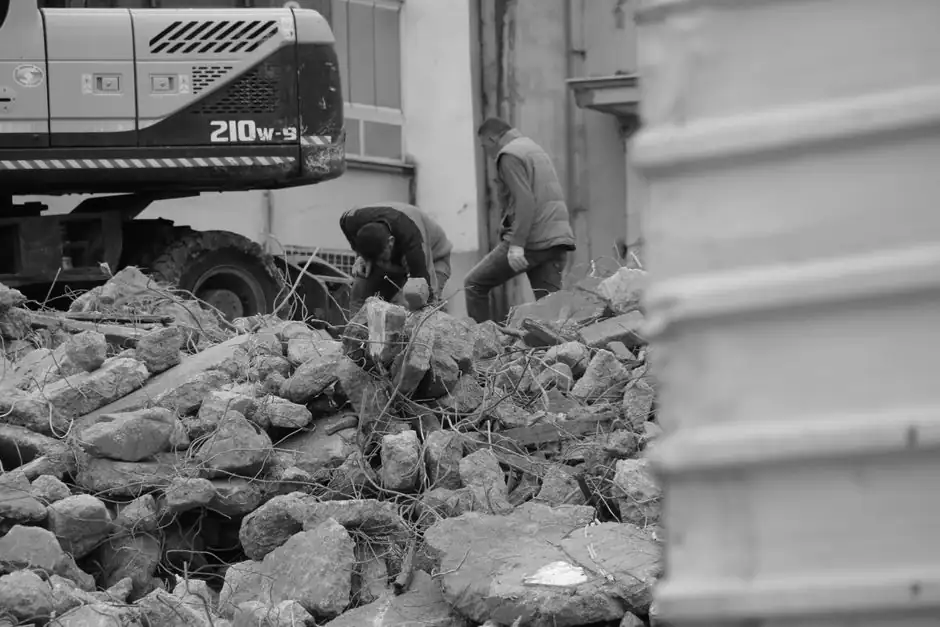
Demolition crews need a laser distance meter that survives dust, drop impact, and reflective debris while still resolving a ±1.5-2.0 mm tolerance over 0.05-50 m, with a Class 2 eye-safe source under 1 mW and an IP54 or better housing.
Selection on a wrecking site is gated by four numbers: declared range, accuracy tolerance, laser safety class, and the IP rating of the housing, because the meter is either useless outdoors, illegal on site, or dead inside a quarter if any of those four is wrong [S2]. For the cross-link to adjacent reference, see the laser distance sensor family, which is the fixed-mount counterpart to a handheld tool.
Why Demolition Site Conditions Break Consumer Meters
Concrete dust, water spray from suppression hoses, and accidental 1.5-2 m drops onto rebar or slab are routine on a demolition site, and a consumer-grade housing with no IP rating is typically replaced within 30-90 days under those conditions [S1]. Pulse-based time-of-flight designs on uncooperative surfaces (concrete, dirt, dark wood) lose 30-60% of their white-target range, so a 50 m handheld spec commonly degrades to 20-30 m on a construction substrate, which means a 0.05-50 m band unit needs headroom built in for the dirty end of the range [S5]. IP54 stops splashed water and dust ingress, IP65 handles low-pressure jets plus concrete fines, and IP67 survives temporary immersion, which matters when a hose-down is part of the daily cleanup.
Red lasers emit around 635-650 nm and green units emit near 515-532 nm, close to the eye's peak sensitivity, and the same power output looks several times brighter in green, which is why outdoor crews pay the premium for a green diode on a demolition site where the dust column itself scatters the beam [S1]. Sunlight washing out the dot, low-reflectivity targets like dark wood or matte concrete, and measuring near the edge of the rated range all increase real-world error beyond the published tolerance, so the rated figure must be de-rated by the field factor.
Range, Accuracy, and Drop Class: The Three Spec Gates
Handheld phase-shift meters dominate the 0.05-50 m segment and rely on modulating a continuous laser beam against the reflected return to derive distance by phase difference, with typical accuracy of ±1.5-2.0 mm at the cheap end and ±1.0 mm once the unit passes the $200 mark [S2]. Mid-tier industrial handhelds like the Leica DISTO X3 and Bosch GLM 120i C stretch the same technology to 100-150 m, add a tilt sensor (±90° or 360°), and package it in IP65 housings rated for a 2 m drop onto concrete, which is the practical floor for demolition duty [S2]. The NormPro MD Series ships as a 40 m unit at ±2.0 mm, 0-40 °C operating, 110x46x25 mm and 72 g, with Class II output under 1 mW at 620-690 nm and CE, FDA, FC, and RoHS compliance, which is a representative mid-tier benchmark for the price-conscious crew [S3].
Range-to-accuracy ratio matters more than the headline figure: a ±1.5 mm spec at 30 m is roughly 5 ppm, whereas a ±3 mm spec at 50 m is 60 ppm, a 12× gap that decides whether the meter fits a surveying workflow or a rough-estimate workflow [S5]. For demolition pre-cut layout where the slab tolerance is 200 mm and the MEP rough-in must be within ±10 mm, a ±2.0 mm handheld is the practical floor; tighter than that costs money without buying anything the slab can resolve. A 50 m digital laser distance meter retails for roughly $22 on the consumer channel as of mid-2025, a Leica DISTO X3-class industrial unit sits around $250, and 3.5-5,000 m pulsed industrial rangefinders climb into four-figure territory [S2]. For comparison with the broader category and how handheld units map to industrial sensors, see the laser distance meter reference page.
Laser Class and Jobsite Legality on an Active Demo Site
Handheld units ship as Class 2 (visible, 1 mW CW) by default, which is eye-safe for accidental glances of under 0.25 s and is the legal default for construction sites in most jurisdictions [S2]. Class 3R units (≤5 mW) appear on long-range models and require nominal operator briefing but no PPE, while Class 3B and Class 4 pulsed rangefinders (the 1,500 m plus survey instruments) demand laser-controlled areas, interlocks, and OD-rated eyewear, a category jump rather than a price jump [S2]. Specifying a Class 3B or higher unit onto an active construction site without the controlled-area paperwork is the most common compliance miss in 2024-2026 project audits, and a demolition permit review will flag it the same way a new-build review does [S2].
For demolition work, the practical ceiling is Class 2, both because the work zone is shared with non-trained personnel and because a 1 mW CW source keeps the meter interchangeable with general contractor gear without site-specific laser paperwork. The NormPro MD Series publishes Class II at less than 1 mW across 620-690 nm, which is the standard construction-laser band and matches the blink-reflex protection assumption in IEC 60825-1-style jobsite practice [S3]. Demolition also pairs naturally with a demolition hammer for wall and slab work, where the same crew will need distance checks before and after each breaking pass.
What Demolition Layout Demands That Interior Fit-out Does Not
Demolition layout is read-once-and-cut work, so stakeout accuracy matters as much as the headline tolerance: a new line of measurers delivered ±1/16 inch on normal measurements but deviated up to ±1/2 inch in stakeout mode, eight times the published tolerance, and that gap compounds across a 30-mark stud or anchor run [S1]. Pre-demolition surveys also need Pythagoras and area modes because the operator often cannot reach a corner safely, so a unit with indirect-height calculation, tilt sensor, and continuous measurement is worth more than one with a longer headline range. Power-tool selection guidance for concrete and demo work treats laser measuring tools, rotary hammers, and dust-controlled breakers as a paired set, not a shopping list of independent buys [S7].
A short comparison for demolition duty, lined up against four decision criteria: 0.05-50 m phase-shift handheld (range adequate, ±1.5-2.0 mm tolerance, Class 2 default, IP54-65 typical, $20-250 price band); 100-150 m industrial handheld like the DISTO X3 (longer range, ±1.0 mm, tilt sensor, IP65 + 2 m drop, roughly $250); 3.5-5,000 m pulsed time-of-flight (kilometre range, ±0.5-1.0 m at distance, Class 3B or higher, four-figure price); and the fixed-mount industrial sensor (240 m on reflector for closed-loop control, SSI/analog/fieldbus interface, used on cranes and stages, not a handheld) [S2][S5]. For concrete-specific pre-cut layout, a 50 m green-beam IP65 handheld is the most common match, and the related article on laser distance meter picks for concrete work covers the same selection in a heavier-readymix context.
Display, Battery, and Connectivity on a Noisy Site
A 4-digit backlit LCD with unit conversion (m, ft, in) and a one-touch measure/clear/mode-switch key set is the practical interface floor; rechargeable NiMH or USB-C powered units cut downtime, but a fallback to AAA alkaline is a real advantage on a demo site where charging is not guaranteed [S3][S4]. Bluetooth to a phone app for floor-plan markup and cloud backup is useful for as-built surveys before the wall comes down, but it is a productivity add-on, not a spec gate. A 5,000-measurement battery life on AAA alkaline is published for the 40 m MD Series, which is roughly four to six weeks of single-crew layout use and removes a category of field failure [S3].
Field rules: do not trust a reading at the far end of the rated range on a matte concrete target, do not trust a stakeout measurement tighter than the published stakeout spec, and do not trust a meter without a current calibration sticker when the reading feeds a structural cut line. The next trackable signals for this category are the late-2026 updates to the IEC 60825-1 compliance notes on Class 2 outdoor use and any 2026-Q4 release of a 50 m green-beam IP67 handheld in the sub-$300 band, both of which would shift the four-gate filter currently anchored on IP65 and Class 2 red or green at 1 mW.