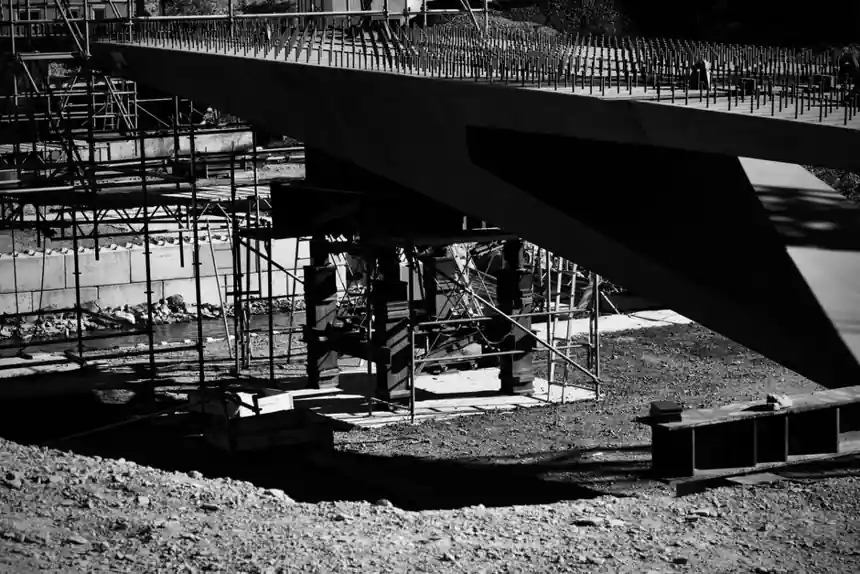
Bridge theodolite selection in 2026 follows the same four-gate logic as general civil work, but the gates are pulled tighter because pier verticality, deck deflection monitoring and long-span cable-stayed alignment leave no room for the 5″–10″ accuracy tier that road work tolerates [S2].
For most bridge piers, cable-stay geometry and segmental deck erection, the practical accuracy band is 1″ to 2″ (≈ 0.3–0.6 mm per 100 m), with 1″ reserved for cable-stay geometry, balanced-cantilever verticality checks and deformation monitoring of the completed deck, and 2″ covering routine pier cap set-out, bearing alignment and approach-span stake-out [S2]. 30x magnification remains the common standard on optical eyepieces [S1].
Gate 1: Angular accuracy tier matched to bridge element
2″ electronic theodolites are the baseline for pier-cap set-out, bearing pedestal alignment and approach road/street tie-in, sitting inside the 2″–10″ realistic band for civil and structural contracts in 2026 [S2]. A 1″ instrument is the right call for short-span deformation monitoring of completed decks, dam-adjacent bridge piers where the substructure cannot tolerate drift, and tight control-traverse work on rail/metro viaducts where a 2″ closure error compounds over kilometres of track [S2].
Below 1″, the productivity cost climbs faster than the accuracy gain on a typical bridge site; above 2″ on a bridge site, you are paying for precision the concrete will not hold. For 1″ and 2″ production units, dual-axis tilt sensors are standard with typical compensation range of ±3′ (≈ ±0.05°) and resolution around 1″, and the better instruments report the tilt-corrected angle directly on the face display so the operator does not have to apply corrections manually on a plumb-line check [S2].
Gate 2: EDM range for cable-stay geometry and pier face work
Most new bridge kits move to a total-station-class configuration because the EDM is what lets one operator set a target on a stay-cable anchor 300 m up the pylon without a second crew walking the prism up. The 2026 mainstream EDM class hits 2000–3500 m on a single prism, 5000 m or more on a triple prism under good conditions, and 200–600 m reflectorless on a white target [S2].
For bridge work, 200 m non-prism range is enough on concrete-pour and pier-face layout where the target is a paint mark on formwork, while 500 m+ drives the spec when the target is the top of a stay-cable pylon or the opposite abutment across a wide river valley. Beam divergence in the 0.3–1.0 mrad class is typical for 2026 prism EDMs, with sub-0.5 mrad a useful spec to keep on long-range cable-stay geometry where walking a prism up the pylon is impractical [S2]. For control-traverse closure on a long viaduct, an integrated atmospheric-pressure/temperature sensor or a dedicated input for ppm correction is the difference between a clean and a compromised result.
Gate 3: IP rating and the pier-environment reality
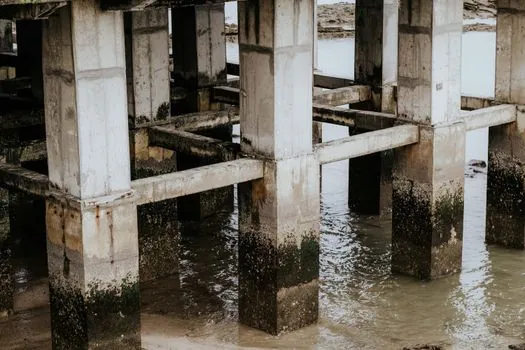
IP54 is the floor for any field theodolite used outdoors in 2026, and IP65/IP66 is the right specification for river-pier sites subject to splash, monsoon-region bridge sites and tunnel-mouth portals where the encoder housing is drenched on every cycle [S2]. The IP rating maps directly to the dust-and-rain survival of the encoder housing, the EDM optics and the keypad, and the field failure modes are dominated by dust ingress on the keyboard and condensation on the objective in cold/warm swing conditions [S2].
Operating temperature window is typically −20 °C to +50 °C on survey-grade units; northern-latitude bridge sites built through winter need a vendor-confirmed window at the low extreme, while desert and Middle East bridge sites need confirmation at the high extreme [S2]. Over-bridge cranes, batch plants and the diesel spatter around a cofferdam make the pier environment harsher than a road or rail formation line, which is why bridge procurement specs routinely step one IP tier above what the same contractor accepts on a highway job. The broader theodolite category sits inside the construction tools family and is specified alongside construction machinery and equipment on the same site, but the theodolite is the one instrument that does not tolerate a wet keyboard.
Gate 4: Plumb, encoder class and data path
For bridge pier verticality, the plumb-line check is the single most repeated observation on site, and three things decide whether the check is fast or a fight. First, the instrument needs an optical or laser plummet with a stated accuracy; second, dual-axis tilt compensation must be active and the corrected angle must be displayed, not raw encoder counts; third, the data path must let the surveyor push the angle to a collector without re-keying it into a field book in the rain [S2][S3].
Encoder technology in 2026 production lines is almost universally absolute-encoding, with incremental encoders confined to a small tail of low-cost optical theodolites, and absolute encoders retain angle on power-down so a pier cap crew does not re-initialise every setup on a multi-pier day [S2]. The same encoder logic is the reason 1″ and 2″ theodolite units are now specified as the default for bridge work, while 5″–6″ instruments stay on earthworks volumetrics and 9″–10″ optical units stay on education and preliminary reconnaissance where closure tolerance is not the constraint [S2].
Comparison: 1″ vs 2″ theodolite on a typical bridge project
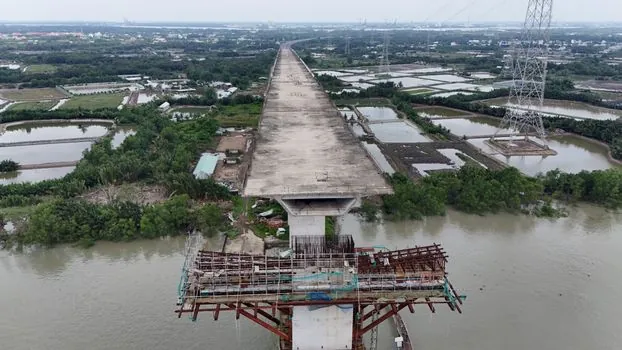
The decision between 1″ and 2″ collapses to four criteria: pier-element tolerance, span length, EDM reach and crew productivity. On pier-cap set-out and approach spans, 2″ matches the concrete placement tolerance at roughly half the unit cost of a 1″ instrument and lets the crew run two simultaneous set-out teams with the same hardware pool. On cable-stay pylon geometry, balanced-cantilever segment erection and deformation monitoring of the completed deck, 1″ is the floor because the tolerance window on stay-cable anchor positions is single-digit millimetres and the closure error on a long control traverse compounds at 2″ faster than 1″. [S2]
On EDM reach, both tiers now ship in the 2000–3500 m prism class and 200–600 m reflectorless class, so the EDM no longer separates 1″ from 2″ as it did a decade ago; the differentiator is the encoder class, the tilt sensor and the display path, not the laser [S2]. On crew productivity, absolute encoders cut roughly 2–3 minutes per setup versus incremental encoders, which on a 30-setup pier day is a full hour reclaimed for prism walking. For deeper trade-off detail on accuracy and IP choices, the tunnel theodolite spec walk-through lines the same gates up against a tunnel drive, and the demolition theodolite spec map covers the inverse case where vibration and dust, not tolerance, drive the spec.
Limitations and what 1″/2″ does not fix
A theodolite, even at 1″, is a single-operator angle instrument and does not replace a total station for stake-out where a coordinate file needs to be pushed to the prism pole. Reflectorless EDM in the 200–600 m band is fine for concrete and steel, but on a hot, shimmering river crossing the beam-walk error at 400 m+ can swamp the encoder accuracy, so long pier-to-pier sight lines still need a prism on the far target, not a paint mark. [S2]
Verticality from a theodolite is a relative check against gravity, not an absolute plumb, and on a tall pylon the residual tilt-sensor error after dual-axis correction is typically in the 1–3″ band, which is why cable-stay pylon plumbing on major bridges still uses an independent optical plummet or a GNSS-inertial reference rather than relying on the theodolite alone. Procurement specs should call for a stated plummet accuracy, not a generic "laser plummet" line, and the same spec should name the atmospheric-ppm input path for any control-traverse work over 1 km.
Sourcing and standards grounding

The 2026 mainstream accuracy band, EDM class, IP rating and tilt-sensor envelope used in this article are drawn from the four-gate selection criteria published on 2026-06-29 [S2] and the field-use guidance for general construction published 2026-08-12 [S1]. Vendor product framing on the theodolite as a precision angle instrument for surveying and construction is the public position from Topcon's product page [S3]. IP ratings as cited follow the IEC 60529 ingress-protection convention used across the 2026 theodolite market; ISO 17123 series covers the field-test procedure for surveying instruments and is the relevant accuracy-verification reference for any 1″/2″ acceptance test, with the specific part (ISO 17123-3 for theodolites) governing the field procedure for angular accuracy verification on acceptance.
Trackable signals to watch: any vendor-stated operating-temperature extension below −20 °C or above +50 °C for the same encoder class, the appearance of integrated GNSS-inertial hybrid modules on 1″ bridge-class theodolites, and any tightening of the IP66 spec to include salt-fog testing for coastal and offshore-pier bridge work. The hardware pool is mature and the differentiators in 2027 will be on the data path, not the optics.