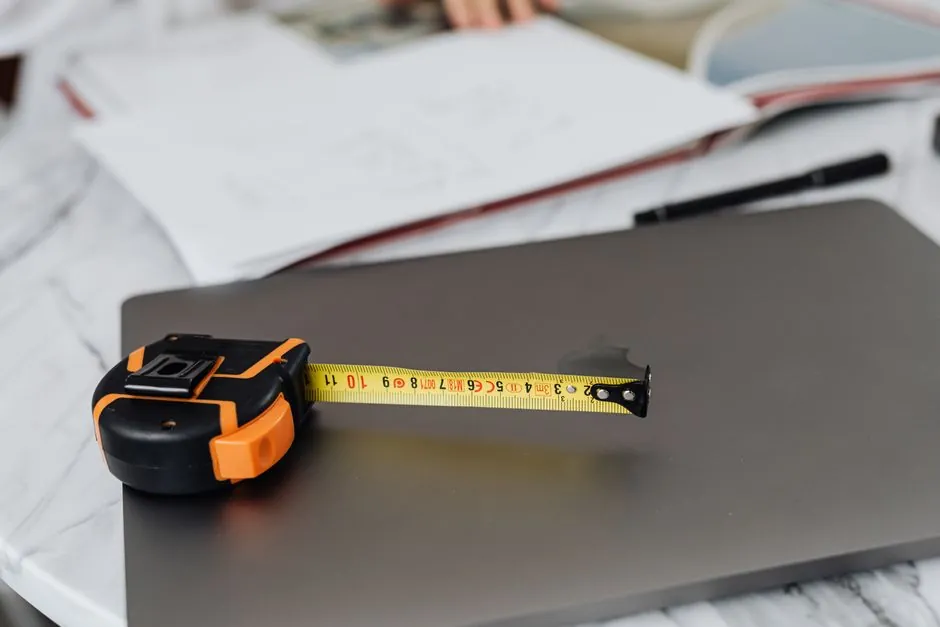
On a concrete crew, the laser distance meter is the workhorse for form layout, diagonal checks, slab dimensioning, and quantity takeoffs, so the right spec is a 50 m minimum range with ±1.5 mm tolerance, IP65 sealing, and a 2 m drop rating [S3][S9].
Concrete substrates are dark, dusty, and often wet, which collapses the usable range of a phase-shift handheld by 30-60% versus the white-card spec, so a meter rated 50 m on a reflector may only deliver 20-30 m on a formed wall [S2]. The combination of accuracy, environmental rating, and visible-beam performance separates a tool that earns its keep on rebar and formwork from one that ends up in the gang box.
Range Bands That Match Concrete Layout Tasks
Concrete layout splits into three distance bands, and the right meter maps directly to which band dominates the pour. Interior slabs, foundation forms, and small footings sit in the 0.05-30 m band where phase-shift units deliver ±1.5-2.0 mm accuracy on a white target at the cheap end and ±1.0 mm once the unit clears the $200 mark [S3]. Mid-range 0.05-50 m handhelds with Pythagoras and area/volume functions cover driveways, garage slabs, and most residential foundation work, with mainstream catalog pricing clustering at the 50 m ceiling for non-reflector outdoor measurement [S2].
Long-baseline commercial pours, tilt-up panels, and warehouse slabs push the requirement to 60-100 m or beyond, and that is where the visible green dot and an integral viewfinder earn their place, because a 165-foot indoor range commonly drops to 50-60 feet (about 15-18 m) in direct sunlight on a concrete target [S4]. For reference, the same selection logic that drives meter sizing also governs a laser level choice, since the two tools are paired on the same pour.
Accuracy Tolerance: ±1.5 mm Is the Practical Floor
For formwork, slab edge verification, and rebar cover checks, ±1.5 mm at full range is the practical accuracy floor, with ±1.0 mm reserved for facade, steel-fabrication, and surveyor-grade verification where a steel-tape cross-check is not expected [S3]. Entry-level 50 m units typically publish ±2.0 mm typical accuracy, which is acceptable for room dimensions and cabinet fit-out but accumulates visibly across a 20 m run and starts to eat into FF/FL floor flatness budgets on industrial pours [S3].
The range-to-accuracy ratio is more informative than the headline number, because a ±1.5 mm spec at 30 m is roughly 5 ppm, whereas a ±3 mm spec at 50 m is 60 ppm, a 12× gap that decides whether the meter fits a surveying workflow or a rough-estimate workflow [S2]. For concrete volume takeoffs on a 200 mm slab tolerance, ±1.5 mm is the working minimum, anything looser and the cubic-yard invoice drifts by a percentage point per 10 m of run. Engineers cross-referencing this against a laser distance sensor spec for fixed-position concrete-plant use should treat the handheld number as a one-off reading tolerance, not a closed-loop linearity figure.
Laser Class, Beam Color, and Outdoor Visibility on Concrete
Handheld construction meters ship as Class 2 (visible, 1 mW CW) by default, which is eye-safe for accidental glances under 0.25 s and is the legal default for construction sites in most jurisdictions; Class 3R (≤5 mW) appears on long-range models and requires nominal operator briefing but no PPE [S3]. Inside Class 2, the choice between 635-690 nm red and 510-530 nm green is decided by sunlight, because the human eye's photopic response at 520-530 nm is roughly 4× higher than at 635 nm, which is why a green beam reads 30-50 m of usable range on a plain reflective target while a red beam of the same internal power class falls to 10-15 m [S5].
For exterior concrete layout, foundation batter boards, fencing, and any daytime work past 20 m, green is the default; the price premium is typically 1.5-3× an equivalent red unit, and the runtime penalty on a given battery pack runs 20-40% shorter [S5]. A red beam can be rescued outdoors by a Class-3R detector or line receiver, which extends effective range to 50-80 m on a rotary red unit, but a static-line red meter is a poor fit for an open deck pour in July sun [S5]. A short verbatim line from the catalog guidance sums it up: Class 2 with 635 nm red or 515 nm green is the safe default for handheld construction work [S2].
IP Rating, Drop Rating, and Why the Housing Matters on Rebar
IP54 is the consumer handheld baseline, IP65 is the industrial baseline and the point at which dust and low-pressure water jets stop being a warranty-voiding event, and a 2 m drop test onto concrete is the de-facto industrial-handheld standard that Leica publishes on the DISTO X3 datasheet [S3]. Concrete sites are wet, muddy, and abrasive, so an unsealed housing will fail at the USB port or the battery door within a single season, and a meter without a published drop spec is a red flag regardless of brand [S3].
Display readability is a parallel gate that is easy to miss: backlit screens with large numerals and a reference-point indicator (bottom or top edge) cut transcription errors in dim basements, crawl spaces, and rebar-cage interiors where concrete measurement often happens [S4][S10]. A negative LCD for sunlight readability and unit switching between inches, feet, and meters are the three store-checks that separate a usable field meter from one that frustrates the rodman on a bright slab. The same display logic drives selection of a laser distance meter for any jobsite where the operator cannot control the ambient light.
Comparison: Handheld Phase-Shift vs Time-of-Flight vs Rotary Pairing
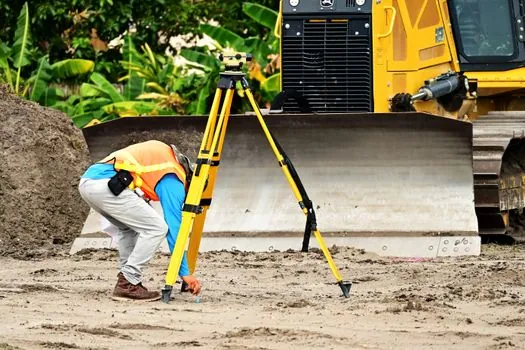
Three options cover almost every concrete-work scenario, and the right pick follows from range, tolerance, and the type of pour. A handheld phase-shift meter (0.05-50 m, ±1.5-2.0 mm, IP65) handles interior slabs, foundation forms, and quantity takeoffs at the cheapest entry point, with mainstream 50 m models retailing near $22 on the consumer channel and industrial units such as the Leica DISTO X3, Bosch GLM 120i C, and Stabila LD 520 stretching to 100-150 m with tilt sensors and IP65 housings rated for a 2 m drop onto concrete [S2][S3].
A handheld time-of-flight meter (100-650 ft, ±1/16 in at 50 ft) covers exterior wall layouts, roof ridges, and large warehouse dimensions where range matters more than sub-millimetre accuracy, and the technology reads accurately on bright outdoor targets where phase-shift loses SNR past 30 m [S4]. A rotary laser paired with a Class-3R detector is the right tool for long-baseline grading, slope work, and concrete-pour elevation control on commercial slabs, with a 200-500 m diameter coverage radius and accuracy that tightens to ±1.5 mm / 20 m on the professional tier [S5]. The same physics that lets a laser marker engrave a datum also lets a rotary sweep a 300 m grade baseline, and the detector is what turns visible-beam fade into a usable elevation reading.
Common Misapplications and Concrete-Site Failure Modes
The most common compliance miss on a 2024-2026 project audit is specifying a Class 3B or higher pulsed rangefinder onto an active construction site without controlled-area paperwork, which is a category jump, not a price jump, and triggers laser-controlled-area, interlock, and OD-rated eyewear requirements that no concrete crew will actually implement [S3]. The second failure mode is treating the headline range as a concrete-on-concrete number: pulse-based time-of-flight designs on uncooperative surfaces such as formed concrete, dirt, and dark wood typically lose 30-60% of their white-target range, so a 50 m handheld spec commonly degrades to 20-30 m on a construction substrate [S2].
The third is the M8 tripod-mount misconception: mounting a handheld laser distance meter as a fixed sensor without a vibration-isolated mount and a temperature-stable reference will produce drift that the spec sheet does not warn about, and a handheld that is repositioned between every reading cannot serve as a closed-loop position sensor regardless of its SSI or fieldbus interface [S2][S3]. For concrete crews, the practical rule is: handheld for layout and verification, rotary for elevation, and leave the fixed industrial sensor to the batching plant and the rebar-mill.
Sourcing, Standards, and What to Verify Before Purchase
Three datasheet checks separate a serious concrete meter from a DIY rebrand: a published mm-per-distance accuracy figure (not an arc-second or a vague "±0.05%" headline), a stated drop test height in metres onto concrete, and an IP rating written as IP5X or IP6X with the second digit, not as "water resistant" [S3][S5]. Laser class must read Class 2 with a wavelength in nm on the housing label and in the manual, and the FDA/CDRH accession number or the IEC 60825-1 conformance line should be findable in the datasheet, not only on the box.
Trackable signals to watch between now and the next pour season: distributor catalogs continue to show 50 m as the mainstream ceiling for non-reflector outdoor measurement, with 40 m OEM variants widely stocked for export channels, and the consumer entry price for a usable 50 m phase-shift unit has held near the $22 mark since mid-2025 [S2][S3]. For crews who already own a rotary, the aerial work platform spec only matters for high-bay pours, and the aerial work truck spec only matters for bridge-deck work, but both are worth a cross-check if elevation transfer is being staged from a vehicle.