For linear motion under 500 mm stroke and intermittent duty, an Acme or trapezoidal lead lead screw typically costs 60–80% less than an equivalent ball screw and ships in 2–4 weeks, while a ball ball screw remains the default once duty cycle pushes past 50% or repeatability below ±0.01 mm is required.
This 2026 buying guide maps the three commercially dominant types (Acme, ball, roller) against load class, speed, efficiency, environment and the standards that govern them, then walks through the levers that move landed cost: diameter, lead, end machining, material, lubrication and MOQ. Sourcing context is drawn from current vendor catalogues, including Thomson's Micro Stage MS25-100043 (lead-screw drive, 540 mm stroke, preloaded ball guide) [S4] and active open-source ELS integration threads dated 2026-05-02 [S1].
Three lead-screw types and where each one wins
Acme/trapezoidal screws use sliding contact between the nut and the flights; they tolerate dirty environments, run with grease or oil, and survive side loads that would brinell a ball screw. They are the default for low-speed, low-duty, hand-driven or motor-driven positioning under roughly 0.25 m/s, and for jigs, manual stages and shop equipment. Ball screws replace sliding contact with re-circulating ball bearings between nut and shaft, lifting mechanical efficiency into the 90% range and pushing repeatability down to ±0.005–0.01 mm in standard rolled product, with ground versions reaching ±0.002 mm or better. Roller screws push hardened rollers through a planetary track between nut and shaft, raising static load capacity roughly 1.5–2× over a same-diameter ball screw at the cost of slower maximum speed and higher unit price. For comparison: a 16 mm Acme screw with 5 mm lead, 300 mm length, in 303/304 stainless with simple end machining, lands in the tens of dollars per axis at single-unit MOQ, while the equivalent rolled ball screw lands in the low hundreds; a ground or roller equivalent sits in the high hundreds to low thousands. [S1]
Selection criteria: load, speed, precision, life and environment
Five variables decide the type, and they should be ranked before diameter is touched. (1) Dynamic load capacity in N, sized to the required L10 life hours at the calculated mean axial load (the standard equation relates dynamic load rating C, equivalent load Fm and travel in millions of revolutions, and ignores lubrication quality at the specifier's peril). (2) Required linear speed and acceleration, which combined with lead defines the input rpm and thus the screw's critical speed — the rotating shaft's first natural frequency must be at least 20–25% above the maximum operating rpm for steel screws of typical length-to-diameter ratio. (3) Positioning accuracy and repeatability: ±0.1 mm is reachable with rolled ball screws and most Acme nuts; ±0.01 mm or below forces ground ball or roller screws, and tightens the call on nut preload (oversize, spring or double-nut). (5) Environment: cleanroom, vacuum or food-grade builds push material toward 304/316 stainless and PTFE or food-grade grease lubrication; washdown or marine service pairs stainless with sealed nut housings. [S2]
Standard bodies and the documents to keep on the desk during selection: ISO 3408 for ball-screw geometry and acceptance grades (C0–C10, with C0/C1 the precision grades below ±0.005 mm/300 mm); ISO 2901/2902/2903 for metric trapezoidal screw threads; DIN 103 for older Acme callouts; ASME B1.1 for inch Acme; and the machine builder's own life and stiffness targets, usually expressed in L10 hours and µm/m stiffness.
Material, lubrication and end-machining levers
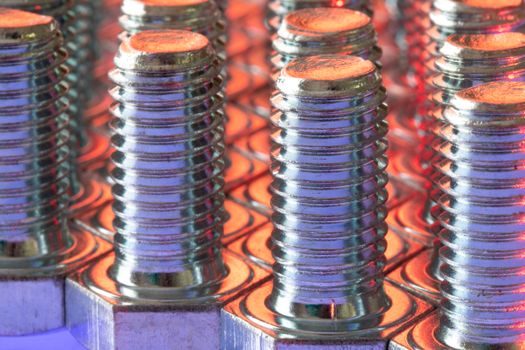
Material choice is the single biggest non-precision cost lever. Carbon steel (C45, C50) induction-hardened to HRC 58–62 is the default for general industrial ball and Acme screws in dry or lightly lubricated service, and ground versions typically use 50CrMo4 (DIN 1.7225) for through-hardening stability. 304 stainless tolerates wet and mildly corrosive service at the cost of lower hardness (typically HRC 28–35) and shorter life under high-cycle load; 316 stainless adds chloride resistance and is mandatory for marine, food and medical. Aluminium and polymer screws exist for ultra-light or low-load stages but are outside the scope of any ISO 3408-grade build. On linear guide interfaces, screws are almost always paired with a recirculating-ball or crossed-roller guide to take moment and side load off the nut; Thomson's MS25-100043 bundles a preloaded ball guide with a 540 mm lead-screw drive for exactly this reason [S4].
Lubrication has its own cost versus life trade. Grease lubrication (lithium or polyurea with MoS2) is standard for Acme nuts and many ball nuts, applied at assembly and re-applied every 500–1,000 hours or per service interval; oil-mist or forced-oil lubrication extends life 2–3× at the cost of a pump, reservoir and sealed bearings. PTFE or polymer-based dry-film coatings (Teflon, Dyneon, Xylan) cut friction on Acme screws enough to approach ball-screw efficiency on short, low-cycle strokes and to remove the maintenance burden entirely, but they are not a substitute for ball contact at high cycle. End-machining — wrench flats, lead-screw support bearings, keyways, threaded journals or drive couplings — is what turns a raw screw into a buildable axis; standard catalog end-machining on Thomson-, Misumi- and Kaiwo-class vendors is typically 20–40% of the raw screw cost and worth quoting as a line item rather than a free add-on [S2][S4].
Standards, certifications and the specifier's checklist
Specifying engineers should anchor the requisition on ISO 3408 grade (C0/C1/C3/C5/C7/C10), the L10 life target in hours or millions of revolutions, the required straightness (typically 0.05–0.10 mm/m for rolled, 0.01–0.02 mm/m for ground), surface finish (Ra 0.2–0.4 µm on the ball track for precision grades) and the material certificate (EN 10204 3.1 for full traceability). The datasheet should also call out: lead accuracy (µm/300 mm), backlash after preload (typically 0.01–0.05 mm for preloaded ball nuts, zero-backlash for double-nut or roller), and the lubrication regime. Where the axis is paired with a linear guide, the spec should reference the interface — the ball screw and the guide should be from the same accuracy class and the same supplier where possible to avoid mismatched stack-up tolerances [S4].
Vendor landscape and 2026 sourcing map

For high-volume industrial buyers, Taiwan and mainland China remain the dominant manufacturing base: Kaiwo (kaiwoleadscrew.com) and Shyh Min Machinery (leadscrew.com.tw) list rolled Acme, ball and roller screws up to roughly 80 mm diameter with C5–C7 grade and custom end-machining, with single-axis MOQ as low as 1 piece and price breaks at 10/50/100 axes [S2][S3]. For catalog lead-screw-driven stages with matched linear guide, Thomson's Micro Stage family — including the MS25-100043 (540 mm stroke, lead-screw drive, preloaded ball guide) — gives an integrated axis with CAD downloads and a single part number, which is the cheapest path when the design does not need a custom screw [S4]. For one-off hobby and retrofit builds, the open-source electronic leadscrew (ELS) community continues to publish firmware and hardware revisions against metric and imperial lead screws, with active issue tracking in May 2026 confirming ongoing integration work for lathe retrofit kits [S1]. Total landed cost in 2026 sits at roughly 1.3–1.5× 2024 levels for rolled ball screws in carbon steel, and 1.4–1.7× for ground, driven by bearing-steel and grinding-capacity costs; Acme screws have moved less, in the 1.1–1.2× band.
2026 lead-screw decision matrix: type vs. criteria
For the buyer, a four-criterion matrix covers most cases. (1) Load and life: below 2,000 N static and <50% duty, Acme is acceptable; 2,000–10,000 N with high duty, choose rolled ball; above 10,000 N or sub-±0.01 mm precision, choose ground ball or roller. (2) Speed: below 0.25 m/s, Acme; 0.25–1.0 m/s, rolled or ground ball; above 1.0 m/s, ground ball or roller with critical-speed analysis. (3) Environment: dirty, low-temperature, low-cost — Acme; clean, oil-mist, precision — ball; heavy side load, shock — roller or Acme with preloaded guide. (4) Budget and lead time: tightest budget and shortest lead — Acme; mid-budget and 2–4 week lead — rolled ball from a Taiwan or China catalog vendor; premium precision and 6–10 week lead — ground ball or roller from a Thomson, NSK, THK, SKF or Hiwin catalogue [S2][S3][S4]. For engineers weighing lead-screw axes against alternative drives, the linear guide vs ball screw sourcing map and the ball screw vs linear actuator selection guide carry the cross-technology comparison in more depth.
Common failure modes and what to inspect on receipt
The four failures that show up in warranty returns, in order, are: (1) brinelling of the ball track from shock or side load, almost always a guide-stack design error rather than a screw defect; (2) backlash growth from insufficient preload or worn threads in Acme nuts, fixable with a new nut or shim adjustment on double-nut designs; (3) corrosion pitting of stainless or plated carbon-steel screws in washdown or marine service — surface finish (Ra, plating type) should be checked against the spec on receipt; (4) fatigue spalling at the first engaged thread under the highest load zone, the classic symptom of under-rated C versus the actual equivalent load. The cleanest field test on a received screw is to run the full stroke at design speed, measure no-load torque against the datasheet value (a 30%+ gap means over-preload, dry lubrication or a damaged track), and check straightness on a granite block with a dial indicator at both shaft journals. [S3]
Trackable signals for the rest of 2026: monitor ISO 3408 grade availability at the major Taiwan/China catalog vendors for C3 and C5 rolled product, where 2025–2026 capacity has been tight, and watch for the next Thomson Micro Stage release cycle for integrated lead-screw-driven stages above 600 mm stroke. Related cost benchmarks for adjacent components are in the steel pipe price guide and the silicone rubber price guide for the seals and wipers that go on the end of every screw axis.