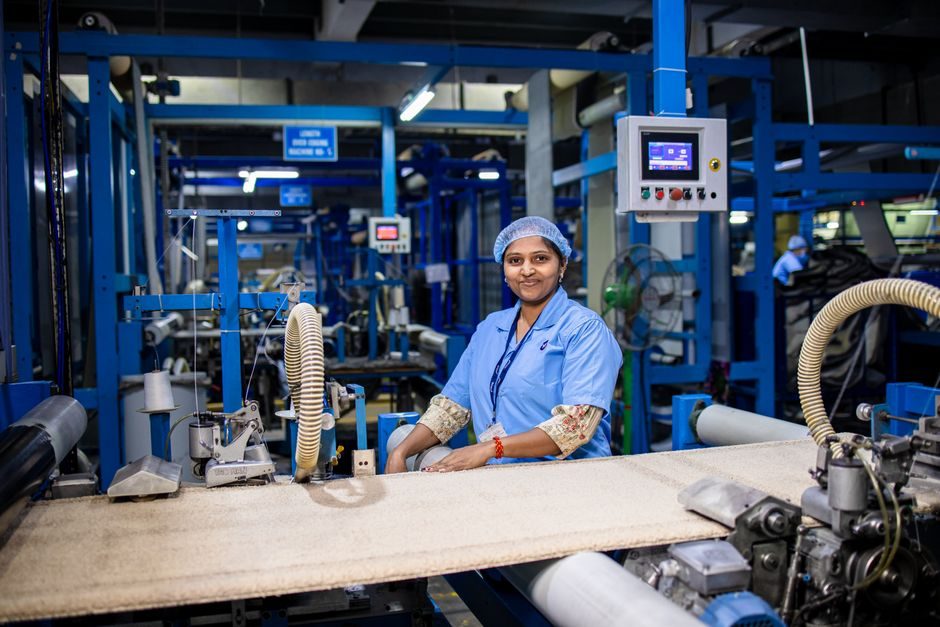
As of June 2026, LED smart manufacturing is no longer a single-machine upgrade story — it is a stack of AI-led process intelligence (Haber eLIXA / Mt. Fuji platforms, recognised by Frost & Sullivan for industrial AI in 2026), IIoT sensor layers, and cobot-mobile robot contact systems that together define the line architecture for flexible LED, rental LED and gallery LED display production [S2][S4].
Supplier-side, Chinese OEM/ODM clusters in Guangdong and Jiangsu continue to anchor the volume tier: a Nanjing Chechi Technology listing on Made-in-China quotes a P3.91 stage LED dance-floor panel at 300.00 USD per unit with sample service, while Guangdong-based flexible-LED vendors offer soft LED curtain, transparent LED and glass-LED variants from a single factory footprint [S6][S8]. On the buyer side, AI-led automation platforms now expose trim-loss reduction (Kaiznn), digital-twin predictive interventions, and IIoT-driven consistency control as discrete, line-by-line product modules rather than one monolithic MES bundle [S2].
What "Smart Manufacturing" Actually Means in an LED Plant
Smart manufacturing in the LED sector is the integration of cyber-physical systems, high-density sensor arrays and AI inference loops over the SMT placement, reflow, ageing-test and optical-bin-sort stages of the line [S5]. The contact-system method published in the International Journal of Precision Engineering and Manufacturing-Green Technology (2023) formalised a precise-interaction protocol between collaborative robots and mobile robots — the cobot-mobot contact layer that 2026 LED lines now use to feed bin tubes between SMT head and AOI station without human handoff [S4]. IBM's 2023 framing still holds: SM systems rely on high-tech sensors collecting performance and health data, feeding back into process models that drive yield, throughput and energy decisions per workcell [S5].
Rockwell Automation's product-management and configuration tooling, refreshed on its US site on 2026-06-01, gives buyers a single portal for controller, I/O, drive and visualisation selection — the practical entry point for North American LED integrators who must map smart-manufacturing claims onto a bill of materials [S3]. For LED line builders the practical implication is concrete: pick a control platform whose IIoT and analytics modules expose yield, AOI defect class, and reflow-oven profile as structured data, not as PDF logs.
Selection Criteria: Where the Money Actually Moves
Four criteria separate a 2026 LED smart line from a glorified PLC retrofit: (1) AI inference latency on the AOI defect-classifier, typically targeting sub-200 ms per panel for a P3.91-class module; (2) data backbone — Ethernet/IP, PROFINET or OPC UA over MQTT — and whether the vendor's platform supports a real-time analytics layer rather than batch CSV export; (3) cobot-mobot contact safety, which in collaborative LED-handling cells must satisfy ISO/TS 15066 power-and-force-limiting guidance for the specific end-effector mass; (4) ageing-test traceability, with per-module burn-in data addressable by serial number through the IIoT layer [S4][S5].
Compare the main options on a 2x4 decision matrix before specifying: AI-led platform (Haber eLIXA / Mt. Fuji) — strong on process-intelligence and trim-loss, weaker on legacy brownfield integration; traditional SCADA/HMI plus edge AI — strong on greenfield uptime, weaker on cross-plant benchmarking; cobot-mobot contact cell — strong on labour substitution in binning and ageing-rack handling, weaker on capital cost for low-mix lines [S2][S4]. The dominant Chinese OEM/ODM tier (Fujian, Guangdong, Jiangsu) delivers flexible-LED, rental-LED and bar-screen formats at unit prices from 3 USD low-end flex modules up to 300 USD per P3.91 dance-floor panel, with sample service and OEM/ODM R&D capacity flagged on the factory profile [S1][S6][S8].
Who the LED Smart-Manufacturing Stack Is For — And Who Should Skip It
The stack is built for plants running high-mix, high-volume LED display production — flexible LED curtain, rental LED panel, transparent LED and glass-LED SKUs — where changeover time and per-module yield loss dominate the cost stack. Plants with 50,000+ modules per month of mixed pixel pitch (P1.25 to P3.91) typically recover the IIoT and AI-inference capex inside 18-24 months when trim-loss reduction and predictive reflow-oven maintenance are real, not aspirational [S2][S6][S8].
It is NOT for low-volume architectural-only LED galleries running <1,000 units per year: the IIoT data volume is too thin to train defect classifiers, and the cobot-mobot contact-cell capex cannot be amortised across that run rate. The Fujian-based gallery-LED trading-company cluster (Adidea Xiamen and similar Diamond Members) targets exactly that low-volume North America / Europe / Southeast Asia gallery channel, not the smart-factory buyer — different scope, different product, different conversation [S1].
Standards and Sourcing Levers That Decide the Quote
Three sourcing levers actually move the LED smart-manufacturing quote in 2026: (1) line origin and tier — Jiangsu and Guangdong OEM/ODM factories offer OEM/ODM R&D service and sample service with transparent-LED and soft-LED curtain on the same shop floor, which compresses tooling cost; (2) the AI/IIoT license model — Haber's eLIXA / Mt. Fuji / Kaiznn stack is sold as a platform with three discrete product surfaces (process intelligence, digital twin + predictive intervention, trim-loss reduction) rather than a bundled MES, so the buyer picks the surface that maps to their yield problem [S2]; (3) the cobot-mobot contact-system specification, where the 2023 Springer paper provides the only formally published precise-interaction reference that auditors will accept in a vendor capability review [S4].
The Smart Manufacturing Experience show (IMTS, September 9-14, 2024) ran a showcase format for small-to-medium manufacturers that is likely to be reprised in the 2026 IMTS cycle, and is the single best North American venue to inspect AI, cybersecurity, data-management and workforce-development stacks in a working LED line context [S7]. For a deeper dive into the wider smart-manufacturing automation stack across power-grid component production, see Power Grid Smart Manufacturing 2026, and for a cost-side benchmark of adjacent high-mix automation capital, the BESS Manufacturing Process 2026 spec map and AS/RS System Buying Guide 2026 both quantify the throughput and total-cost levers that any LED line builder will hit within two years of going live.
Real Failure Modes Buyers Hit at Commissioning
Each failure mode is detectable at FAT if the buyer insists on a defect-classifier F1-score test on a held-out panel set and a deadlock-injection test on the cobot-mobot cell.
Chinese OEM/ODM factory profiles consistently flag R&D capacity, OEM/ODM service, and sample service as the three buyer-facing differentiators, but a smart-manufacturing buyer should treat those as table stakes and interrogate the IIoT data backbone, the AI defect-classifier F1 baseline, and the cobot-mobot contact-system test record instead [S1][S6][S8]. A vendor that cannot produce a defect-classifier F1 baseline measured on the buyer's own pixel-pitch mix is not running smart manufacturing; it is running a connected PLC.
Track two signals over the next reporting cycle: the next IMTS Smart Manufacturing Experience 2026 prospectus (likely mirroring the 2024 September 9-14 showcase format for small-to-medium manufacturers) and any update to the Haber eLIXA / Mt. Fuji product surfaces, since the Frost & Sullivan industrial-AI recognition in 2026 puts that stack on a watchlist for OEM licensing changes that will reshape the 2026 H2 line-integration quotes [S2][S7].
For component-level specifications, see additive manufacturing material, smart camera, and smart meter.