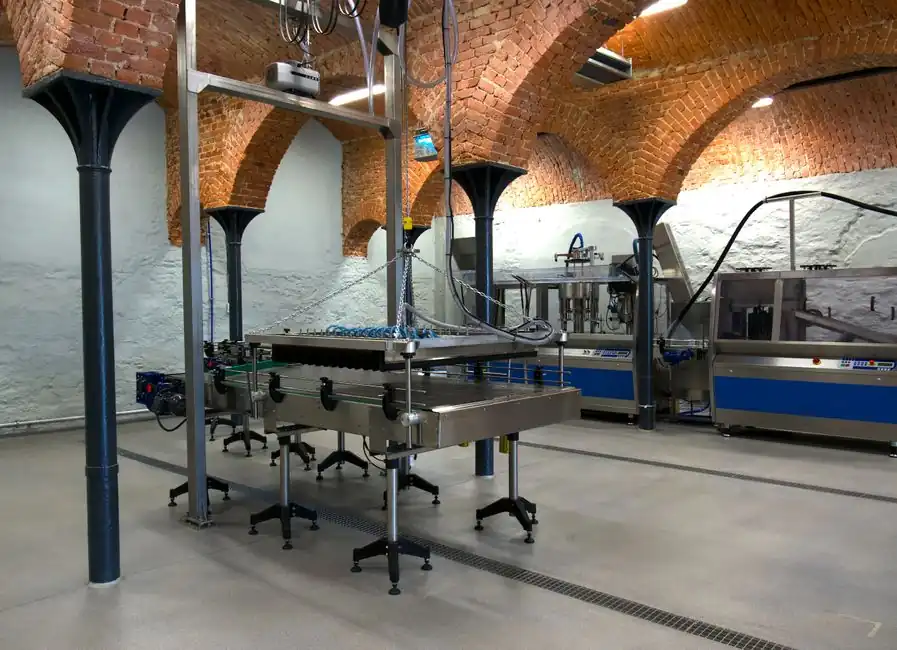
A lithium carbonate production line in 2026 is sized against battery-grade purity (≥99.5% Li2CO3), an upstream feed specification, and a chosen concentration route, with IMARC's reference plant running 10,000-30,000 MT per year and S&P's 27 kta spodumene case using a 6 wt% concentrate feed at the same mass flow as a paired lithium hydroxide monohydrate (LHM) line [S2][S6].
Two feed families compete: continental brines (evaporation + DLE) and hard-rock spodumene (roast + acid leach + soda-ash precipitation), and the line configuration below must be locked to one of them, because each route drives different reactor metallurgy, drying duty, and crystallizer cut points [S1][S4].
Feed Specification and Mass-Balance Anchor
The feed specification is the first design lock, and S&P's reference case sets a 6 wt% spodumene concentrate feed rate that simultaneously feeds a 27 kta battery-grade Li2CO3 plant and a paired LHM plant at the same solids throughput, simplifying front-end crushing and roasting duty [S6]. On the brine side, the JR Lezama model uses a five-pond fractional crystallization train (halite → sylvinite → carnallite → bischofite → Li-rich liquor) to lift Li concentration before the refining step, with effluents recirculated to pond 1 to cut fresh brine draw [S1].
Spodumene concentrate grade in commercial practice sits around 3.73% Li by weight in the ore, and the upstream crushing + roasting stage is what determines the acid-leach lithium sulfate mass flow feeding the carbonate reactor train [S5]. For a molding line analogy: just as a molding line's shot weight and cycle time lock the downstream cure oven duty, the concentrate Li grade and leach recovery lock the precipitation reactor size and soda-ash stoichiometry here.
Core Unit Operations and Equipment Chain
The hard-rock route runs a fixed chain: mining, crushing, beneficiation, roasting (α→β spodumene conversion), sulfuric acid leach, impurity removal (Fe/Al/Ca/Mg), soda-ash precipitation of Li2CO3, crystallization, filtration, drying, and packaging, with each step setting the size of the next [S2]. Metso's May 2026 launch collapses the refining train into a one-pass route from spodumene to battery-grade Li2CO3, removing intermediate re-dissolution stages and cutting the equipment count versus a conventional carbonate circuit [S3].
On the brine side, the line consists of evaporation ponds (solar or mechanical), a Li-rich liquor clarifier, boron and magnesium polishing (typically with lime and selective ion exchange), soda-ash precipitation, washing, and a dryer. Direct Lithium Extraction (DLE) modules are increasingly inserted between the last evaporation pond and the precipitation reactor to bypass the lowest-recovery, weather-dependent pond steps and to lift lithium tenor entering the crystallizer [S1][S4].
Selection Criteria: Hard-Rock Spodumene vs Solar Brine vs DLE
Hard-rock spodumene lines deliver the fastest time-to-battery-grade (weeks, not 12-24 months of ponding) and the highest plant-level lithium recovery, at the cost of higher energy intensity per ton Li2CO3; solar-brine evaporation is the lowest-CAPEX route but is climate-locked, slow, and generates large co-precipitate salt volumes that must be harvested periodically [S1][S4]. DLE sits between them: higher CAPEX than ponds, faster cycle time, and recovery rates that typically beat solar evaporation while still accepting a Mg-rich salar feed [S4].
Decision rules for 2026 designs: pick spodumene when the project needs ≥99.5% battery-grade output on a 12-24 month build, pick solar ponds only when land cost is low, climate is reliably arid for 8+ months/year, and offtake tolerates 18-30 month ramp, and pick DLE when brine Mg:Li is high and the operator wants to skip the carnallite/bischofite pond pair entirely [S1][S4]. S&P's 27 kta spodumene case is a useful sizing reference even for brine projects, because the downstream precipitation, filtration, and drying sections scale on Li2CO3 tons per year, not on upstream feed chemistry [S6].
Plant Capacity, Economics, and Equipment Sizing
IMARC's reference lithium carbonate plant is designed for 10,000-30,000 MT/year, with gross profit margins typically running 35-45% under normal operating conditions and battery-grade output capturing the upper end of that range [S2]. Project economics depend on concentrate cost, sulfuric acid price, soda-ash stoichiometry (roughly 1.0-1.05 mol Na2CO3 per mol Li in the precipitated liquor), and dryer natural-gas or steam duty, all of which scale with the 27 kta figure used in S&P's paired-train case [S2][S6].
For a battery-grade purity target of ≥99.5% Li2CO3, the critical equipment list is a vacuum crystallizer or controlled precipitation reactor, a wash centrifuge or belt filter, a rotary or flash dryer sized for ~1-2% residual moisture, and a packaging line rated for hygroscopic fine powder, with each piece sized off the 10,000-30,000 MT/year annual capacity envelope [S2][S5]. A comparison of the three routes against four decision criteria is useful at the FEED stage:
Standards, Purity Targets, and Process Constraints
Battery-grade Li2CO3 specifications center on Li content (theoretical 18.78% Li in Li2CO3), impurity ceilings for Na, K, Ca, Mg, Fe, Cu, and moisture, and a particle size distribution that downstream cathode precursor lines can slurry without re-milling [S2][S5]. The 99.5% minimum purity cited in commercial plant reports is the working threshold for cathode-grade qualification, and it sets the number of re-crystallization or washing stages in the downstream train [S5].
Process constraints to design around: spodumene concentrate moisture at the leach feed, Mg:Li ratio in brine feeds (high ratios force extra polishing stages), sulfate residuals from the acid leach that bleed into the soda-ash reactor, and the hygroscopic nature of finished Li2CO3, which mandates a closed packaging line with desiccant at the bag or supersack stage [S1][S2]. For projects sourcing from oilfield or geothermal brines, trace boron and calcium removal becomes a defining polishing step, often requiring selective ion exchange ahead of the soda-ash reactor [S1].
Failure Modes and Design Pitfalls
Common design pitfalls in 2026 lithium carbonate line builds: undersizing the soda-ash reactor (Li2CO3 precipitation is fast but mixing-sensitive, and a low P/V ratio produces fine, hard-to-wash crystals); skipping the magnesium polishing step on high-Mg brine (Mg co-precipitation with Li2CO3 destroys battery-grade purity in a single batch); and using carbon-steel crystallization vessels in the brine route, where chloride pitting forces 904L or rubber-lined reactors instead [S1][S2].
Operational failures observed in the field include pond-rain dilution in solar-brine designs (one wet season can wipe a year's concentration progress), spodumene roast under-conversion when kiln residence time is set from α-spodumene data instead of β-spodumene targets, and DLE sorbent fouling when feed pretreatment is omitted [S1][S4]. For reference designs, an automatic molding line shows the same lesson at smaller scale: locked-down upstream specs and a defined cycle time are the only way to keep the downstream drying and packaging sections stable, and lithium carbonate lines apply the same logic to the leach liquor and the crystallizer.
Vendor and Technology Options in 2026
Metso's 2026 one-pass spodumene-to-battery-grade Li2CO3 process is the most prominent new licensable route, targeting simplification of the refining train and avoidance of intermediate re-dissolution steps that historically added reactor count and sodium sulfate by-product handling [S3]. DPR-level reference designs from IMARC and Expert Market Research remain the baseline for greenfield feasibility, sized at 10,000-30,000 MT/year with full CapEx/OpEx breakdowns and a 35-45% gross margin envelope [S2][S5].
For brine projects, DLE technology providers are typically evaluated by sorbent class (alumina-based, manganese-oxide, titanium, or ion-exchange resin), lithium selectivity at the project's Mg:Li ratio, and sorbent lifetime in cycles, because these three parameters dominate the OPEX of a DLE front-end [S4]. Across all routes, the precipitation, filtration, and drying sections downstream of the concentration step are the most commoditized, and a conveyor sorting line approach applies for plant-internal Li2CO3 powder transfer between crystallizer, dryer, and pack-out, where sealed conveying with desiccant air is required to keep moisture pickup below the 0.5% ceiling typical for battery-grade specs.
For capex and opex benchmarking, a useful cross-industry reference is the compressed-air market share view, which sets plant-scale expectations for utility-side equipment sizing that lithium carbonate lines also depend on for leach agitation, dryer air, and DLE eluate pumping. A direct lithium carbonate line to plan around: lock concentrate grade and feed rate first (S&P's 6 wt% spodumene / 27 kta case is the cleanest 2026 anchor), then run a JR Lezama-style mass balance on the chosen route, and finally size the precipitation reactor, crystallizer, and dryer against the 10,000-30,000 MT/year reference envelope from IMARC before committing to equipment orders. Trackable 2026 signals: new DLE sorbent cycle-life disclosures from licensors, and any follow-on Metso one-pass reference plant capacity announcements beyond the May 2026 launch.