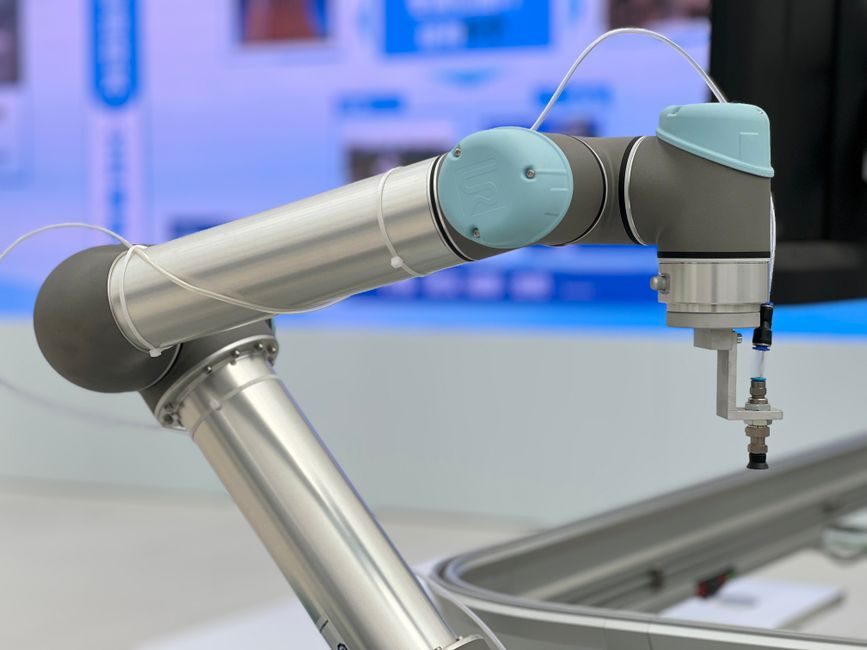
Lithography equipment smart manufacturing is converging around four tool classes — mask aligner, projection, laser direct imaging and laser ablation — all bound into a common IIoT/AI data spine, with the global market logged at US$ 22.1 Bn in 2022 and modeled to reach US$ 41.3 Bn by 2031 at a 7.2% CAGR [S2].
The driver is structural: rising IC and advanced-packaging complexity has pulled lithography out of an isolated cleanroom and into a MES-connected cell that shares overlay, dose and stage metrology with adjacent process tools [S2][S3]. A litho cell that ten years ago ran as a stand-alone station is now specified with networked sensors, edge gateways and cloud-side analytics, matching the broader smart-manufacturing pattern of IoT, AI, big-data and cloud integration described for general industrial lines [S3].
Tool Classes and Where Smart-Manufacturing Hooks Attach
The lithography tool pool splits into mask aligner, projection (steppers/scanners), laser direct imaging (LDI) and laser ablation, each with different automation surfaces [S2]. Mask aligners and projection tools dominate front-end wafer patterning, while LDI and laser ablation are heavily used in advanced packaging, MEMS and LED lines where direct-write flexibility matters [S2]. Smart-manufacturing integration is deepest on the projection side, where overlay metrology feeds back to stage calibration in real time, and on LDI, where digital masks eliminate the physical reticle inventory that used to constrain job-shop changeover [S2][S3].
For OEM-vendor implementations, Canon publicly positions its semiconductor lithography lineup (steppers/scanners) as configurable for both wafer processing and adjacent panel/LED applications, with the line exposed through a product page that doubles as a service and spec entry point [S4]. The peer-reviewed literature treats these tools as nodes inside a larger intelligent manufacturing system — see the IWAMA workshop taxonomy covering mechanisms, advanced manufacturing technologies, monitoring, mechatronics/robotics, intelligent systems and supply chain as six integrated chapters [S1].
Automation Stack: From Tool-Level Control to Fab-Level Orchestration
A modern litho cell is built in four layers: (1) tool-level control (stage motors, reticle/wafer handlers, dose controllers), (2) cell-level supervisory control (recipe management, lot tracking, dispatch), (3) edge aggregation (MQTT/HTTP brokers, time-series DB, alarm/event stream), and (4) cloud analytics (yield dashboards, FDC models, predictive maintenance) [S3]. Predictive maintenance is the single highest-ROI smart-manufacturing function on a litho tool: vibration, gas-flow, laser-energy and chiller-temperature sensors feed models that flag chiller pump wear, laser tube degradation or stage-bearing drift before a wafer lot is lost, matching the vibration-sensor predictive-maintenance case in EMQ's reference write-up [S3].
Real-time monitoring and control closes the loop on dose, focus and overlay. Sensors monitoring variables such as temperature, pressure and speed feed an instantaneous adjustment layer; anomalies are flagged for investigation rather than discovered at end-of-line metrology [S3]. On litho specifically, the analog is in-situ overlay metrology, where the tool corrects its own stage mapping between exposures, reducing rework and scrap. Equipment-manufacturing research has formalized this stack under "sensor technology, measure control technologies, micro-electronic technology and intelligent systems" as integrated chapters, not silos [S6].
Selection Criteria: When Each Litho Class Fits the Application
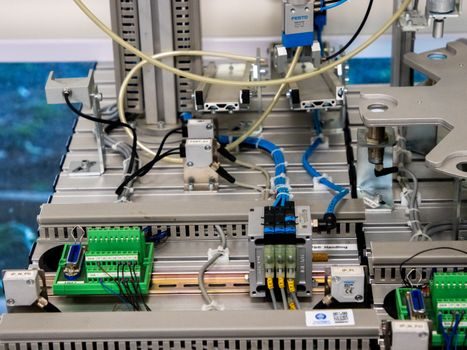
The four lithography technologies are not interchangeable; selection is driven by resolution, throughput, substrate form factor and packaging roadmap [S2].
Application fit is a second axis: advanced packaging, MEMS devices and LED devices are the three end-use groupings most often cited, each pulling a different mix of tool classes [S2]. A fab predominantly running 3D IC, 2.5D interposer, FO WLP wafer, WL CSP, flip-chip bumping, 3D WLP, embedded die, FO WKP panel and glass panel imager work needs projection-dominant capacity with LDI as a flexible supplement [S2]. By contrast, an LED line is largely LDI plus mask aligner, with limited projection share.
Smart-Manufacturing Reference Architecture for a Litho Line
The reference architecture has been laid out across multiple peer-reviewed volumes. IWAMA's six-chapter structure — mechanisms, advanced manufacturing technologies, measurements/monitoring, mechatronics/robotics, intelligent systems, and logistics/supply chain — maps almost 1:1 onto the layers a litho line needs to integrate with the rest of the fab [S1]. The parallel "Equipment Manufacturing Technology and Automation" volume adds NEMS/MEMS tooling, micro-electronic technology, sensor technology and machine vision as the chapters that surround a litho cell [S6].
On the production-side vendor landscape, LEAD Intelligent's public portfolio shows the same architectural pattern applied to lithium-battery and fuel-cell lines: PHM (prognostics and health management) systems, high-precision stack assembly, and ESG/regulatory reporting hooks (EU Battery Regulation, UN Global Compact) — the same IoT-and-analytics spine a litho fab would need [S7]. For a fab engineer, the take-away is that the smart-manufacturing stack for lithography is no longer a cleanroom special; it is the same reference architecture used in adjacent high-precision lines, and adopting it shortens integration time.
Failure Modes, Limits and What Smart-Manufacturing Does Not Fix
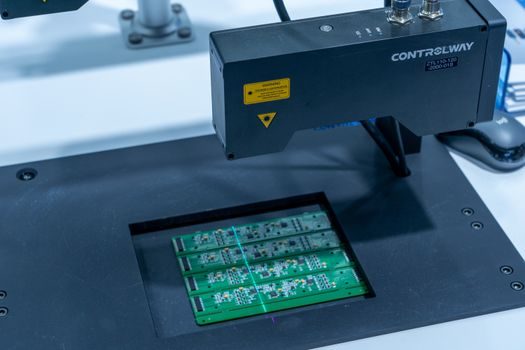
Smart manufacturing reduces unplanned downtime and improves yield, but it does not lift hard physical limits. Vibration sensors and FDC models can predict pump failure, but they cannot extend the theoretical resolution floor of a given exposure wavelength [S3]. LDI offers reticle-less flexibility but at lower throughput than projection for high-volume wafer work; mask aligners are cheap but cannot match the overlay budget of a scanner [S2].
The other constraint is data quality. A predictive model is only as good as the sensors behind it; under-instrumented legacy tools generate noisy streams that erode model confidence, and the "speed vs. precision" trade-off seen on fuel-cell stack lines (LHI's published 1 s/pcs × ±0.1 mm figure) is a useful analog for any high-throughput litho decision [S7]. Engineers planning a smart-manufacturing retrofit should budget for sensor upgrades, reticle/stock-management rework and operator retraining alongside the analytics layer, otherwise the digital twin tracks a tool that is only partially observable.
Standards, Sourcing and a Trackable 2026 Signal
Standards relevant to a smart-manufacturing litho cell are not the lithography exposure standards themselves but the IT/OT integration stack: industrial networking (OPC UA, MQTT), cybersecurity (IEC 62443 family for industrial automation), and functional safety on robotics/cobots used in wafer handling. Smart-manufacturing platforms are typically integrated via MQTT brokers over OPC UA, with cloud-side analytics in Python/SQL stacks and edge gateways running containerized FDC models [S3].
Trackable signals for the next planning window: (1) follow IWAMA and related Equipment Manufacturing Technology workshops for peer-reviewed case data on litho-cell FDC deployments [S1][S6]; (2) watch Canon and competing vendors for product-page updates that disclose new stepper/scanner variants aimed at advanced packaging and panel-level work [S4]; (3) compare automation depth across adjacent high-precision lines — for example, the fuel cell stack manufacturing reference on MEA assembly and bipolar-plate stack-up, or the offshore wind foundation smart-manufacturing track on robotic welding, and the crystalline-Si cell smart-manufacturing 2026 closed-loop defect repair line — to benchmark which MES and PHM patterns transfer cleanly into a litho environment.
For component-level specifications, see additive manufacturing material, anti static equipment, and smart camera.