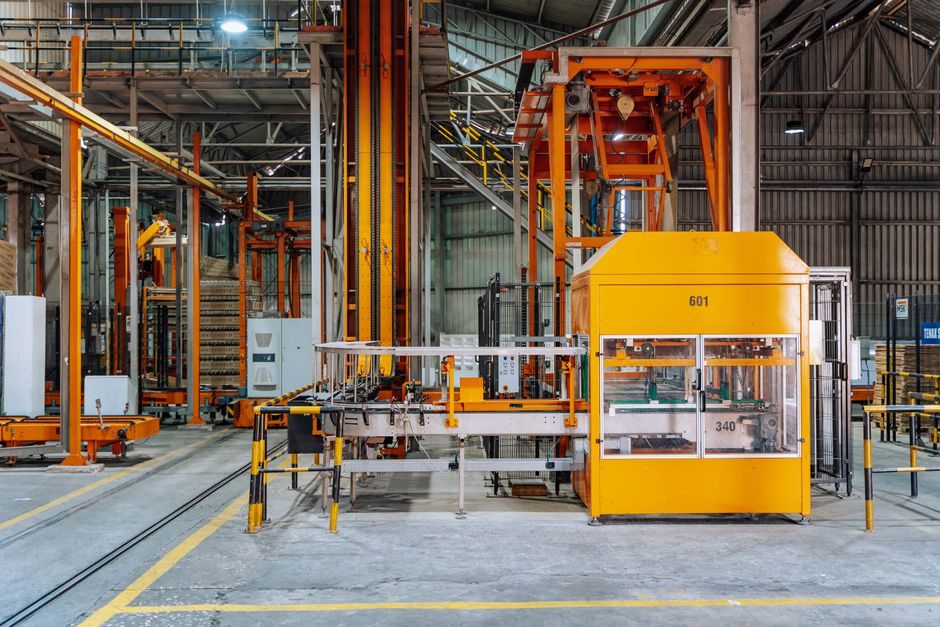
Offshore wind foundation fabrication has moved into a heavy-plate, multi-cell automation phase, with PEMA robotic welding cells, automated NDT stations and overhead logistics now standard for monopiles, transition pieces (TPs), jackets and floating substructures [S4].
The shift is structural rather than cosmetic: as commercial offshore turbines push toward 15 MW+ ratings, single-piece monopile diameters in new European projects are now quoted in the 8-10 m range and weights per piece are climbing past the 1,000 t mark [S3]. That moves the bottleneck from steel procurement to in-shop welding throughput, fit-up repeatability and traceability, which is where smart-camera inspection and MES-anchored production data are bought in.
What the foundation scope actually covers
Offshore wind turbine foundations are depth-dependent: fixed-bottom monopiles and jackets dominate water depths up to roughly 60 m, gravity bases cover shallow sites, and floating platforms (semisubmersible, spar, TLP) take over beyond roughly 60 m of water [S3]. A typical European fixed-bottom project such as Butendiek in the German North Sea used 80 monopile-supported 3.6 MW turbines for a total 288 MW, installed between 2014 and mid-2015 with the offshore substation on a four-pile jacket foundation [S2].
For fabricators, the four product families that drive line design are: monopiles (single large-diameter rolled cylinders with heavy flange rings), transition pieces (TPs with secondary steel, J-tubes, boat-landing and cable-management brackets), jackets (tubular lattice with cast or welded nodes), and floating foundations (pontoons, columns, bulkheads) [S4][S3]. Each family stresses a different combination of seam welding, circumferential welding, node welding and post-weld NDT.
Robotic welding and seam tracking on heavy plate
Pemamek's offshore wind offering — PEMA robotic welding systems for tower sections, monopiles, TPs, jackets, nacelle structures and floating foundations — is built around thick-plate seam welding using arc sensors, through-the-arc tracking and force-control torches that compensate for the heat distortion typical of 40-80 mm wall monopile plate [S4]. The PEMA cell model is sold as a complete solution covering welding, material handling, fixturing and line-level MES integration [S4].
On the process side, the three methods that dominate foundation welding are SAW (submerged arc) for long longitudinal and circumferential seams, FCAW-G for outdoor and field welds, and GMAW for short, position-critical node welds. The cycle-time win from robotics comes less from weld speed and more from arc-on time: a flow-meter-grade shielding-gas regulation, stable wire feed and continuous seam tracking typically push arc-on time above 70-80% of the shift, which is hard to achieve with manual cells at the same wall thicknesses.
Line-level MES, traceability and IIoT anchors
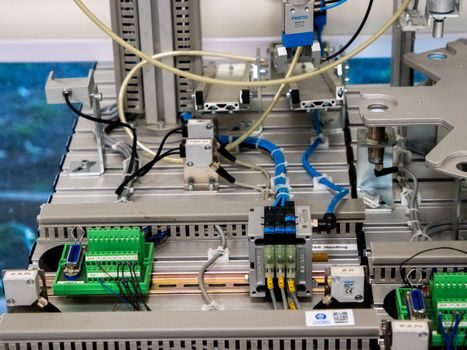
Foundation fabrication is a discrete, one-off product (each monopile and each jacket leg carries a unique serial), so the MES role is heavier than in consumer welding. Standard data items captured per part include: WPQR/WPS reference, actual heat input, interpass temperature, weld consumable batch/lot, NDT operator and result, dimensional inspection against the ITP, and parent-material cast/heat number with 3.1/3.2 certificates [S4].
For instrument buyers, the relevant instrumentation layer is the welding-power-source bus (Ethernet/IP or PROFINET), the pressure-transmitter network on shielding-gas manifolds, the smart-valve-positioner chain on shielding-gas and cooling-water regulation, and machine-vibration / spindle-current sensors on the welding positioners and rotators. These signals feed the MES KPI tree: arc-on percentage, rework hours per tonne of steel, weld defect rate per kilometre of seam, and on-time delivery to the load-out quay.
Typical floor layout and tonnage throughput
A modern monopile/TP line is laid out as: plate receiving → edge milling → rolling (3-roll or 4-roll plate rolls capable of 10-12 m diameter forming) → longitudinal seam welding → girth welding between cans → flange ring fit-up and welding → NDT (UT/RT/MT) → dimensional inspection → blasting and coating → load-out. PEMA-style robotic cells replace the manual seam and girth stations with multi-torch welding heads on linear slides or column-and-boom carriers, with part rotation handled by heavy welding rotators [S4].
For a baseline reference, Butendiek's 80 monopiles were installed using a hydraulic hammer driving each pile up to 50 m into the seabed, and each scour-protection filter layer was built to about 35 m diameter around the foundation — both numbers that have grown in the decade since [S2]. Current European monopile TP shops report 5-8 finished monopiles per line per week at steady state, with the rate set by welding and NDT rather than by rolling capacity.
Selection criteria for fab automation upgrades
Four decision criteria usually decide the cell configuration. (1) Wall thickness range — drives SAW vs GMAW choice and dictates heat-input control windows. (2) Seam type and orientation — long longitudinal seams on monopile cans favor long-stroke column-and-boom cells; circumferential girth welds favor roll-and-positioner cells. (3) NDT intensity — UT/RT post-weld is mandatory on load-bearing seams, so cells with built-in mechanical handling into NDT bays reduce crane moves. (4) Production mix — single-product lines (monopile-only) can specialize, while mixed TP/jacket lines need flexible fixturing and quick changeover. [S1]
The comparison between the three main process routes: (a) manual SMAW/FCAW cells — low capex, high welder-skill dependency, typical on legacy jacket fabs; (b) mechanised SAW/ESW cells — high throughput on long seams, limited on short node welds; (c) robotic GMAW/SAW cells with arc tracking — higher capex but stable arc-on percentage and consistent heat input, and the only path to the documentation depth that offshore project ITPs require [S4].
Standards, inspection and qualification
Offshore wind foundation welds are typically qualified to ISO 3834-2 (quality requirements for fusion welding of metallic materials), with WPQR/WPS chains referenced back to ISO 15614-1 (procedure qualification) and welder qualification to ISO 9606-1 [S4]. For German and adjacent North Sea projects, the offshore substation jacket and monopile packages are procured against project-specific technical requirements layered on top of EN 1090-2 execution class EXC3 or EXC4, with NDT scope typically 100% UT on circumferential girth welds and 100% MT on fillet welds, with selective RT on critical nodes.
For the fab's instrumentation layer, the dominant fieldbuses are PROFINET and Ethernet/IP on the welding power sources and PLCs, with HART still used on 4-20 mA loops for shielding-gas and cooling-water pressure transmitters, and Foundation Fieldbus / PROFIBUS PA used where installed-base preference calls for digital field communication. HART itself is FSK-modulated on a 4-20 mA analog loop and is not interchangeable with Foundation Fieldbus / PROFIBUS PA — a cell designer picking the wrong bus protocol forces a control-cabinet redesign.
Limitations and failure modes to plan around
Three practical constraints. First, fit-up gap variation in heavy plate still defeats arc tracking if it exceeds the sensor window — robotic cells need a fit-up tolerance band tighter than the legacy manual line was held to, which means invest in fit-up jigs, not just welding robots. Second, heat-input control on 50-80 mm wall monopile girth welds drives interpass cooling racks and flow-meter-instrumented cooling water; an undersized cooling cell becomes the line bottleneck inside two quarters. Third, the MES/PLM link is the documentation bottleneck: the welding cell generates data faster than the QA team can review, so plan for a structured release workflow (WPS → as-welded → NDT → as-built) with clear sign-off gates. [S2]
Operationally, the fab's biggest labour risk is welder availability for the residual manual joints (root passes, repairs, tack welds).
How it ties into the wider energy-equipment fab chain
The same robotic-cell, MES-anchored playbook is being applied across adjacent energy-equipment lines — see the Solar Inverter Smart Manufacturing: 2026 Power Bands, Cell Pairing and Audit Anchors write-up for the inverter-side contrast, and the Electrolyzer Smart Manufacturing: Stack-Assembly Automation Specs and 2026 Line Reality piece for the stack-assembly analogue. Both share the same template: robotic workstations, inline smart-camera inspection, MES-released documentation and project-anchored ITPs. [S3]
The composite signal: with Nordex reporting 3.1 GW of Q2 2026 order intake and a 4.9 GW order book on 9 July 2026 [S1], and Enercon's first Wind+ Storage hybrid projects going to contract on 9 July 2026 [S1], the turbine-OEM demand side is firming. That demand is what justifies the foundation-fab capex wave that PEMA and its peers are chasing; next node to watch is the Q3 2026 capex announcements from the major European monopile/TP shops and the publication of revised DNVGL-ST-0126 fabrication guidance.