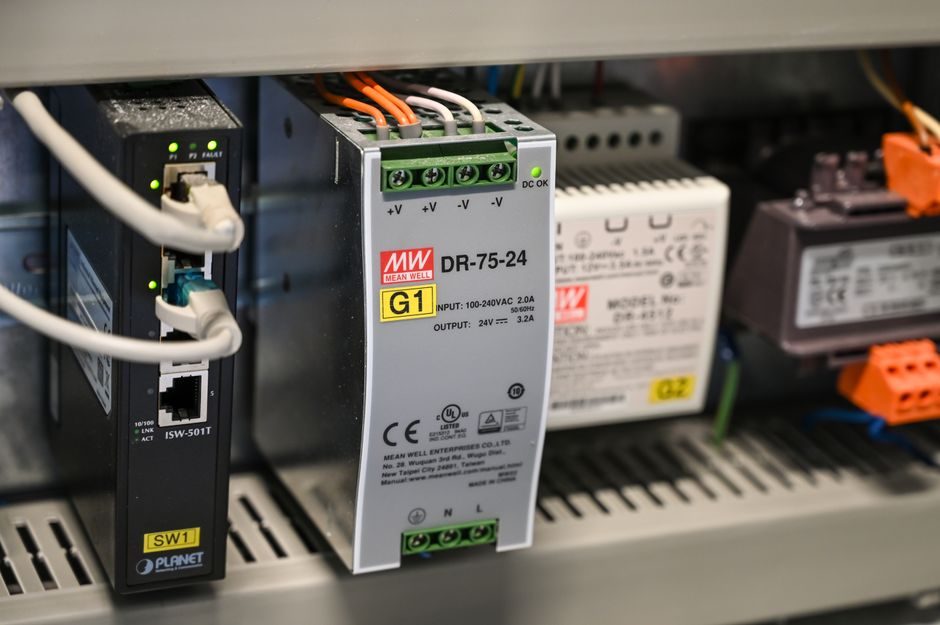
ABB positions its E-mobility line as a full DC fast charger portfolio spanning compact AC wallboxes to high-power units, with the DC fast charger family explicitly listed under its Electric Vehicle Charging Infrastructure offering [S1]. The product stack ties into ABB's wider plant-level digitalization push — Distributed Control Systems, drives, and control rooms — meaning the charger is treated as an industrial automation node rather than a stand-alone consumer box [S1].
Hardhitter Electric publishes a 60 kW–5 MW commercial DC fast charger range on its 2026-07-07 product page, signalling that the top end of the market has moved from "high-power" 350 kW units into megawatt-class systems for fleet and depot use [S5]. iocharger's 2026-06-09 catalog shows the spread more granularly: 30–60 kW DC wallboxes, 60–180 kW pedestal DC fast chargers, 240–420 kW ultra-fast stations, and a 480 kW / 960 kW Megawatt Charging System (MCS) line, all OCPP 1.6J and OCPP 2.0.1 compliant, with the 60 kW+ tier also carrying ISO 15118 Plug & Charge and V2G (Level 3) readiness [S4].
Power-stack architecture: FEC + isolated DC-DC at 800 V bus
Mathworks' Simscape Electrical reference model defines a DC fast charging station as three functional blocks: grid (3-phase constant-voltage AC source), the charging station power electronics, and the EV battery pack modelled as series cells [S2]. Inside the station, a Unity Power Factor (UPF) Front End Converter regulates the DC bus at 800 V, available in average, two-level, and three-level inverter fidelities, followed by an isolated DC-DC stage built from an inverter, an HF isolation transformer, and a diode-bridge rectifier that delivers constant charging current to the pack [S2].
That 800 V DC bus is the structural reason 350 kW and above is now a single-stack design point for most new 400 V-class EVs that support it via the 800 V boost pack, and it is also why DC fast charger factories standardize on 1000 V-rated SiC MOSFET modules with liquid-cooled cold plates; a practical 1000 W overcurrent-resistant automotive-grade DC-DC converter is already listed as a catalog SKU by Echelon Energy (Hangzhou) on made-in-china.com, evidencing the on-board + off-board DC-DC supply chain overlap [S6]. For a wider spec reference, see the DC-DC converter encyclopedia entry on switching topology and isolation ratings.
Communication backbone: OCPP 2.0.1 and ISO 15118 Plug & Charge
OCPP 2.0.1 is now the de-facto back-office protocol for new DC fast charger SKUs: iocharger's entire pedestal and ultra-fast range (60 kW through 420 kW) is listed as "OCPP 2.0.1 Compliant," while the 30–60 kW DC Wallbox retains OCPP 1.6J for legacy site compatibility [S4]. The Megawatt Charging System family (480 kW and 960 kW) and the ultra-fast stations add ISO 15118 Plug & Charge plus V2G (Level 3) capability, meaning the same hardware supports both authentication-and-billing flows and bidirectional power transfer [S4].
ABB's E-mobility organization frames its DC fast charger line inside the same vendor stack that runs DCS, drives, and control rooms, so OCPP traffic can be fed directly into plant-side SCADA rather than walled off in a separate EV operations cloud [S1]. For charger-side metering and AC/DC power-quality telemetry that the OCPP backend consumes, the smart meter reference page covers the typical Class 0.5 / Class 0.2 accuracy tiers seen in EVSE revenue-grade installations. Hardhitter's 2026 catalog explicitly publishes "Business Charging," "Home Charging," "Super Charging," and "Special Charging" as four application buckets, with the Super Charging tier corresponding to public DC fast charger 120 kW+ units and Special Charging covering off-grid and harsh-environment builds [S5].
Manufacturing automation: power-module lines, end-of-line test, MES stack
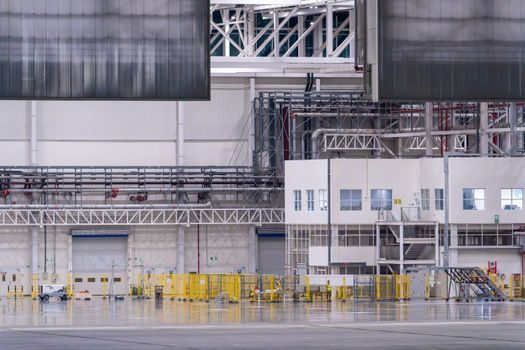
Made-in-China's OEM/ODM factory directory lists 515 DC/DC converter manufacturers shipping 1,545 SKUs, with verified Tier-2 suppliers like Jiangsu Sfere Electric running ISO 9001 / ISO 14001 / ISO 45001 management systems and offering multi-functional power meters, motor controllers, and data-center power monitoring as the metering fabric that wraps every charger stack [S3][S6]. That supplier density is what makes a 60 kW–5 MW product spread economically buildable — a single assembly plant can pull the FEC, isolated DC-DC, AC/DC meter, and wiring harness from regional Tier-2s without holding all the IP in-house.
End-of-line test for a DC fast charger line typically has to cover: insulation resistance (≥1 MΩ at 1000 V per typical IEC 61851-1 routines referenced by charger QA stations — verify against the current local edition), protective-earth continuity (≤0.1 Ω), DC output voltage and current accuracy across the 200–1000 V operating window, ISO 15118 PLC signal-quality sweep on the control pilot line, and a full OCPP 2.0.1 transaction handshake against a CSMS simulator. ABB's framing of E-mobility as part of its industrial automation portfolio means its chargers are designed to ship with the same traceability and alarm-handling discipline its DCS customers expect, rather than consumer-grade logging [S1]. For a parallel automation reference, the EV traction motor smart manufacturing: 2026 line automation map article covers the rotor-stator cell build that supplies the EV side of the same charging connector.
Vendor and product-type comparison for spec-in teams
Three real product lines from the research can be lined up against four decision criteria. ABB delivers a full-scope industrial E-mobility portfolio tied to its DCS / drives / control-room stack, with a focus on AC wallboxes through to high-power DC fast chargers, and the strongest fit for plants that already run ABB automation and want one vendor for SCADA, drives, and EVSE [S1]. iocharger ships the broadest power-class spread: 30 kW DC Wallbox (OCPP 1.6J), 60–180 kW pedestal DC fast charger (OCPP 2.0.1), 240–420 kW ultra-fast station, and 480 kW / 960 kW MCS, with ISO 15118 Plug & Charge and V2G Level 3 on the upper tiers, making it the most flexible catalog for mixed fleet / depot / public-site builds [S4]. Hardhitter pushes the published ceiling to 5 MW, with explicit segmentation across Business / Home / Super / Special charging and a partnership channel that signals Chinese-system integrators targeting export-grade depot builds [S5].
For cost-per-kW and lead-time, no published figure in the research should be quoted — those numbers belong in a quotation, not a spec article. The two qualitative splits that ARE sourceable are: ABB = industrial-automation integration; iocharger = widest public-DC SKU coverage; Hardhitter = highest disclosed power ceiling. On the supply-chain side, Jiangsu Sfere Electric's smart-meter ecosystem is a reasonable proxy for the metering tier that wraps the power modules in any of these chargers [S3]. See the DC power supply reference page for the wider rectifier and bus-voltage context that the FEC inside a DC fast charger sits within.
Failure modes and constraints that drive the spec
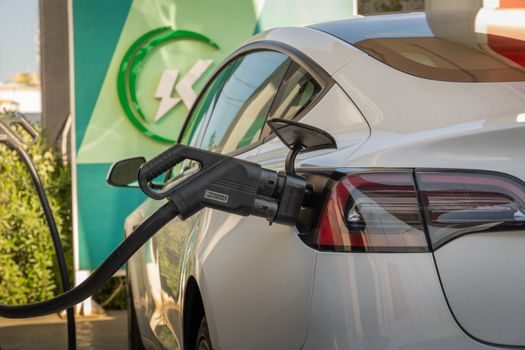
Three constraints dominate DC fast charger manufacturing decisions in 2026. First, connector thermal budget: the CCS2 / NACS liquid-cooled cable assembly must reject 30–60 kW of heat at 500 A continuous, which forces cold-plate integration into the dispenser head and adds a leak-test station on the EOL line — none of the vendor pages publish a leak-rate spec, so spec-in teams must request it directly. Second, grid-side harmonic compliance: the UPF FEC architecture in the Mathworks reference handles the 800 V DC bus regulation, but a real site still needs filter + AC measurement stages for harmonic and flicker limits that vary by utility [S2]. Third, cybersecurity on OCPP 2.0.1: ISO 15118 Plug & Charge and V2G both rely on certificate-based authentication, so the charger's secure element and key-management lifecycle become a manufacturing test point, not just an IT concern [S4].
ABB's E-mobility positioning inside its industrial-automation portfolio is itself a risk-control message — DCS-grade availability, safety, and cyber-security disciplines are explicitly part of how ABB frames its control architecture, which is the closest published statement to a "this charger is built to industrial uptime targets" claim [S1]. For charger-side additive manufacturing of busbars and cold-plate covers that shorten lead time on the metal-fabrication stage, see the additive manufacturing material reference page. A useful adjacent read for spec-in teams sizing the upstream grid connection is the Grid-Scale BESS Smart Manufacturing: 2026 Automation Stack Specs and Vendor Signals article, which covers the bidirectional storage that increasingly pairs with high-power DC fast charger sites.
Trackable signals over the next reporting cycle: (1) any vendor release that moves OCPP 2.0.1 from "compliant" to "certified" against an OCPP 2.0.1 conformance test tool — iocharger's current page only states compliance, not third-party certification [S4]; (2) Hardhitter's published 5 MW ceiling implies an MCS-class connector roadmap, so a 2026 connector-type disclosure (likely MCS / ChaoJi) would be a meaningful spec event [S5]; (3) ABB's E-mobility portfolio will likely publish an updated DC fast charger SKU list under the Electric Vehicle Charging Infrastructure page as new power classes roll out, given the cadence of product additions in its DCS and drives lines [S1].