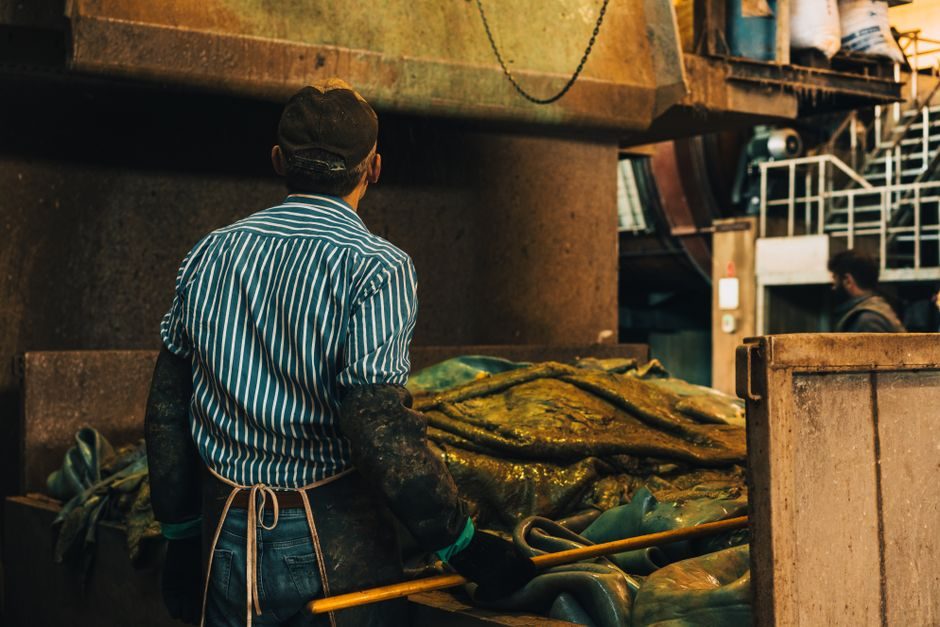
A modern lost foam casting line consolidates foam pattern making, refractory coating dipping, sand molding, vacuum hold, pouring and shake-out into one continuous cell, and the buying decision in 2026 hinges on four coupled spec gates: pattern foam density, coating refractoriness, vacuum and mold-loop throughput [S1][S4].
Lost foam — also called evaporative pattern casting (EPC) — replaces a bonded sand core with a full-shape expanded-polystyrene (EPS) pattern that vaporises on contact with molten metal, removing draft, parting line and most core work in a single fill [S4]. The trade is process control: bead-fill density, coating permeability and negative pressure under the flask drive the density and integrity of the final casting more than the metal chemistry does [S3][S4].
Process Map: Where Each Spec Lever Actually Lives
Each station in a lost foam cell carries one dominant variable. Pre-expanded EPS bead density sets the pattern rigidity and collapse behaviour on pour; commercial EPC lines target 18-22 kg/m³ for ferrous castings, with finer 20-25 kg/m³ grades used for thin-wall or non-ferrous work [S4]. Coating rheology — typically a water-based refractory slurry of zircon, alumina or graphite — is applied by dipping or flow coating to a controlled 0.8-1.5 mm dry film and must stay permeable enough to vent pattern pyrolysis gases without letting metal bleed through [S2][S4].
Molding uses unbonded silica or chromite sand compacted around the coated pattern inside a flasket; the automatic molding line feeding this station must maintain flask flatness to ≤1 mm/m so the vacuum seal holds [S1][S4]. Vacuum (typically 0.04-0.06 MPa absolute under the flask) extracts decomposition products and supports the sand fill against metallostatic head — without it, collapse folds and veining propagate straight into the casting [S3][S4].
Decision Criteria: Foam Density, Coating, Vacuum, Throughput
Pattern foam density is the first cut. Below 16 kg/m³ the bead collapses unevenly under coating weight and the surface rips; above 24 kg/m³ the pattern resists collapse and leaves carbonaceous defect clusters in the casting, so most EPC suppliers cap density at 22-25 kg/m³ for iron and steel [S4]. For aluminium and copper-base alloys, densities sit at 20-25 kg/m³ because lower pour temperature reduces residue formation [S4].
Coating refractoriness is the second cut. A baseline water-based zircon or mullite coating handles grey and ductile iron up to ~1400 °C pour; austenitic stainless and high-manganese steel need alumina or magnesia-enriched coatings with refractoriness above 1600 °C [S2][S4]. The supplier spec to verify is the dry coating's gas permeability — typically 0.5-2.0 cm⁴/(g·min) — because a coating that is too dense traps gas and reproduces veining regardless of the vacuum pulled at the flask [S2].
Vacuum level is the third cut. A capable EPC line holds 0.05-0.07 MPa under the flask throughout fill and skin formation; below 0.04 MPa the pattern vapour cannot be evacuated fast enough and the metal front breaks through the coating [S3][S4]. Fourth comes throughput: a manual single-station cell runs 10-20 moulds/shift, while a fully automated molding line with robot dipping, flask indexing and shake-out reaches 80-150 moulds/shift, which is the real driver of per-piece cost [S1].
Who a Lost Foam Line Is For — and Who It Is Not
Lost foam fits when the part is complex (no-draft internal cavities, sculpted external surfaces, integrated features that would otherwise be cored), the alloy is castable in an open EPS-moulded flask, and the lot size is 50-5000 pieces per year where the pattern tooling amortises over a mid-volume run [S4][S5]. Typical case weights range from ~1 kg small castings up to 5-10 tonne one-off steel bases; American Foam Cast and similar jobbing EPC shops list aluminium, ductile iron, grey iron, carbon steel and select stainless grades in their published capability [S5].
It is the wrong tool when the part is high-volume (>>5000/year) with simple geometry — high-pressure die casting or green-sand automatic molding will beat it on cycle time — or when the alloy is highly reactive magnesium, very high-chromium white iron, or reactive titanium, where the EPS carbon residue and pattern gas defeat metallurgical cleanliness [S4]. For thin-wall mass production of copper conductors or hydraulic fittings, gravity die casting or linear guide-style die cells remain cheaper per piece despite higher tooling cost.
Comparison: Manual Cell, Semi-Automatic Line, Fully Automatic Line
The 2026 buy hinges on which spec gates a foundry can live with. A manual single-station cell costs the least and suits jobbing and prototype work, but pattern dipping, flask transport and shake-out are hand-driven; capacity stalls at 10-20 moulds/shift and coating thickness scatter runs high [S1].
A semi-automatic line adds robot dipping, conveyor-indexed flask transport and a batch vacuum chamber; capacity moves to 30-60 moulds/shift and coating uniformity tightens to ±0.1 mm dry-film tolerance, but the line still needs an operator at pour and shake-out [S1][S2]. A fully automatic EPC line — robotic pattern feed, dipped-pattern drying tunnel, indexed molding on a conveyor sorting line-style loop, continuous flask vacuum, pouring on a controlled-pour ladle, and automated shake-out with sand re-conditioning — runs 80-150 moulds/shift with a 3-4 person crew and is the only configuration that competes with green-sand on per-piece cost for volumes above ~2000 pieces/year [S1][S4].
Across the three options the decision criteria line up as: tooling CAPEX lowest-to-highest from manual to automatic, throughput lowest-to-highest in the same order, and pattern-to-pour repeatability worst-to-best from manual (±3-5 mm shift) to automatic (±0.5-1.0 mm), with coating uniformity and vacuum hold-time tracking the same axis [S1][S4].
Limitations and Failure Modes to Spec Against
Four defects dominate EPC production and each maps to a buying spec. Veining and folding — a corrugated surface that mirrors the pattern's surface wrinkles — is caused by inadequate vacuum, coating permeability collapse, or both, and is suppressed by holding flask vacuum at ≥0.05 MPa and selecting coatings with controlled permeability above 0.5 cm⁴/(g·min) [S3][S4]. Carbon defects and lustrous carbon films inside iron and steel castings trace to high pattern density and slow collapse; the fix is capping foam density at 22-25 kg/m³ and adding 0.05-0.1 % anti-collapse additives such as calcium stearate to the EPS pre-expansion [S4].
Porosity in the final casting is reduced by applying external pressure during solidification — reported studies on A356.2 alloy bars show solidification time and porosity both fall as applied pressure rises, with measurable gains in mechanical properties [S6]. Sand inclusions and burn-on happen when the coating cracks during flask fill or metal pour; specifying a coating dry-film tolerance and a flask vibrator that compacts sand to ≥1.6 g/cm³ are the two preventive levers [S2][S4].
Standards, Sourcing and Build Discipline
EPC process control draws on ISO 1083 (ductile iron grade designation) and ASTM A536 / A48 for the cast grades most commonly run on a lost foam line, while refractory coatings are typically qualified to internal OEM specifications rather than a single published standard — the buying spec should therefore demand a coating datasheet with permeability, refractoriness and dry-film density at the minimum [S4]. Foam pattern tooling is qualified against dimensional repeatability and surface roughness, not a published ISO clause, and the supplier's track record on similar castings is the practical audit [S4][S5].
For sourcing, 2026 supply is dominated by Chinese integrators (turnkey EPC cells with robot dipping, flask loop, vacuum, shake-out and sand re-conditioning) and Japanese specialty builders such as TSUCHIYOSHI ACTY for high-refractoriness coating chemistry [S1][S2]. The buying move is to anchor the spec on a 2025-dated process trial report (porosity %, dimensional scatter, coating life in cycles) rather than a brochure, and to confirm the cell's vacuum-pump duty cycle, EPS pre-expander throughput and sand cooling capacity before signing [S1][S2][S5].
For foundries already running an automatic molding line on green sand, retrofitting EPC is rarely worth it — the pattern tooling and coating chemistry are different disciplines — but for a greenfield jobbing shop targeting ductile iron and aluminium mid-volume work, a 2026-spec lost foam cell at 80-150 moulds/shift is now the lowest-cost route to draft-free castings. Two signals to track next: published 2026 trials of pressure-assisted EPC on A356.2 [S6] and any EPC-line OEM release of inline coating-thickness metrology, since coating uniformity is the single largest unmeasured variable on most installed cells today.