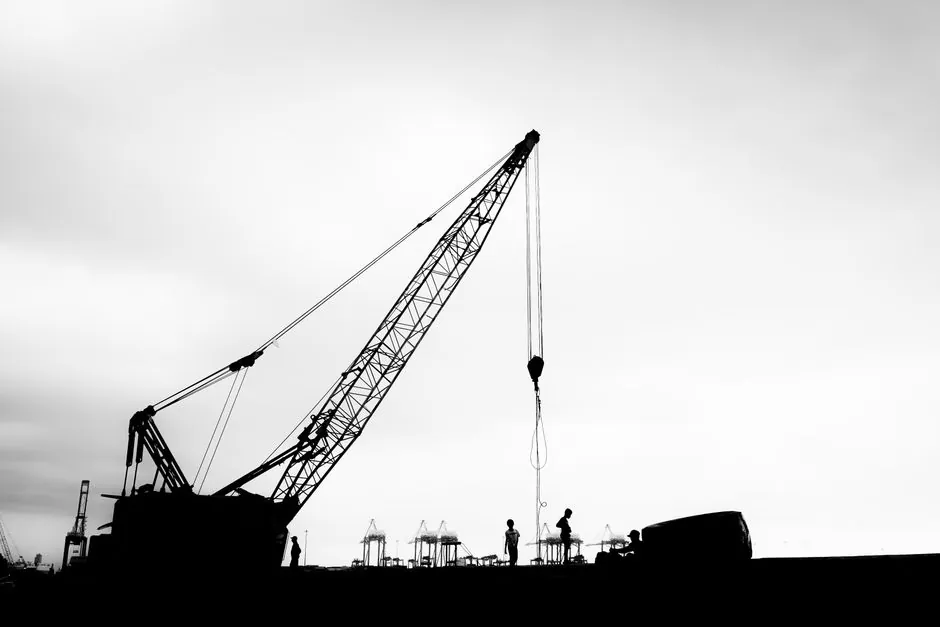
A luffing jib crawler crane adds a second winch-driven pivot above the main boom so the jib can be raised and lowered through a continuous arc, letting the operator lift loads up and over nearby structures instead of over the top of them [S1]. A fixed jib crawler crane bolts a straight lattice extension to the boom tip at one of several preset offsets (commonly 0, 15, 30, and 40 degrees) and leaves it there for the duration of the job [S1]. The base machine is the same; the head is where the engineering and the cost diverge.
This is a real engineering decision on wind-farm, high-rise, and petrochemical sites, because the wrong jib type can mean the difference between a clean lift and an airspace conflict with an adjacent tower, flare stack, or live power line.
How each head works on a crawler
A luffing fly jib is moved continuously by a wire rope and a separate luffing winch, which sits on the boom behind the jib pivot rather than on the jib tip [S1]. That second winch lets the operator change the jib angle during the lift, and OEM literature describes "infinite lifting capacity interpolation when luffing the boom combination" as the key advantage of the lattice luffing jib on a large mobile base [S3]. The mechanical cost is real: an extra winch, more rope, more sheaves, and a luffing cylinder or adjustment winch that the crane controller has to manage [S3].
A fixed (lattice) jib is a passive structure. The operator sets the offset once at erection, then drives the hoist and the slewing ring only. Because there is no luffing winch, dead weight at the boom tip is lower, and the head can be carried closer to the main boom centreline during transport, which matters on crawler machines that have to walk to site under their own power.
Radius, hoist height, and where each head wins
Liebherr's own product page states the luffing jib "is used in particular for hoisting work which requires a large radius" and "covers a massive working range" with a lattice luffing jib on large mobile bases [S3]. The fixed jib, by contrast, is "particularly helpful when working with projecting edges, such as on high buildings" where the operator needs a clean upward line but not necessarily a varying angle [S3]. In practice, fixed jib configurations tend to peak at moderate radii because the head load on the main boom is the limiting factor; luffing configurations keep capacity usable at long radii because the geometry, not the boom length, is being adjusted.
AllCrane's component guide adds the trade-off operators care about: "While the addition of a jib allows cranes to improve their reach, attaching a jib will reduce the maximum lift capacity of a crane" and the planning burden of that loss has to be absorbed by the lift study [S1]. The same is true of the lattice jib itself; the longer the jib, the more main-boom capacity you give up, and the luffing version gives up more than the fixed version because of the extra steel and the second winch at the head.
Airspace, slew room, and jobsite geometry
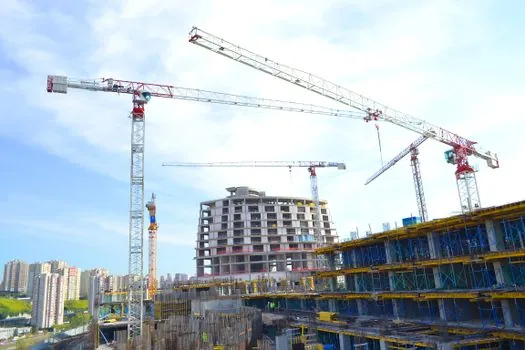
A fixed jib sweeps a tall, narrow arc above the crane; a luffing jib sweeps a shorter, lower arc that the operator can tuck down between lifts. The AllCrane guide is explicit that luffing fly jibs are "excellent for HVAC, facility maintenance jobs, and other lifts that require lifting loads over large-scale complexes" because the fulcrum gives added horizontal reach and the variable angle lets the hook clear obstacles [S1]. Construction Cogs makes the same point in a different form: luffing-jib tower cranes "take up less airspace than a saddle jib" and that reduced swing envelope is exactly why luffers appear in dense urban and congested industrial sites [S7].
For crawler work, the same rule applies, but the constraint is usually the next turbine, the next column line, or the next live pipe rack rather than a neighbouring high-rise. A fixed jib at 30 degrees offset can deliver faster cycle times on an open pad because the operator does not have to coordinate a second winch; a luffing jib wins when the load has to be dragged up from behind a structure that the fixed jib's arc would clip. For a related decision on chassis and transport configuration that often constrains which head a crawler can carry at all, see 6x4 vs 8x4 loader crane chassis: load, route and regulation drive the choice.
Capacity, cycle time, and operating cost
Both heads reduce the base machine's maximum lift, but the luffing head costs more capacity at every radius because of its heavier tip and the geometry losses from the A-frame and pendant system. Construction Cogs notes that luffing-jib tower cranes "are usually more expensive to run and hire" than saddle-jib machines, and the same is true on crawler bases once you add the second winch, the extra counterweight, and the extra crew time to reeve the head [S7]. Fixed jibs are cheaper to rent, faster to erect (no luffing winch to reeve and no A-frame to pin), and simpler to inspect because there is less moving hardware at the boom tip.
The fixed jib is also described as "ideal for long-term jobs, such as commercial construction projects" where the same offset and the same radius are used day after day [S1]. That matches what planning engineers see in practice: a wind-farm erection crawler with a fixed jib cycles faster per turbine because the operator is not luffing between picks, while a refinery turnaround crawler with a luffing jib takes longer per pick but reaches loads that a fixed jib physically cannot.
Comparison matrix: luffing vs fixed jib on a crawler
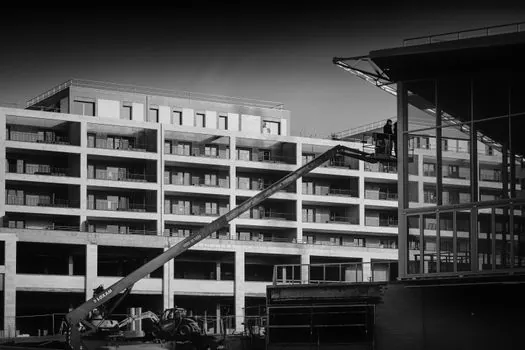
The two options line up against the four criteria that drive a real specification:
Airspace footprint: luffing jib wins, because the jib can be lowered to a near-horizontal rest and the hook path stays under the jib pivot [S1][S7]. Fixed jib occupies a tall, narrow envelope set by the chosen offset angle (0, 15, 30, or 40 degrees) and cannot be tucked between lifts [S1].
Long-radius capacity: luffing jib wins, with "infinite lifting capacity interpolation when luffing the boom combination" allowing usable charts at large radii [S3]. Fixed jib is limited by the head load it places on the main boom and is generally sized for moderate radii and high hoist height [S3].
Cycle time on repetitive picks: fixed jib wins, because there is no second winch to coordinate, no luffing interpolation, and the operator only drives hoist and slew [S1]. Luffing jib adds a winch motion to every pick.
Rental and erection cost: fixed jib wins, because the head is lighter, there is no luffing winch, and AllCrane's guide notes it is favoured for "long-term jobs" where the simpler setup is paid back many times over [S1]. Luffing-jib crawlers carry a measurable premium in hire rate, similar to the luffing-vs-saddle-jib gap seen on tower cranes [S7].
For related industrial spec-driven comparison work, the decision logic in Modular vs Full Steel Deck Truck Scale: 2026 Spec Comparison follows the same criterion-by-criterion structure used here.
Selection rules a planner can act on
Specify a luffing jib crawler when any of the following is true: the load sits behind a structure taller than the fixed jib envelope, the required radius is more than roughly two-thirds of the main boom length, multiple cranes are working in the same airspace, or the lift study shows that a fixed jib at the required radius leaves no usable margin on the load chart. Specify a fixed jib crawler when the work area is open above, the radius is moderate, the same pick geometry repeats cycle after cycle, and the lowest hourly cost is the deciding factor. [S1]
A third option, the folding or swing-away jib, covers the middle ground: it "stows on the side of the boom" and can be hydraulically offset, which makes it useful "in tight, congested workspaces, such as oil and gas refineries" [S1]. For most crawler applications, however, the choice collapses to luffing versus fixed, and the deciding data points are the obstruction map, the radius-vs-capacity chart, and the daily cycle count rather than the headline tonnage of the base machine.
What to verify before the head is pinned
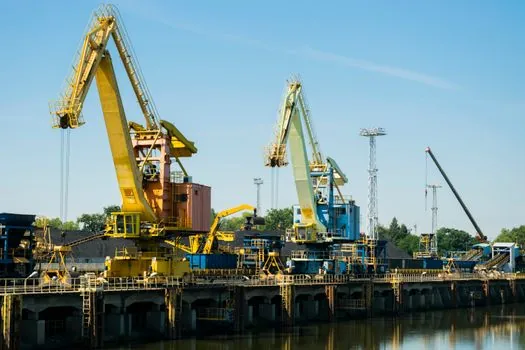
Three numbers should be on the lift study before either head is ordered: the maximum required radius with the load weight at that radius, the height of every obstruction between the crawler centre and the lift point, and the number of picks per shift at the worst-case radius. If the obstruction map forces a low hook path at long radius, the luffing jib is almost always correct. If the radius is short, the obstructions are above the boom tip, and the same pick repeats hundreds of times, the fixed jib is almost always correct. For background on the crawler base that carries either head, see the crawler crane reference page. [S3]
Trackable signals to watch through 2026: OEM revisions to lattice luffing jib capacity charts that extend usable radius at a given boom length, and rental-house rate sheets that show the luffing-jib premium narrowing as second-winch automation matures, since Liebherr already describes an "automatic system" that "allows the lattice luffing jib to be raised easily" by letting the crane controller drive the adjustment winch while the operator only luffs the telescopic boom [S3].
For the relevant spec sheets and selection criteria, see fixed gas detector, and crane scale.