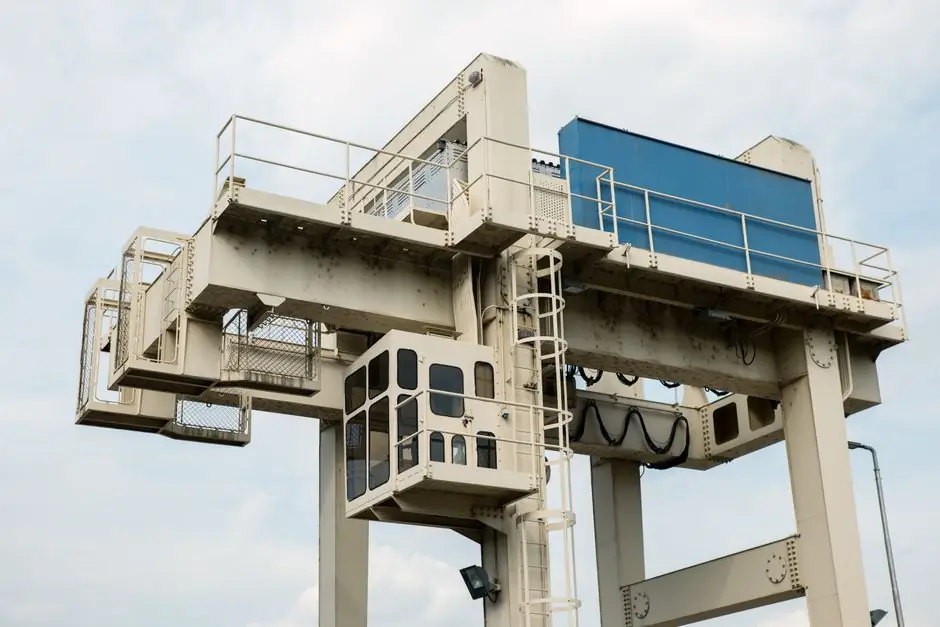
A rubber-tired gantry crane can reposition across a paved yard without fixed tracks, while a rail-mounted gantry crane remains confined to a predefined rail line [S1][S5].
Both systems can provide a 50-ton rated lifting capacity, but they suit different operating patterns: mobile blocks for changing layouts and fixed rails for repetitive, high-volume workflows [S3].
Mobility advantage comes with movement constraints
The principal difference is the travel envelope. A rubber-tired gantry crane, commonly called an RTG, moves on rubber tires and can travel freely across the yard without fixed tracks. It can move between work areas, cross yard lanes, and transfer the lifting function to another operating zone without reconstructing permanent tracks [S1][S7].
Steering mode remains configuration-dependent rather than universal. Some RTGs can turn or circle, while others travel in more constrained patterns [S3]. The usable surface must also support the tires: paved yards, concrete areas, or prepared industrial floors are identified as suitable operating environments [S3].
A rail-mounted gantry crane, or RMG, travels on parallel steel rails installed over reinforced foundations. It cannot move laterally outside that line, so its operational territory remains tied to the permanent track layout [S3][S5]. This is a limitation for layout changes, but it creates repeatable travel geometry for a fixed material-flow pattern.
The operating question is therefore straightforward: select an RTG when one crane must serve multiple zones or a yard that will change, and select an RMG when the work stays within a stable, repetitive block [S1][S7].
Comparison by yard changes, repeatability, and infrastructure
RTG versus RMG decisions should be made against four measurable variables: relocation frequency, travel repeatability, civil works, and available stacking density. The equipment data below describes operational differences documented for container-handling applications, rather than a universal performance guarantee. [S3]
The comparison confirms that flexibility is not the same as every form of performance. RTGs reduce the need for fixed infrastructure and can change operating position quickly [S7]. RMGs gain from rail-supported stability and predictable positioning, which makes them suitable where the workflow and crane alignment remain unchanged [S3].
Capacity alone does not determine the better crane
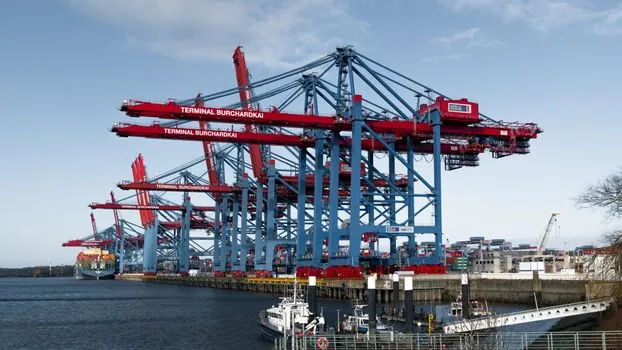
Capacity can be matched between the two designs. A 50-ton RMG and a 50-ton RTG can serve the same rated-load envelope, but their lifting systems still have to be checked against load distribution, outreach, trolley range, hoist performance, and the selected spreader [S3].
For container handling, rail-mounted container gantries are described as handling approximately 40 to 50 tons under the spreader, with spans from 20 to more than 60 meters [S5]. RTG configurations are described with telescopic spreaders for 20-foot, 40-foot, and 45-foot containers, although that equipment feature does not replace a project-specific capacity calculation [S5].
Operating arrangement can be as important as nominal tonnage. An RTG is a dedicated stacking machine that spans multiple rows, while a straddle carrier combines lifting, travel, and stacking in one vehicle [S4]. An RTG therefore does not eliminate the need for horizontal transport, such as terminal tractors, reach stackers, or automated guided vehicles [S4].
RMGs are also used for 5-over-6 stacking in high-density container terminals [S5]. Density should therefore be compared using the actual block design rather than inferred from the drive system.
RTG suits changing operations; RMG suits fixed repetition
An RTG is suitable for facilities where the crane must serve mixed traffic volumes, expanding yards, or work areas that are likely to move. Its rail-free design allows independent scaling without rebuilding a fixed block, and it can be repositioned across the yard when traffic patterns change [S2][S7].
This makes the RTG a practical choice for container terminals, inland depots, steel and lumber yards, precast-concrete storage areas, and distribution centers with changing layouts [S3]. It also suits operations where multiple cranes must be added and parked independently rather than tied to one continuous rail network [S1].
An RMG is the stronger option for a fixed industrial process. Published applications include container handling in rail-intermodal terminals, precast-concrete beam production, steel-coil storage, heavy manufacturing lines, and logistics hubs with a fixed workflow [S3]. The fixed route supports repetitive handling and precise alignment, but changing the block geometry requires rail and foundation work [S1][S3].
Neither type fits every operation. An RTG loses some advantages where repeated high-density cycles demand tight positioning, while an RMG loses flexibility when equipment must cover separate blocks or the terminal layout evolves [S1][S5].
Infrastructure shifts the ownership of operating risk
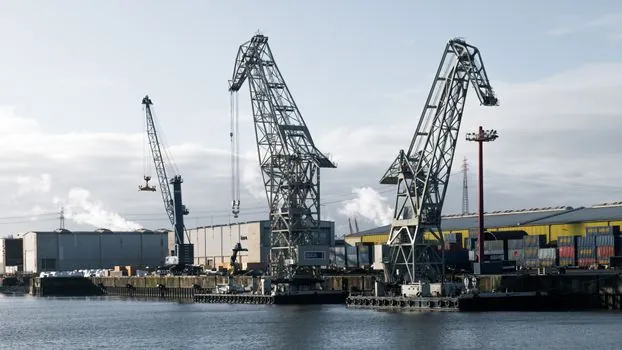
Rail infrastructure raises the initial civil-works requirement for an RMG, including steel rails and reinforced-concrete foundations [S3][S5]. That investment produces a fixed, stable route and supports predictable positioning, but relocation and layout modification become more difficult and costly [S1][S3].
An RTG avoids permanent rails but still needs pavement or another prepared supporting surface [S3]. Published operating-cost information identifies tire replacement every 2 to 4 years, diesel fuel where the machine is not electrified, and brake service as recurring RTG maintenance items [S5]. Power arrangements can include onboard generation, cable reels, diesel generators, or electric systems, so the energy configuration belongs in the lifecycle comparison [S5].
For an RMG, rail-wheel maintenance and electrical supply replace some of the RTG tire and fuel burden. Published examples use conductor bars or cable reels for fixed electric power and use 16 to 24 heavy-duty steel wheels [S5]. These counts describe a particular container-gantry configuration, not a universal RMG specification.
Do not equate “no rails” with “no civil works.” Surface strength, drainage, turning radius, traffic crossings, and pavement tolerances can determine whether an RTG can move safely and repeatably [S3][S5].
Safety and control systems follow the mobility model
RTG control must manage steering, tire-based positioning, sway, and mixed vehicle traffic. Contemporary RTG systems can include proximity detection, condition-monitoring sensors, electronic steering, positioning support, and partial automation [S2]. These functions support safer movement across a yard where visibility and traffic interactions are less predictable than on a fixed rail line.
RMG control benefits from a constrained path and rail-supported geometry. Automated RMGs are used for stacking configurations of 1-over-5 and 1-over-6, while RTGs commonly stack 1-over-4 or 1-over-5 in the cited comparison [S5]. These values are operating configurations rather than universal limits and must be confirmed against the selected crane and safety assessment.
Pre-operational checks, anti-sway systems, load-positioning controls, and communication with other yard vehicles should be specified for either design. RTG flexibility changes the traffic interface because the crane can cross lanes and reposition; RMG stability does not eliminate the need to control suspended loads, wind exposure, and personnel access [S2][S5].
For any mobile lifting machine operating in the United Kingdom, the statutory examination regime may also affect deployment. The separate guide to LOLER thorough examination intervals for vehicle-mounted lifting equipment explains why legal status and inspection planning matter even when the lifting equipment itself remains within a crane system.
Specify the yard before choosing the travel system
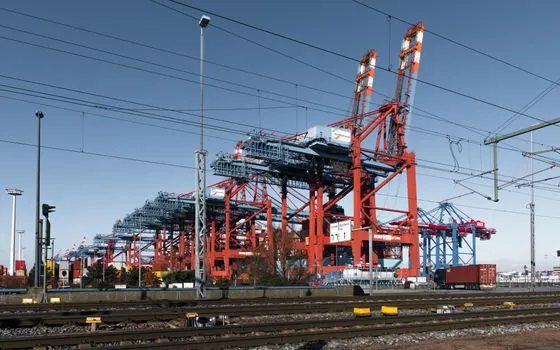
The defensible selection starts with four documented operating questions: how many operating zones the crane must cover, how often that footprint changes, what stacking density is required, and whether the site can support prepared pavement or fixed rails [S1][S3][S5].
Choose a rubber-tired gantry crane when mobility, relocation, and independent block expansion outweigh the highest repeatability requirement. Choose a rail-mounted gantry crane when the route is fixed, repetitive handling dominates, and rail-supported precision justifies permanent foundations [S3][S5][S7].
Track the first three signals in a procurement review: RTG travel distance across distinct work zones, RMG cycles within one fixed block, and the required civil-work interruption for each layout. These operating values determine whether extra flexibility is genuinely useful or merely an unpriced option.
