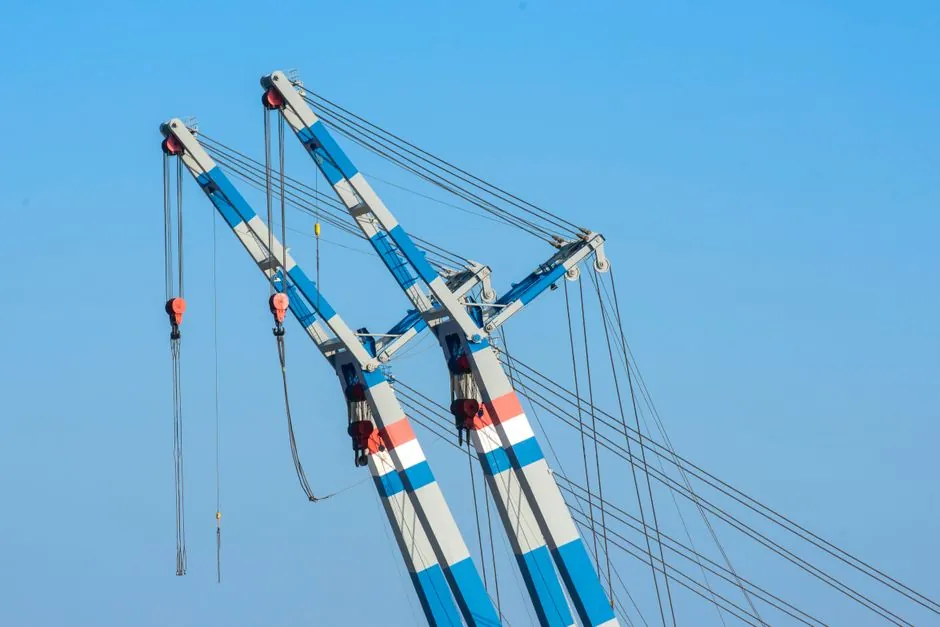
A dual-hoist gantry crane can combine 10 t and 10 t hoists for a 20 t tandem lift while using two lifting points to control a long load across a 12–31 m span [S2].
The MHE series supports separate or synchronized electric-hoist operation, truss, box, or hybrid box-truss girders, and indoor or outdoor duties [S2].
Dual-Point Lifting for Long Loads
Two independent hoists create two controlled attachment points, reducing the rocking and centering problems associated with a single trolley lifting an elongated component [S2][S3]. The load remains supported near both ends, which is especially useful for long steel structures, pipes, ship sections, concrete piles, and large molds [S2][S3].
A double-hoist gantry crane can use one trolley carrying two hoists or two trolleys, each fitted with its own hoist [S8]. In the twin-trolley arrangement, both trolleys run on one main girder and can move independently or together [S3]. This makes the gantry crane configuration adaptable to different load lengths and lifting-point positions.
The crane solution is designed according to cargo weight, length, lifting points, and site conditions [S3]. Load weight, length, width, center of gravity, and permissible attachment points must be established before the lifting arrangement is finalized [S3].
Capacity, Span, and Girder Selection
Published MHE capacity combinations include 5+5 t, 10+5 t, 10+10 t, and 16+16 t, corresponding to model designations 10(5+5)t, 15(10+5)t, 20(10+10)t, and 32(16+16)t [S2]. The standard span range is 12–31 m, while span, hook height, cantilever length, and hoist capacity combinations can be customized [S2].
Girder selection involves structural stiffness, mass, wind resistance, appearance, and budget. The main girder can be configured as truss type, box type, or hybrid box-truss type [S2]. These claims describe configuration choices, not equal performance across all three structures.
The girder must be verified for the governing load case rather than for one hoist capacity alone. A tandem lift by two 10 t hoists creates a combined 20 t load, so the main girder and its components must be rated for that case as well as for either single-hoist condition [S2]. A heavier-duty arrangement can also use a double-girder crane when the duty cycle and structural demands exceed a single-girder solution.
Synchronized Control and Load Balance
Synchronized tandem lifting requires more than starting two drives at the same time. PLC logic and absolute encoders can monitor trolley position, speed, and lifting force while forcing both hoists to operate at matched speeds [S3]. In the described system, the two independent lifting mechanisms operate in synchronized mode and are designed to address the centering and leveling of long loads during lifting [S3].
Independent operation remains useful when one hoist must be positioned or unloaded before the other. Synchronized operation is the controlled mode for a long load that needs both ends raised and lowered together, with the electrical system distributing the load evenly between the lifting points [S2][S3].
Braking must be coordinated rather than treated as two unrelated commands. The published twin-trolley design uses two independent, synchronized lifting mechanisms to hold both ends of extra-long loads [S3]. This coordinated stop directly addresses diagonal pulling, unequal elevation, and load rotation, but it does not remove the need to define safe rigging, attachment points, and travel limits.
Double-Hoist Versus Spreader Systems
A dual-hoist crane provides two independently driven lifting points on one supporting girder, while a spreader system uses a purpose-built beam to distribute one trolley’s force across a load [S8]. The deciding factors are load length, required attachment accuracy, structural stiffness, trolley positioning, control complexity, and whether both points must travel independently.
For two strong, defined lifting points separated by a large distance, two independent hoists offer direct positional control [S3][S8]. For a load that requires one continuous lifting frame, a spreader can simplify rigging while retaining a single overhead pickup point [S8]. The two approaches therefore address different rigging problems even when both are used to improve load distribution.
Independent winches can also be installed on a double-beam gantry crane, with encoder-based synchronization providing balanced control during lifting and descent [S4]. That architecture provides two upper-beam lifting points for bulky loads while retaining the structural separation associated with a double-beam chassis.
Where Dual-Hoist Gantry Cranes Fit
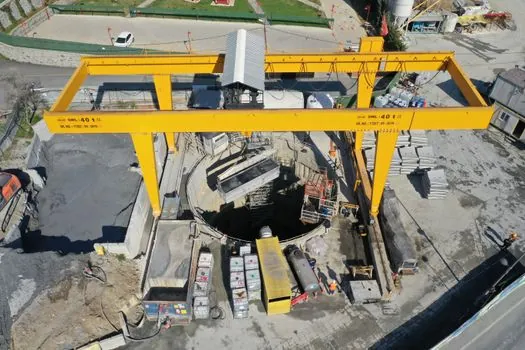
The MHE series is intended for subway construction, station terminals, warehouse yards, construction sites, cement-product plants, machinery assembly workshops, and hydropower stations, in either indoor or outdoor settings [S2]. Suitable loads include subway segments, concrete piles, steel structures, and large molds [S2]. The system uses two independent, synchronized lifting mechanisms that can operate at the same time to hold both ends of extra-long loads [S3].
Available gantry crane examples range from 250 lb for light-duty systems to an 11,000 lb working load limit for portable aluminum models, and the portable systems have adjustable A-frame heights and beam spans up to 27 ft [S6][S7]. These lighter systems are relevant to component handling, not automatically to a 20–32 t tandem lift.
A single-girder crane may be adequate where site clearance, capacity, and operating severity permit, while double-beam construction provides an alternative for bulky or large loads [S4]. Turnkey heavy-duty systems are engineered around specified capacity, span, and height rather than a fixed product family [S5].
Controls, Site Constraints, and Sourcing
The MHE control options include wired pendant, wireless remote, and cabin operation, with mixed configurations and a cabin version that can also carry a remote controller [S2]. A double-beam mobile alternative uses proportional radio controls for motion and lifting, motorized turntables for steering, and a color-display remote with a weight-reading system [S4].
Published MHE delivery lead time is 15–30 days, but rail gauge, girder type, and hoist combination are determined from site conditions [S2]. That lead time should not be treated as a universal delivery promise because the same source identifies the series as semi-custom and dependent on project configuration [S2].
Heavy-duty turnkey packages include a one-year parts-and-labor warranty [S5]. The supplier also lists 60+ years of overhead-crane experience, while fixed-height steel, adjustable-height aluminum, and heavy-duty designs are available from a separate distributor portfolio [S5][S6]. For an engineered purchase, specify the combined tandem load, span, hook height, rail gauge, trolley separation, control mode, and operating environment before comparing commercial proposals.
The next procurement checkpoint is a coordinated load test plan covering independent movement, synchronized raising and lowering, emergency stopping, and unequal-load response, with the accepted load geometry and rigging recorded before shipment [S2][S3].