
Global machine vision system spend is projected to rise from $49.7 billion in 2023 to $159.2 billion by 2032, a 13.9% CAGR over 2024-2032 [S7]. An earlier Allied Market Research release tracked the same market at $29.7B in 2019 growing to $74.9B by 2027 at 11.3% CAGR, with the upward revision driven by accelerated Industry 4.0 capex [S1].
Adjacent segments move in step: smart cameras are tracked at $6.3B in 2024, scaling to $17.97B by 2035 at 10.0% CAGR (2025-2035) [S2], while the 3D machine vision sub-segment was sized at $5.9B for an earlier forecast period [S6]. Together these two product lines — smart-camera and 3D — form the bulk of new spec sheets in 2026 [S2][S6].
2026 Demand Drivers: AI Inspection, EV Battery Lines, and Pharma Traceability
Three forces dominate 2026 machine vision purchasing. First, AI-enabled defect detection on SMT and semiconductor lines is replacing rule-based AOI; the related automated optical inspection market was valued at approximately USD 1.8-2.1B in 2024 [S8]. Second, EV battery cell assembly and gigafactory lines require sub-pixel 3D metrology — the same force that has lifted the broader machine vision CAGR from 11.3% (2020-2027) to 13.9% (2024-2032) [S1][S7].
Third, pharmaceutical serialization and clinical-diagnostics workflows pull healthcare-segment growth to 15.3% CAGR — the fastest end-use vertical in the Allied forecast [S1]. Combined with autonomous-vehicle guidance and UAV automated navigation, these four application clusters now account for the majority of new RFP volume entering 2026 [S1]. Process engineers specifying a machine vision system should size the inspection station against these four application profiles, not generic throughput targets.
Component Spec Map: Smart Cameras, Vision Controllers, and Light Sources
At the device level, sensor choice remains a binary: CMOS or CCD, with CMOS dominating new designs in both area-scan and line-scan configurations [S2]. Connectivity is split across Wi-Fi, Bluetooth, and Wireless HART, although Wireless HART remains a niche option in process plants — most industrial vision cells still use Gigabit Ethernet or CoaXPress over copper [S2].
Stand-alone smart cameras led unit share in 2024, but embedded cameras posted the fastest unit growth, with AI/ML on-camera inference reducing host-controller load [S2]. For non-camera architectures, a discrete vision controller paired with a programmable vision light source remains the standard for high-speed 3D metrology, where structured laser and LED strobe illumination dictate measurement uncertainty budgets.
Regional and Vertical Sourcing Map for 2026
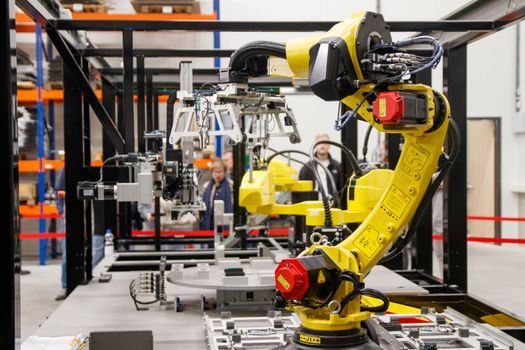
Asia-Pacific is the fastest-growing region for both machine vision and machine control systems through 2030, driven by electronics manufacturing concentration in China, Japan, South Korea, and Taiwan [S1][S3]. North America remains the largest single market for machine vision in absolute terms, while Europe holds the second-largest share with strong automotive-tier demand in Germany [S1][S2].
Key listed smart-camera vendors include Canon, Sony, Nikon, Samsung Electronics, Panasonic, LG Electronics, Fujifilm, Xiaomi, and GoPro [S2]. End-use verticals cluster predictably: electronics and semiconductor lead volume; automotive leads revenue per line; healthcare leads growth rate at 15.3% CAGR; and logistics/automated sorting ride the e-commerce wave [S1]. A related coverage of Industry 4.0 semiconductor fab adoption — including the SEMI EDA / GEM 300 / gRPC stack — is available in this 2026 adoption map, useful when spec'ing vision cells that must handshake with MES.
Selection Criteria: When to Use a Smart Camera vs. a PC-Based Vision Measuring Machine
Decision matrix for 2026 specifiers — four criteria, three architectures:
1) Resolution and frame rate: stand-alone smart cameras cap out around 12-20 MP at 30-60 fps for typical inspection; line-scan or multi-camera vision measuring machine rigs reach 16K line-scan at 80+ kHz for web and battery foil inspection [S2]. 2) On-camera inference vs. host-side AI: embedded smart cameras run quantized CNNs at 5-15 ms latency; PC-based cells run full TensorRT or OpenVINO stacks at sub-ms latency but consume 200-400 W per cell. 3) Environmental sealing: smart cameras ship IP67-rated as standard; PC-based cells need separate enclosures for washdown or Class I Div 2 areas. 4) Software stack: smart cameras lock the user to vendor IDEs; PC cells accept any GenICam-compliant SDK, which is the safer choice for multi-vendor lines.
For 3D metrology on EV cell stacking and semiconductor packaging, the PC-based vision measuring machine architecture with discrete vision light source and a dedicated vision controller remains the only option that meets ±2 µm repeatability at production takt. For traceability, barcode, and presence/absence checks, stand-alone smart cameras deliver the lowest cost-per-inspection in 2026 [S2].
Forecast Comparison and Methodological Caveats

Forecast figures diverge sharply by source and base year, so specifiers should treat the headline number as a range, not a point. The 2026 Allied update ($49.7B 2023 to $159.2B 2032 at 13.9% CAGR) sits above the older 2020 Allied release ($29.7B 2019 to $74.9B 2027 at 11.3% CAGR) and above the IndustryArc 2021 track ($16.4B by 2026 at 6.9% CAGR) [S1][S7][S9]. Smart cameras and machine control systems both use 10.0% and 8.2% CAGR respectively, anchoring the lower bound of credible growth assumptions [S2][S3].
Three caveats apply to all four sources. First, base years differ by 2-5 years, so direct CAGR stacking inflates the implied 2026 figure. Second, none of the public summaries disclose installed-base figures, so no penetration rate can be cited as fact. Third, the 13.9% CAGR [S7] is sensitive to the assumed AI-defect-detection adoption curve; a 2-percentage-point drop in semiconductor capex would compress 2030 totals materially. For sourcing logic on adjacent automation lines, the 2026 filling-machine TCO driver map and the automatic molding line selection map carry compatible threshold logic when vision cells sit upstream of packaging or assembly.
Standards, Connectivity, and Compliance Constraints for 2026 Specs
Compliance work in 2026 clusters around three standard families. GenICam and GigE Vision remain the de-facto transport protocols for PC-based vision; CoaXPress 2.0 governs high-speed 3D cells; and the EMVA 1288 standard defines sensor characterisation, so any vendor datasheet quoting SNR or dynamic range should reference an EMVA 1288 curve, not a manufacturer-internal metric. Functional safety on vision-guided robotics is handled under ISO 13849-1 (performance level) and IEC 61508 (SIL), but the actual PL or SIL target depends on the cell's role in the machine — vision itself is rarely the safety-rated function. [S1]
Network security is the new constraint: vision cells attached to MES now fall under IEC 62443 zone-and-conduit models in most greenfield plants, and OPC UA over TSN is replacing proprietary fieldbuses for cell-level coordination. Buyers running brownfield semiconductor lines should also plan for the SEMI EDA / GEM 300 / gRPC handshake described in this 2026 semiconductor Industry 4.0 adoption map — vision-cell rejection events feed the host MES through this stack, and the protocol choice is locked at cell-purchase time, not retrofittable later.
Limitations, Failure Modes, and Trackable Signals

Three failure modes dominate 2026 vision-cell returns: (1) lighting drift in unattended cells, mitigated only by closed-loop vision light source feedback, not by software alone; (2) GPU obsolescence — a 3-year-old CUDA stack will not run newer AI models, so PC-based cells need a 5-year refresh plan; (3) thermal management on smart cameras deployed above 50 °C ambient, where CMOS dark current degrades SNR within months. The 13.9% CAGR [S7] assumes these are solved; in practice they push effective TCO up by 20-30% over a 7-year cell life.
Any of these will move the 13.9% CAGR by ±1.5 points and reset the 2030 sizing.