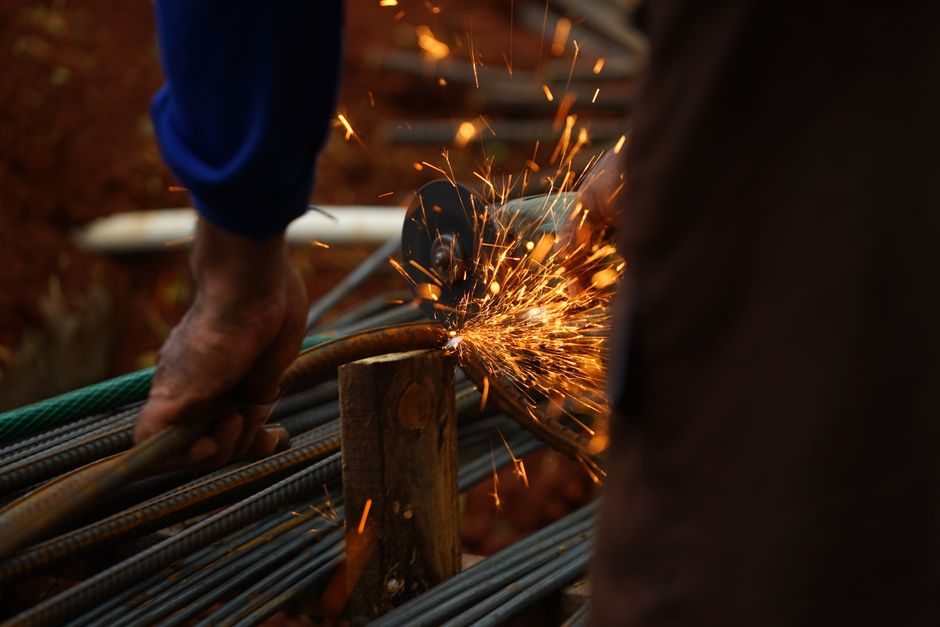
A portable AC/DC magnetic yoke like the Dandong XY-M1 lists without battery at the entry tier, with quoted units commonly running on AC 220 V mains and weighing in the 2-3 kg handheld class for field weld inspection [S2].
At the top end, stationary wet horizontal MPI benches with 4,000-6,000 A magnetizing current, demagnetization cycles, and ASTM E1444 / E709-08 process compliance sit in the USD 18,000-25,000 band, before coils, calibrators, and fixturing. Consumables — wet fluorescent particles, dry powder, contrast paint — are a separate, recurring line that typically equals 15-25% of equipment cost across a 5-year window [S3].
What "magnetic particle tester price" actually includes
The published price on a B2B listing covers the magnetizing instrument only — the power source that drives current through the part or induces a field via a coil. Handheld AC yokes (typically 1.5-2.5 kVA, lift test 4.5-11 kg at pole face) anchor the low end, and bench-top wet horizontal units anchor the high end [S2].
What it does not include, and what quietly doubles the line item, are the gauss meter / magnetometer used to verify residual field strength, the NIST-traceable calibration certificate, the test pieces (ASTM E709 ASP-1 or similar), the UV-A black light (365 nm, ≥1,000 µW/cm² at the surface), the particle bath and agitation system, and the contrast paint. F.W. Bell 5170-series gauss meters ship with a NIST ISO-9001 calibration certificate included at no added lead time or cost, which is a useful benchmark when comparing accessory quotes [S4].
Cost drivers ranked by impact on price
Magnetizing current capability is the single largest cost driver. A 1,000 A portable unit is a different procurement class than a 6,000 A stationary bench with simultaneous circular-longitudinal magnetization, because the latter needs a 30-80 kVA three-phase transformer, a 200-500 µF discharge bank, and an integrated head/tailstock current bar rated for continuous duty. [S1]
Duty cycle and continuous-current rating rank second. Specs like "1,000 A momentary" versus "3,000 A continuous at 50% duty cycle" separate portable from production-floor units and shift price by a factor of 3-5× within the same OEM catalog. Wet versus dry method hardware rank third — a wet bath with agitation, pump, and sump adds USD 2,000-5,000 versus dry powder, which is largely a hopper and air nozzle.
Specifications that gate the decision
ASTM E1444 and ASTM E709-08 are the two process standards that show up in nearly every serious OEM datasheet, including the LISUN UI9730 bench-top platform that lists compliance to both alongside UL 1993 and UL 6500 electrical-safety requirements [S1].
For welds and forgings, the magnetizing methods comparison matters: a portable AC yoke is good for surface-breaking defects on ferromagnetic parts up to roughly 25 mm thick; a head-shot DC unit with 4,000-6,000 A through the part is required for subsurface indications; and a wet fluorescent system at 2,000-3,500 A peak with black-light verification is the aerospace and power-generation default. The full magnetic particle tester selection map breaks these gates down by part geometry. For consumable selection specifically, magnetic material particle chemistry (fluorescent vs nonfluorescent, water vs oil carrier) is a parallel decision to the instrument itself.
Comparison: portable yoke vs portable power pack vs stationary wet bench
Three form factors cover roughly 90% of NDT shop decisions, and each is a different cost band. [S3]
Portable AC/DC yokes (USD 400-1,500) are battery or mains powered, weigh 2-3 kg, and pass the 4.5 kg lift test at the poles — they are the right answer for site weld inspection, in-service crane rail checks, and small-batch forge shops, but they cannot reliably detect subsurface defects. Portable power packs (USD 2,500-7,000) deliver 1,000-3,000 A through a remote head via heavy cables, opening up demagnetization and head-shot capability without a fixed installation. Stationary wet horizontal benches (USD 15,000-30,000) add 4,000-6,000 A simultaneous magnetizing, integrated UV-A viewing hood, agitated particle bath, and conveyor or roller handling — the only realistic option for high-volume aerospace, casting, and forging production lines running ASTM E1444 procedure qualifications.
Total cost of ownership over 5 years
Sticker price understates real cost. A USD 20,000 wet bench typically carries USD 3,000-6,000 of annual consumables — wet fluorescent concentrate, bath conditioner, contrast paint, replacement UV-A bulbs, and contaminated-part disposal — running USD 15,000-30,000 over 5 years. Circle Systems' claim that its Mi-Glow wet particles use up to 55% less product per inspection is meaningful at that scale, since concentrate cost is the largest consumable line [S3].
Calibration is the second steady line: gauss meter re-certification on a 12-month cycle runs USD 200-500 per unit, and ASTM E709 requires periodic system performance verification using a known-defect test piece. Maintenance parts (UV filters, pump seals, contact pads, thyristor stacks) typically add 3-5% of purchase price per year. Mapping the industrial gear TCO logic onto an MPI cell puts realistic 5-year TCO at 1.5-2.0× purchase price for a wet bench, and 1.2-1.4× for a portable setup. If you are also weighing a complementary NDT method like eddy current or phased array UT, the eddy current tester vs phased array UT selection map is the natural cross-reference.
When NOT to buy a magnetic particle tester
MPI is the right call for surface and near-surface defects on ferromagnetic parts in the 0-25 mm depth band, with fast throughput, low consumable cost, and no couplant. It is the wrong call for austenitic stainless, aluminum, titanium, and most non-ferrous aerospace alloys — eddy current or liquid penetrant inspection is the correct method there, and no magnetizing current will help. [S3]
It is also the wrong call for sub-millimeter crack detection on finished machined surfaces where surface roughness competes with the indication, and for in-line 100% inspection of small fasteners where throughput favors eddy current array. For shops running fewer than 20-30 MPI inspections per week, a contracted NDT service or a shared portable yoke is almost always cheaper than a bench install — the unit economics do not close until throughput justifies the wet-bath consumable and calibration overhead. If you are still framing the procurement question, the broader magnetic particle tester buying guide is the right next read.
Circle Systems markets borate-free magnetic particle products as a differentiator, offering materials that meet world-leading European standards [S3].
For component-level specifications, see magnetic particle tester, and linear guide.