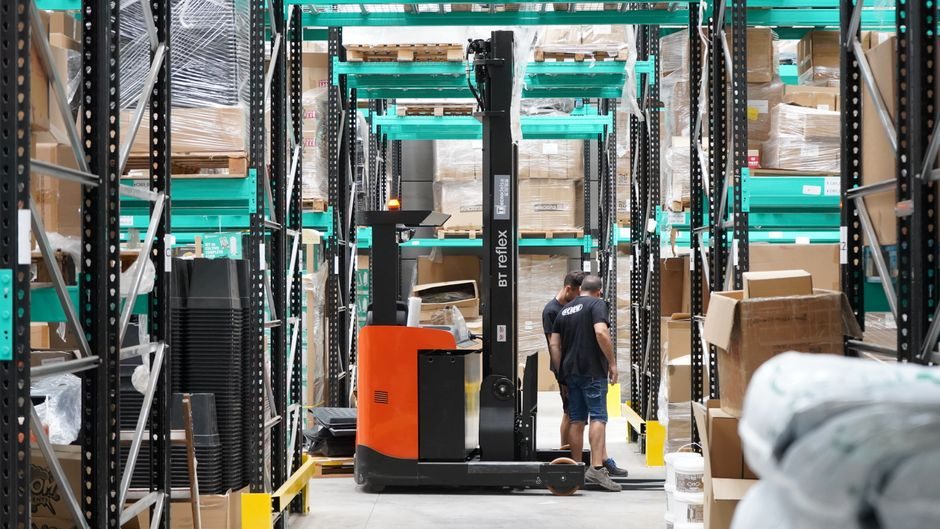
Electric pallet trucks handle the floor at 1,800–2,000 kg with travel speeds of 4.5–5.5 km/h, while electric reach trucks lift 1,000–2,500 kg to 4–12 m in narrow-aisle racking — the two classes are selected by lift envelope and aisle width, not by price tier [S1][S2][S3][S4].
Within DirectIndustry's 2026-05-30 reach-truck index of 38 manufacturers and 143 listings, 137 are walk-behind / stand-on operator classes, and the remainder are ride-on masts with 24 V or 48 V battery packs [S2]. The decision is not which truck is "better" — it is whether the SKU touches the floor or lives in steel racking.
Load Class, Lift Height and Chassis Geometry
An 48 V electric pallet truck from Manuvit is rated at 1,800 kg (3,968 lb) with a 20 Ah battery and 0.9 kW brushless DC drive; it climbs a 10% slope and tops out at 5.5 km/h (3.42 mph) — a floor-transport envelope with no vertical lift stage [S1]. The ICEM HF-series walk-behind pallet truck lists 2,000 kg (4,409 lb) with a three-phase AC drive hood and inclined ergonomic grip, again a horizontal-transport product [S3].
Reach trucks change the geometry: a CQDH18C double-scissor reach truck from a Shanghai OEM is rated 1,000 kg at a 600 mm load centre, with 280×82 mm front drive tyres and 125×82 mm rear casters, FOB Shanghai at USD 150,000 per unit on a 30-day delivery [S5]. The class converts forklift footprint into vertical reach by extending the mast carriage forward of the drive wheels — that is why a reach truck can work a 2.6–2.9 m aisle where a counterbalanced forklift needs 3.5–4.0 m.
Battery Voltage, Motor Power and Duty Cycle
Pallet jacks live almost exclusively in 24 V packs (occasional 48 V high-speed models such as the Manuvit 0.9 kW brushless DC unit) sized for short shuttle runs of 50–200 m; their Ah rating is the limiting factor between battery swaps [S1]. Reach trucks scale into 48 V and 80 V architectures to feed the lift pump and travel motor simultaneously — a 2,000 kg lift to 8 m draws roughly four times the hydraulic current of horizontal transport at 1,800 kg.
Crown's WT 3020-2.0 platform pallet truck targets short-run, multi-shift loading with an economic compact chassis and folding operator platform — a configuration chosen when the route length does not justify a stand-on reach truck [S4]. For higher throughput on longer runs, the same 2,000 kg class moves to a stand-on stacker or a mini reach truck with a 24 V / 200–300 Ah traction pack, and the price step is real: Chinese-market pallet trucks on Made-in-China cluster at USD 469–1,320 per piece FOB, while a double-scissor reach truck like the CQDH18C sits at USD 150,000 per piece [S5][S6].
Operator Class: Walk-Behind, Platform, Stand-On, Ride-On
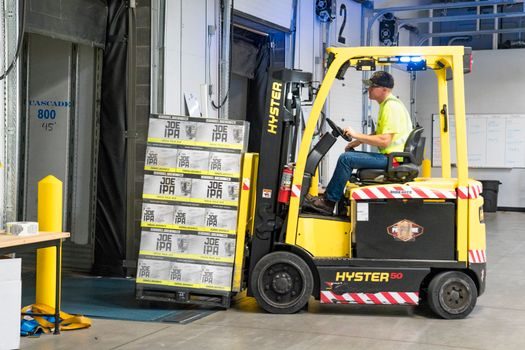
Operator position is a hard selection gate. Walk-behind pallet jacks (ICEM HF, Manuvit 48 V) keep the operator on the floor at the tiller, with the recommended safety distance enforced by a long tiller arm — a layout that works below 50 m run lengths and below ~50 lifts per shift [S1][S3]. Folding-platform pallet trucks (Crown WT 3020-2.0) step the operator up onto a suspended platform for runs of 50–150 m where walking pace becomes the bottleneck [S4].
Reach trucks in 2026 split across the same axis: stand-on reach trucks dominate below 6 m lift heights in 2.6–2.9 m VNA aisles, while ride-on reach trucks take over above 8 m where the operator's eye height for load placement justifies the seat and the longer chassis. DirectIndustry's 2026-05-30 index lists 137 walk-behind reach units versus the ride-on remainder — the skew reflects the European stand-on norm, not a global rule [S2].
Aisle Width, Floor Load and Racking Interface
A standard counterbalanced forklift at 2,500 kg needs an aisle of roughly 3.5–4.0 m plus a turning radius of ~2.2 m; a reach truck with articulated rear axle and 1,000–1,600 kg rating can operate in a 2.6–2.9 m aisle with no right-angle turn penalty [S2]. This is the actual economic argument for reach trucks — they do not lift higher, they pack more SKUs into a given warehouse footprint.
Pallet jacks are aisle-agnostic below ~2.0 m wide: they only need clearance for the 1,150 × 1,150 mm EUR-pallet envelope plus a 200 mm walk-aisle behind the tiller. A folding-platform pallet truck adds ~600 mm to the load envelope but recovers by running faster than a walk-behind unit on the same 24 V pack [S4]. When the warehouse is a cross-dock with pallet-on-floor turnover, no reach truck is specified; when the warehouse is a 12 m VNA rack, no pallet jack is specified — the pallet stacker intermediate fills the 2–4 m lift band.
Standards, Compliance and Sourcing Map
EN ISO 3691-1 governs industrial truck safety, EN 1175 covers electrical requirements, and EN 12895 sets EMC; CE-marked units from Manuvit, ICEM and Crown carry declarations against these [S1][S3][S4]. Chinese-made units (Made-in-China, HKTDC sourcing) typically ship with CE documentation but buyers should verify the four-digit notified-body number, not just the mark [S6].
Lead time separates the two classes sharply: pallet jacks ex-stock China run 7–15 days at USD 469–1,320 per piece MOQ 1, while double-scissor reach trucks quote 30 days FOB Shanghai at USD 150,000 per piece MOQ 1 [S5][S6]. Zhejiang MICROLIFT and Ningbo Ruyi anchor the China pallet-jack supply base at 2,500 cases/month output, with forks, stackers and parts as the bundled product line. For a side-by-side on the broader conveyor vs shuttle trade-off that complements reach-truck throughput planning, see this conveyor sorting line vs shuttle system 2026 spec cut.
Decision Matrix: Which Truck, When
Use an electric pallet truck when the route is below 150 m, the lift is zero, and the load is below 2,000 kg — a Manuvit 1,800 kg / 48 V walk-behind at 5.5 km/h, or an ICEM HF / Crown WT 3020-2.0 platform truck at 2,000 kg [S1][S3][S4]. Switch to a pallet stacker when the lift is 2–4 m and the operator can remain walk-behind or stand-on.
Specify a reach truck when the rack is above 4 m, the aisle is below 3.0 m, and the load is below 2,500 kg at a 600 mm load centre — the CQDH18C double-scissor 1,000 kg class is a typical entry point at USD 150,000 ex-Shanghai [S5]. Do not specify a reach truck for cross-dock floor work; do not specify a pallet jack for rack above 2 m. A deeper frame on selection gates for electric pallet truck model codes is in Electric Pallet Truck Selection: 6 Gates That Lock Model Code Before RFQ.
Failure Modes and Operating Limits to Watch
Three failure modes dominate the two classes. (1) Battery depth-of-discharge: pallet trucks at 24 V / 20 Ah derate sharply below 20% state-of-charge on a 10% slope — the Manuvit 10% slope rating assumes a fully charged 48 V / 20 Ah pack [S1]. (2) Mast deflection at full lift: reach trucks above 8 m show measurable carriage tilt under off-centre load; double-scissor reach trucks (CQDH18C) trade lift envelope for rigidity, not for free lift [S5]. (3) Tyre wear on VNA floors: 280×82 mm polyurethane drive tyres on reach trucks in 2.6 m aisles run 3,000–5,000 hours before re-tread; a walk-behind pallet jack on the same floor exceeds 8,000 hours because the loaded axle weight is lower.
Track two signals into Q3 2026: the DirectIndustry reach-truck index added a new manufacturer entry between 2025-11 and 2026-05 (the 38-firm count on 2026-05-30 is up from prior crawls) [S2], and Made-in-China pallet-jack FOB pricing in the USD 469–499 band held flat across the same window, indicating Chinese supply is capacity-constrained, not price-constrained [S6].