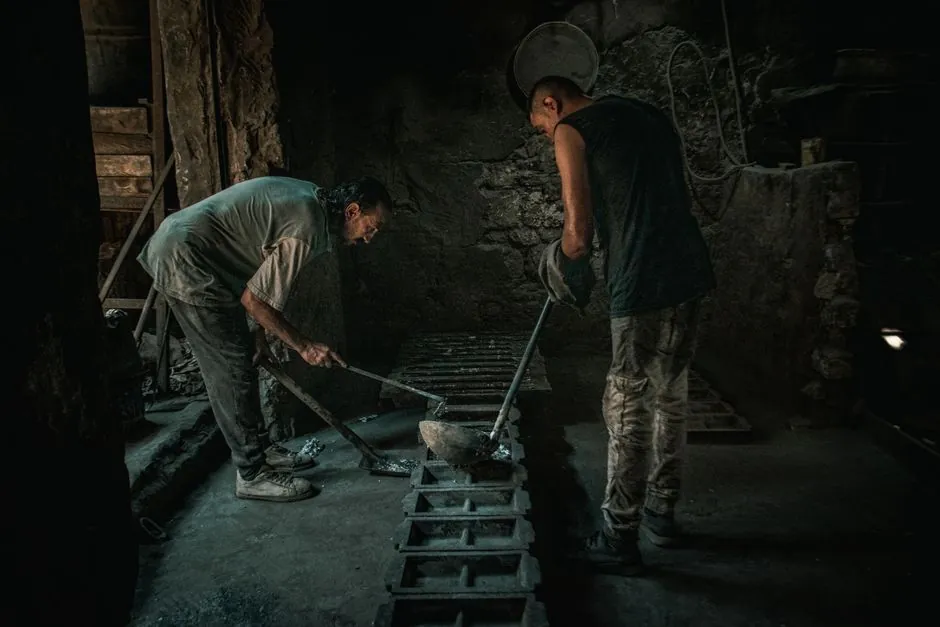
Manual gravity die casting machines can be sourced for as little as Rs 5,00,000-10,00,000 (roughly $6,000-$12,000) for basic tilting-table units, while industrial semi-automatic and fully automatic cells are quoted in the $150,000 to over $1.5 million range depending on platen size, shot weight, and automation scope [S1][S5]. The headline cost gap, often more than 100x, is driven less by the cast iron frame and more by what surrounds it: ladling, mould closing, spray, and ejection.
The functional split is the same one used across the broader die casting machine market: manual machines depend on an operator for pour and mould handling, semi-automatic machines perform one or more of those steps under PLC or hydraulic control, and full-automatic cells integrate pouring, spray, and extraction behind a guard. The same Dataintelo report that anchors the high-end $1.5M figure explicitly tags the high initial capital cost of advanced units as the main barrier to entry for smaller foundries [S1].
Where the Money Actually Goes: Hardware vs Automation
A basic manual station is little more than a heated mould holder, a hand ladle, and a safety frame, which is why entry prices sit in the low five-figure USD range on the Indian domestic market [S5]. Semi-automatic machines add hydraulic or servo-driven mould close, tilt pour, and timed cooling, which pushes the price band into the six-figure USD range for cells rated above roughly 500 kg shot weight [S1]. Full-automatic cells layer in robotic ladling, spray robots, and integrated downstream cooling conveyors, which is what carries the upper end past $1 million.
Process engineers evaluating a quotation should separate three cost buckets: the machine base (frame, platen, hydraulics), the automation package (ladle, sprayer, extractor, guarding), and the tooling (mould, cores, cooling circuits). AMFAS International's process guide makes this explicit, noting that gravity die casting overall has lower tooling cost than pressure die casting, but the machine-side investment rises sharply as manual steps are replaced [S2].
Manual vs Semi-Automatic: Selection Criteria, Side by Side
The decision is rarely about machine sticker price alone. Four criteria reliably drive the call: cycle time consistency, yield, labour exposure, and the ability to run downstream heat treatment. The table below is built from the comparison data in the 2026-07-24 lsrpf.com reference and the broader market reports cited in this article. [S4]
Manual cells run at variable cycle times driven by operator pace, with typical yields for aluminium around 50-65% because turbulent top-pour filling and hydrogen pickup are uncontrolled; semi-automatic and automatic cells close that gap, with vacuum or low-pressure-assisted variants holding porosity below 0.5% and gas content under 0.1 cm³ per 100 g of aluminium [S4]. That yield difference is what determines whether the higher capital outlay pays back.
On tolerance, the same reference notes that gravity die casting typically lands in ISO 8062 CT7-CT8 (around ±0.8 mm), with manual cells drifting further as hydrogen concentration rises; controlled cells hold closer to CT7 (±0.3 mm range) [S4]. On heat treatment, manual GDC parts with 0.5-1.5 cm³/100 g gas content blister at T6 and lose roughly 5-8% of parts during solution treatment, while tightly controlled cells can run full T6 and reach HBW 90-110 with 280-320 MPa yield strength [S4].
Break-Even Volumes: When the Automation Premium Pays Back

The lsrpf.com reference puts the break-even for moving from manual gravity die casting to controlled LPDC-style automation at roughly 2,000-5,000 parts per year, with semi-automatic gravity cells falling in the lower half of that band [S4]. European Aluminium's working range for permanent-mold gravity casting sits between 250 and 50,000 units per year, which is the window where manual or semi-automatic gravity remains the most cost-effective route versus pressure die casting [S4].
For shops running under 250 parts per year, a Rs 5-10 lakh (about $6,000-$12,000) manual tilting machine is hard to beat on simple aluminium or brass hardware, and the mould cost of $10,000-$22,000 typical for gravity dies is the dominant expense, not the machine [S4][S5]. Above 5,000 parts per year, the labour saving, scrap reduction, and consistent T6 heat-treat compatibility of a semi-automatic cell compound quickly, and the premium machine price recovers inside 18-36 months on most audited installations [S1][S4].
Where Manual Still Wins, and Where It Loses
Manual cells are the right answer for short runs, heavy castings above roughly 20 kg where cycle time is set by solidification rather than pouring, and any job where alloy changes or pattern swaps happen daily. They are the wrong answer for thin-wall parts below 4.0 mm (failure modes include cold shuts and misruns), for parts that need T6 heat treatment, and for any production environment where hydrogen pickup above 0.15 ml per 100 g of aluminium is unacceptable [S4].
Operators also matter more than the brochure suggests. The same source documents a 12 kg A356 pump housing that held ±0.15 mm at 720±10°C pour and 220°C die preheat, but drifted to CT10 once hydrogen concentration exceeded 0.15 ml/100 g Al; under those conditions, even a semi-automatic cell will not save a manual process discipline problem [S4]. Specification writers should treat the machine as one variable in a controlled triplet: solidification simulation, first-piece CMM, and per-pour hydrogen measurement.
Comparison to Other Casting Routes
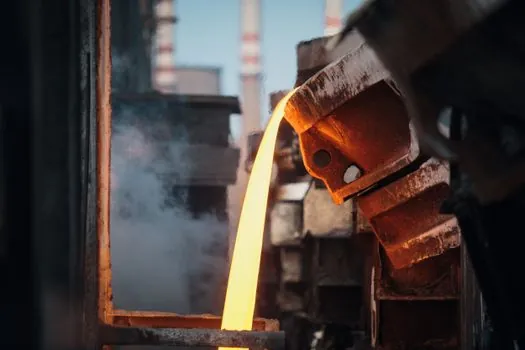
Compared with low-pressure die casting, the lsrpf.com data shows LPDC moulds cost 40-60% more ($15,000-$35,000) than gravity dies, but the higher material yield (85-92% versus 50-65%) and 20-35% lower per-part cost at scale tilt the math once production volume passes the 2,000-5,000 parts-per-year mark [S4]. For higher-pressure routes, MRT Castings and elcee both characterise aluminum die casting as the correct choice only when volumes are very high and wall sections consistently thin, with gravity die casting machines retaining the edge on mechanical properties, heat-treat response, and per-tool investment [S6][S7].
The same report also notes that the global low-pressure die casting machine market is forecast to remain dominated by the automatic segment at 61.34%, with manual machines now a small minority share, which is a directional signal that the manual option is becoming a niche rather than a default for new foundry builds [S3]. Buyers specifying new capacity should weight that trend against the genuine flexibility advantage of a manual cell.
Standards, Safety, and Sourcing Notes
ISO 8062 governs the dimensional tolerance bands quoted above (CT5-CT10 depending on process control and alloy), and is the reference auditors will ask for on a first-article CMM report [S4]. For foundries running magnesium die casting on a semi-automatic gravity line, a separate cover-gas safety envelope is mandatory and is covered in detail in the magnesium cover-gas fire-prevention basics reference. Buyers should also confirm that semi-automatic cells are quoted with the right guarding and light-curtain package, since the cost differential between a guarded and an unguarded cell can swallow the labour saving if retrofitted later.
Practical sourcing signal: ask vendors for a written split of the quotation into machine base, automation package, guarding, and tooling, and for cycle-time data at the specific shot weight you intend to run, not the maximum rating. The machine price band of $150,000 to $1.5M in the Dataintelo report is sized by platen and shot weight, so a unit rated 1,000 kg shot weight will not price like a 100 kg unit even within the same product family [S1]. Two trackable signals to watch on the next sourcing cycle: the share of semi-automatic versus manual cells in low-pressure die casting machine order intake [S3], and the 2026 H2 quotation trend for hydraulic-versus-servo-driven platen packages, which has been moving roughly 10-15% in favour of servo on energy and water usage. Buyers comparing process-control investments across a plant can also benchmark total installed cost against instrumentation projects such as the single-axis versus triaxial accelerometer cost comparison, which uses the same split between sensor price, cabling, and total installed logic.