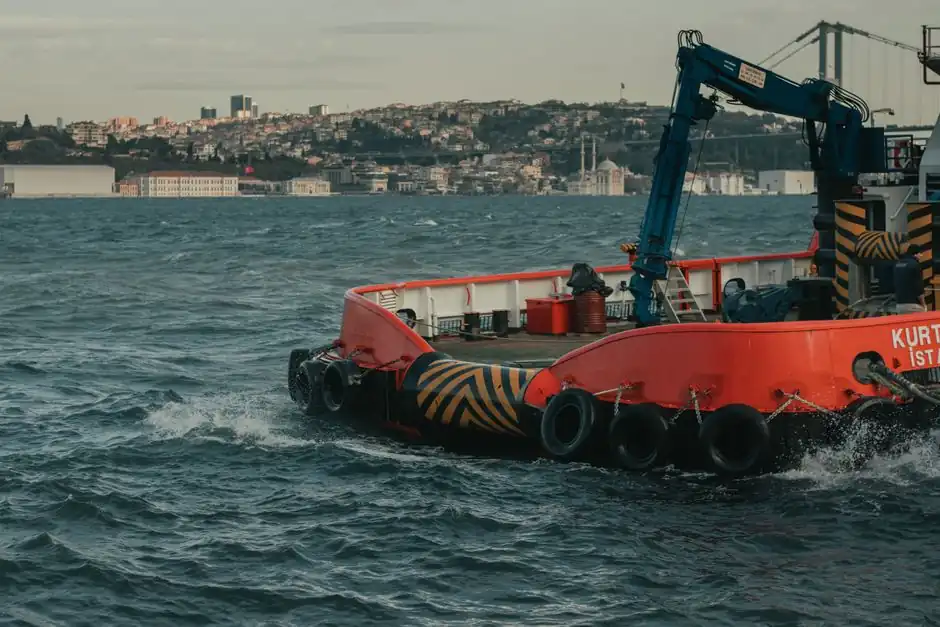
Marine shock absorbers are not a single product category, and treating them as one is the most common spec error on a project. The 2026 ElHamahmy review covers fixed-platform fenders rated for supply vessels of 5,000 tonnes or greater at impact speeds of 0.5-2.0 m/s under NORSOK N-003, while Douglas Marine's 805-series snubbers (1,180-15,000 kg break load, 42-170 cm length) and Hiquool's CCS type-approved rubber mount range (0.45-2,200 kg rated load) sit in completely different load classes and applications [S3][S4][S1].
Picking the right family starts with three questions: is the load a sustained mooring tension, a transient berthing impact, or a continuous machinery vibration? Each question points to a different absorber technology, a different standards regime, and a different vendor pool. The practical selection criteria, with concrete rated-load data from current manufacturer catalogues, are laid out below.
Three absorber families and their load envelopes
Polymer and elastomer mooring snubbers are sized by breaking load and stretch length, with Douglas Marine's product lines spanning 11,800 kg break load at 110-170 cm (805-0014, 805-0020) and a heavier 15,000 kg break-load unit at 42-170 cm body length (806-0017), the latter using differentiated-hardness elastomers to cut mass by up to 75% versus equivalent nautical units [S4]. Hiquool's CCS type-approved rubber mount range covers 30 series spanning 0.45-2,200 kg rated load per mount, used for vibration isolation on engine, gearbox, and pump bases [S1].
Fixed-platform fenders occupy the highest kinetic-energy class. The 2026 review quantifies supply-vessel berthing impact at 5,000+ tonnes, with design impact speeds of 0.5 m/s at the Ultimate Limit State and 2.0 m/s at the Accidental Limit State, numbers that map directly to rubber, cone, pneumatic, and composite fender selection [S3]. A polymer snubber rated 15,000 kg is not a substitute for a cone fender absorbing megajoules of vessel impact, and treating them as interchangeable will under-size the installation.
Selection criteria: load case, environment, and compliance
Match the absorber to the load case first. Sustained mooring tension with cyclic wave snatch (0.5-2 m wave periods, yacht to small-craft scale) calls for a polymer or elastomer snubber selected by break load and stroke; Hiquool's marine product line and Seahorse's Calipso, Nereide, M2/M3, and Ariel ranges are designed for this duty [S1][S2]. Transient berthing impact on a fixed offshore platform is a kinetic-energy problem solved with rubber, cone, pneumatic, or composite fenders selected against NORSOK N-003 reaction-force and deformation curves [S3]. Continuous machinery vibration calls for rubber mounts selected by rated static load and isolation efficiency at the running RPM of the host machine.
Environment is the second filter. Saltwater corrosion, UV, and temperature swing drive material choice. Vista Motion's marine range specifies resistance to saltwater corrosion and temperature variation as the baseline qualification for any rubber compound entering service [S5]. UHMWPE fibre snubbers (the Mantus pendant line) are selected where size-for-size strength matching steel chain is required with lower weight [S4]. For offshore platforms in extreme wave climates, the fender review flags a hard trade-off: a larger fender that protects the vessel imposes additional wave loading on the platform structure, a constraint that does not exist for a marina snubber [S3].
Polymer snubbers vs. hydraulic snubbers: a 2026 comparison
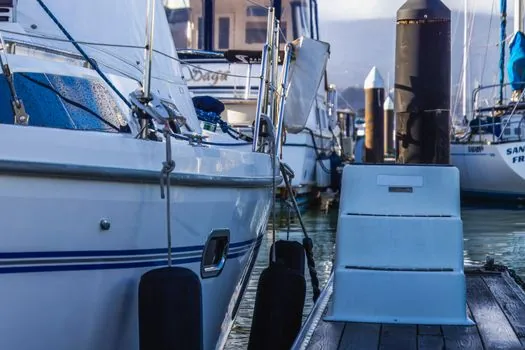
For berth surge control on yachts and small craft, the choice reduces to rubber/polymer snubbers versus hydraulic snubbers, and the trade-off is well documented [S9]. Rubber snubbers are low-maintenance, silent, and fail-safe (they simply stretch), but their energy absorption is limited and the reaction force is roughly proportional to elongation, which produces a sharp snatch at full extension. Hydraulic mooring snubbers dissipate energy through a controlled orifice, giving a flatter, more predictable force-displacement curve and higher energy absorption per unit stroke, at the cost of seal maintenance, potential leak points, and higher purchase price [S9]. A practical rule: rubber snubbers for low-surge marinas with moderate yacht displacement, hydraulic units where surge amplitude and period would otherwise snap lines or exceed the break load of an 11,800-15,000 kg snubber [S4][S9].
For offshore berthing, a separate comparison applies: rubber fenders (cell, cone, arch) versus pneumatic fenders versus composite systems. Rubber fenders deliver high energy absorption at moderate reaction force and a well-characterised performance curve, the category that dominates the 2026 fixed-platform review [S3]. Pneumatic fenders offer lower reaction force at the same energy, useful where platform member strength is limiting, but require air supply and pressure monitoring. Composite systems are emerging for applications where both very low reaction and high energy absorption are mandatory, though published field data from fixed platforms remains limited according to the same review [S3].
Standards, approvals, and documentation
For fixed offshore platforms, NORSOK N-003 governs the action effects and design requirements that drive fender sizing; the 2026 review specifically anchors its analysis to this standard and to the collision-geometry differences between fixed-platform and floating-vessel operations [S3]. For CCS-classed commercial vessels and offshore equipment, the Hiquool marine rubber mount range carries CCS type approval, providing documented compliance for classed installations [S1]. For machinery isolation inside the hull, vendor data sheets and classification-society project specifications typically govern, with rubber compound, static deflection, and rated load per mount as the controlling parameters.
Material and component-level certifications appear throughout the supply chain. Douglas Marine uses differentiated-hardness elastomers with documented mass reduction versus equivalent units; Mantus builds snubber pendants from UHMWPE fibre with size-for-size strength comparable to steel; Vista Motion's marine line is qualified against saltwater corrosion, temperature variation, and UV exposure as baseline [S5][S4]. Engineers should request the test certificates, not just the marketing summary, before ordering.
Limitations and failure modes
Every absorber family has a documented blind spot. Polymer snubbers lose effectiveness at extreme elongation and can fail by tearing if the break load is miscalculated. The 2026 fixed-platform fender review flags three constraints directly: extreme wave conditions limit the size of fender that can be installed, the additional wave loading from a large fender affects platform structural design, and published performance data from actual fixed-platform installations is limited [S3]. For machinery mounts, over-specifying stiffness (to reduce deflection) cuts vibration isolation at the running frequency; under-specifying allows excessive static sag.
Hydraulic snubbers add seal failure and gas-charged preload loss as failure modes, and a hydraulic snubber that has lost its nitrogen charge becomes a hard, short-stroke unit, transferring shock directly into the mooring line [S9]. For the offshore fender case, the same 2026 paper warns that vessel-collision geometry against a fixed jacket is fundamentally different from ship-to-ship or port-facility berthing, so fender selection rules derived from port contexts do not transfer without recalculation [S3].
Decision framework by application
For a recreational mooring (yacht to small craft, 5-30 m, protected or semi-protected berth), select a polymer or elastomer snubber with break load at least 2x the expected peak line tension and stroke of 30-100% of expected surge amplitude; the Douglas Marine 805-0014 (11,800 kg, 110 cm) or 805-0020 (11,800 kg, 170 cm) are typical catalogue fits [S4]. For a marina with heavy surge, step up to a hydraulic mooring snubber sized to the rated energy per cycle [S9]. For vessel equipment isolation (engine, gearbox, pump, generator, AC unit), select a CCS type-approved rubber mount from the 0.45-2,200 kg rated-load family matching the static weight per mount point [S1][S5].
For supply-vessel berthing on a fixed offshore platform, the choice is a rubber, cone, pneumatic, or composite fender sized against NORSOK N-003 to absorb the kinetic energy of a 5,000+ tonne vessel at 0.5 m/s (ULS) and 2.0 m/s (ALS), with reaction force and platform structural capacity as the binding constraints [S3]. A shock absorber on a yacht cleat and a marine valve on a hull penetrator share a saltwater environment, but the load cases, standards, and supplier pools are different; the same selection discipline applies to marine HVAC mounts, where rubber vibration isolators must be selected on the same per-mount rated-load basis as engine mounts.
The next signal to track is the publication of additional fixed-platform fender performance data; the 2026 review explicitly identifies the limited public dataset as a gap [S3]. For procurement teams, the actionable next node is to confirm whether the selected snubber or fender carries a classification-society type approval (CCS, DNV, ABS, LR) and to request the reaction-force versus deformation curve, not just the catalogue energy-absorption number, before issuing a purchase order.
This topic is covered further in Price-Dependent EOQ with Distinct Holding Costs: Composite SKU Specification.