
Locking assemblies in pulp and paper service are specified primarily by transmissible torque at a given shaft diameter, then filtered by axial displacement, hub surface pressure, and material compatibility with the wet, chemically aggressive environment [S1]. A four-stage decision flow (shaft size and torque, hub material, axial movement, and corrosion exposure) prevents over-spec and the all-too-common failure mode of cracked cast-iron hubs around refiner shafts.
The product category spans self-centering, low-surface-pressure, and no-axial-displacement series, with stainless variants available for bleach-plant and white-water contact zones [S1]. Mills that treat the choice as a generic "keyless bushing" purchase typically pay later in unplanned refiner downtime, where a 6 mm shaft-to-hub slip during a roll change can scrap a rotor.
Why Pulp and Paper Loads Are Different from General Industrial Drives
Pulp and paper drive trains combine continuous torque with severe cyclic and shock loading, especially on refiners, calendars, and reel drums, where torque peaks during web breaks can hit multiples of running torque. Refiner applications sit at the top of the shock-load list and are routinely driven through locking assemblies sized with a service factor of 1.5 to 2.0 above the motor nameplate torque [S2]. The drive-side catalogue for one major supplier explicitly lists flange couplings, locking assemblies, shrink discs, locking elements, and elastomer jaw couplings as the matched product set for this industry [S2].
Ambient conditions drive material selection: steam, white water, and acidic or chlorinated chemistries attack carbon steel at the bore, where slip-starting crevice corrosion is invisible until a coupling refuses to release. Stainless variants from RINGFEDER (for example, the stainless-steel 347 hardware used in jaw-coupling rings by another supplier) target exactly this service envelope and stay on-shelf at 200°F continuous urethane temperature limits [S4]. For the broader plant, this category sits inside the wider construction machinery and equipment family of heavy-duty mechanical power-transmission hardware, sharing duty cycles, bearing conventions, and maintenance practices with mining and mineral processing lines.
Selection Criteria That Actually Move the Decision
Four technical gates decide the part number: (1) shaft diameter and the torque the application transmits, (2) hub material and allowable hub surface pressure, (3) whether axial displacement is acceptable during assembly or operation, and (4) corrosion exposure including wash-down chemistry [S1][S2]. The supplier selection tool accepts transmissible torque at a given TA (tightening torque on the locking-assembly screws) or shaft diameter as primary inputs, with axial displacement and hub width as secondary filters [S1].
Hub surface pressure is the gate most often missed. Low-yield hub materials (thin-walled hubs, certain cast irons, light-metal hubs) need a low-surface-pressure series rather than the highest-torque unit, otherwise the hub cracks long before the locking element reaches its rated slip torque. Reverse-torsion fatigue strength matters for calendars and reel drives that run in reversing tension control, where the series rated for high reverse-torsion strength give a measurable life gain over general-purpose units [S1]. Mills that have already invested in predictive maintenance on their drives can pair locking-assembly selection with bearing-health monitoring, since the same supplier ecosystem typically covers both lines [S5].
Matching Locking-Assembly Series to the Major Mill Stations
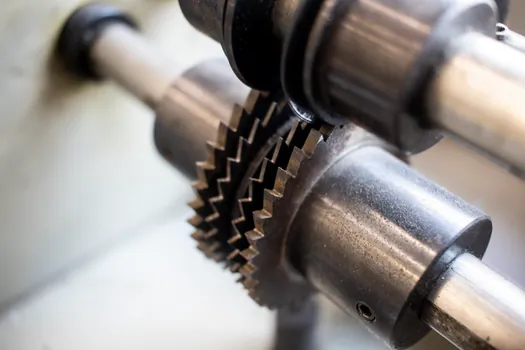
Paper machines, refiners, blenders, calendars, dryers, slitters, vacuums, and wind/unwind stands are the eight application zones the major coupling and locking-assembly suppliers list for this industry [S4]. The same supplier cross-references jaw-in-shear 6-pin couplings (16 standard sizes, bore to 9 inches), disc couplings (bore to 10.5 inches, 3,309,000 in-lbs max torque, API 610/671 compliant), gear couplings (220,000 in-lbs torque, bores 7/16" to 5-3/8"), and shaft locking devices with zero backlash and keyless shaft-to-hub mounting [S4]. That tells the spec writer which of those stations needs a true zero-backlash locking element versus a forgiving elastomer-in-shear design.
A direct side-by-side lets the engineer pick with eyes open. The RfN 7013.0 series gives excellent concentricity and easy dismantling for high-speed dryer and calender rolls; RfN 7014 transmits large peripheral forces and holds position during assembly, which fits refiner and gearbox output shafts; RfN 7015.0/7015.1 targets maximum torque plus axial force with strong centering, the typical refiner-rotor choice; RfN 7061 is the cost-efficient middle-torque option for pumps and agitators; RfN 7110 is the narrow-space pick for retrofit in older machines; RfN 7515 covers combined torque, axial force, and bending moment in one unit [S1]. Decision criteria for that lineup are torque density (Nm per mm of shaft diameter), axial load capacity, hub surface pressure class, self-centering yes/no, and stainless availability.
Installation, Dismantling, and Maintenance Reality in a Wet Mill
Field reality: mills standardise on locking assemblies that install with minimal screws, dismantle with threaded extraction holes, and in some series are self-releasing on screw loosening, which cuts refiner change-out from a multi-hour keyed pull to a single-shift job [S1]. The RfN 7012.2 series explicitly markets easy installation, large-clearance bridging, and wear resistance, useful when shaft wear or nitrided case-hardened journals have built up over years of service [S1]. Self-centering assemblies also protect concentricity on gear-wheel mountings, a recurring pain point in paper-machine gearboxes where even 0.05 mm runout shows up as pitch-line vibration [S1].
Safety integration matters as much as the mechanical fit. Trapped-key interlock systems protect access doors and covers on pulp and paper equipment, and these can be fully integrated with the mechanical-power-transmission package so a refiner or calendar cannot be energised while a guard is open [S3]. For the people side of the same hazards, a paper-pulp helmet versus standard industrial helmet comparison walks through the impact, chemical splash, and high-temperature steam zones a mill worker actually faces. And the rotating equipment around the drive train eventually drives a conveyor or a slitter, where the V-belt selection workflow (though written for mining) carries over the same service-factor logic for belt drives in paper-machine ancillary lines.
Limits, Failure Modes, and What to Watch For

Locking assemblies are not universal. High-misalignment applications, sustained temperatures above the screw-locking compound rating, and hubs below the minimum bore-wall thickness ratio are out-of-scope and should be redirected to geared, disc, or elastomer-in-shear couplings. Disc couplings, for example, carry up to 3,309,000 in-lbs and meet API 610 and API 671, which is a different spec envelope than a keyless shaft-locking device [S4].
The three failure modes the literature flags are: (1) hub cracking from over-pressurising a thin-walled or low-yield hub, (2) fretting corrosion at the shaft-bore interface on reversing drives, and (3) screw-loosening fatigue on assemblies that were tightened below the published TA value. Series with high reverse-torsion fatigue strength and stainless-steel variants directly address the second and third, while the low-surface-pressure series address the first [S1]. The broader automation layer, including the drives, motors, and condition-monitoring gear a mill bolts on around the mechanical power-transmission package, is covered by the major automation vendors' pulp-and-paper practices [S8].
Documentation, Sourcing, and Standards Anchors
Supplier documentation that carries a part number, shaft-diameter range, transmissible torque, axial force, and hub surface pressure is the minimum required data sheet; the leading catalogues publish all four in a single table [S1]. The same suppliers expose online selection tools keyed on transmissible torque at given shaft diameter, so the spec writer can iterate the hub material and axial-displacement choice in minutes rather than email [S6]. For the larger mechanical bill of materials, one supplier's pulp-and-paper industry page anchors flange couplings, locking assemblies, shrink discs, locking elements, and elastomer jaw couplings as a matched set, which is the right way to buy a coordinated drive train rather than mix-and-match across vendors [S2].
Tubing, fittings, and instrumentation that surround the drive train (steam headers, white-water piping, chemical dosing lines) have their own selection rules. Swagelok's pulp-and-paper hub, for example, runs tube-fitting preparation video workflows that any mill mechanic will recognise from a different product family but the same selection discipline [S7]. The through-line for every adjacent component class is the same: pick by the dimensioned spec, verify against the duty cycle, then qualify the supplier. For mills that want to extend the same spec discipline into adjacent process equipment, the bag filter advantages, disadvantages, and selection criteria write-up applies the same evidence-first lens to a different unit operation, and a case packing machine sizing and selection piece is a useful template for any conversion-line equipment decision downstream of the reel.
Trackable signals over the next planning cycle: (a) supplier releases of new low-surface-pressure series for thin-wall hubs, which directly target refiner retrofits, and (b) expanded stainless variant coverage for bleach-plant service, where chloride stress-corrosion cracking dictates material choice. Both are visible on supplier product-paper updates dated through 2026-09-19 [S1][S2].
The underlying component specifications are covered under lamps and light fittings.